On 12 October 2025, we were called from a group of around 140 people escaping from Libya on a fishing vessel. Their GPS position (N34 50, E015 54) at 11:30 UTC showed them in international waters in the Maltese search and rescue zone. The people reported being under attack from another boat, calling the perpetrators Libyan militias. For hours, we kept in contact to the people on the boat as the attack continued and relayed all the information to European authorities, including Maltese and Italian ones – but no intervention followed. Then, the contact to the people on the boat broke off. In the afternoon of 13 October, we learnt the people had been rescued by the Italian Coast Guard, though some of the survivors were severely wounded by gunshots. Some days after our first statement about the violent attack, we identified the perpetrators when videos of the attack were shared with us. The vessel is well known: it belongs to the Eastern Libyan militia Tareq bin Zeyad.
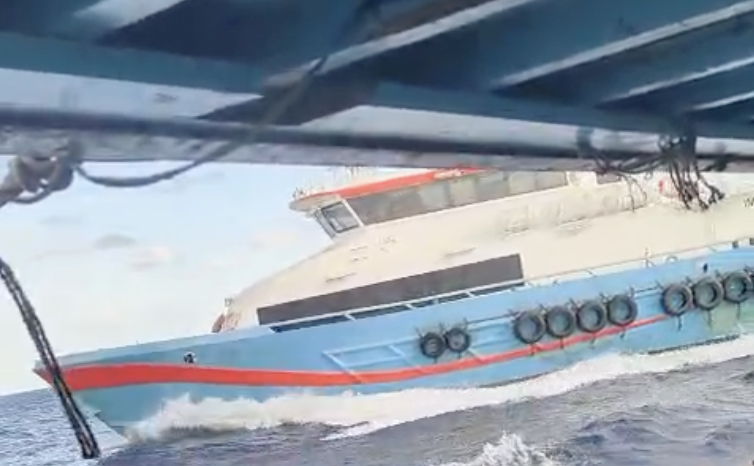
Screenshot of a video of the Tareq bin Zeyad boat approaching the fishing vessel and putting the people on board in danger. The Tareq bin Zeyad boat is known for its ability to sail at a high speed and is recognisable by its shape, colours and other details.
Frontex investigates the case
On 29 May 2026, Frontex issued a Serious Incident Report (SIR) on this case. SIRs are a mechanism of investigation through the Frontex Fundamental Rights Office (FRO) that has repeatedly been criticized for failing to produce any real accountability and for serving as little more than a fig leaf for the European agency. This SIR reconstructs a timeline of the observations and actions of different actors regarding this boat, starting on 11 October: on this day, Frontex’s surveillance aircraft Eagle3 spotted the fishing vessel in the Libyan search and rescue zone and informed its Libyan contacts – whom Frontex recognizes as a rescue coordination centre. It can be assumed that therefore the Tareq bin Zeyad was informed as well.
On 12 October at 08:00 UTC, Eagle3 circled a position at 34.572°, 15.934° in the Maltese search and rescue zone, as the aircraft’s flight data shows. The SIR itself offers no indication of whether this was the fishing vessel’s position. However, given the timeline and the fact that just a few hours later the Tareq bin Zeyad Brigade’s boat turned up in the Maltese search and rescue zone to intercept it, it seems reasonable to conclude that this was indeed where the fishing vessel was and that Frontex, just as the day before, had shared the boat’s coordinates with the so-called Libyan Coast Guard. This systematically used practice is well documented: it led to the creation of a pullback machinery where European planes lead vessels of various Libyan armed entities to boats carrying people on the move. Alarm Phone, together with others, documented such a dangerous pullback by Tareq bin Zeyad in detail as early as 2023.
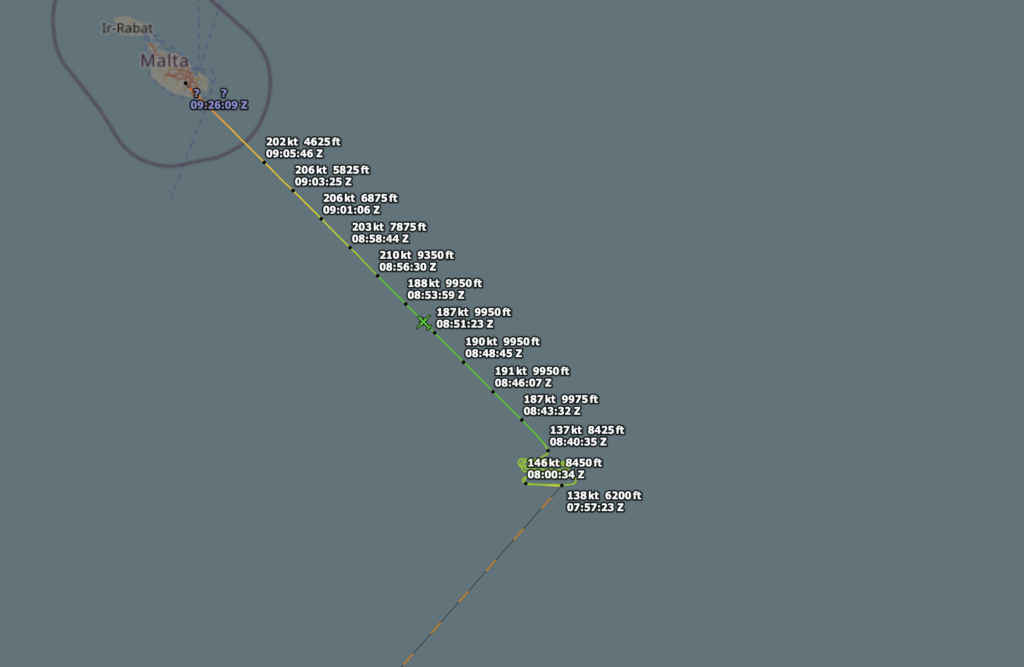
Screenshot from https://globe.adsbexchange.com of the movements of Frontex’ surveillance aircraft Eagle 3 (Hex 43EE55) around 08:00 UTC, showing it circling around the position 34.572°, 15.934°.
At 11:20 UTC, the first call of the people on the boat reached Alarm Phone, reporting shots being fired from a militia boat. Alarm Phone immediately passed this information on to the Maltese and Italian authorities, as well as to Frontex, and kept passing on updates from the boat over the hours that followed. Between 16:57 UTC and 19:50 UTC, the SIR further records the observation from a redacted actor, possibly another aircraft, either from Armed Forces Malta or an untrackable drone or plane run by Frontex, describing an “unidentified patrol vessel” that “was following and circling around the fishing vessel”, at times seeming “to be touching the stern or starboard of the fishing vessel,” and repeatedly “approaching the fishing vessel at high speed and stopping right next to it”, “creating waves in front of the vessel” and forcing it onto an “erratic course”. And yet, despite all this information, the flight data shows that Eagle3 did not take off a second time and head back towards the fishing vessels’ position until 18:30 UTC.
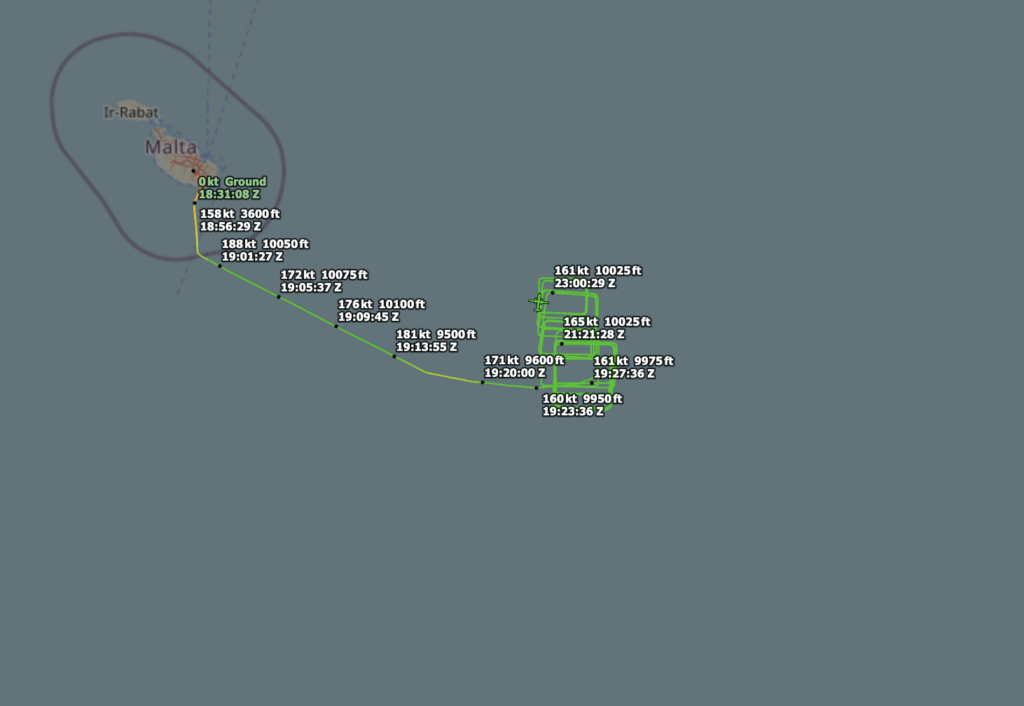
Screenshot from https://globe.adsbexchange.com of the movements of Frontex’ surveillance aircraft Eagle3 (Hex 43EE55) in the evening of 12 October, showing it circling at the position of the fishing vessel.
Sometime after 20:30 UTC, Malta asked the Frontex aircraft Eagle3 to contact the “unidentified vessel” to tell it that it was “doing dangerous manoeuvres in vicinity of a boat”. According to the SIR, the vessel then changed course and moved to a distance of 1.24 nautical miles from the migrants’ fishing vessel. No further action was taken by the authorities at this point. Only in the afternoon of 13 October were the people rescued. The SIR leaves no doubt: From the information received by Alarm Phone, but also from their own surveillance, Italian and Maltese authorities knew for hours what was happening and chose not to act, risking the lives of the people escaping from Libya. Moreover, the flight tracking data combined with the information from the SIR suggest that it was Frontex who informed the Tareq bin Zeyad Brigade and therefore bears responsibility for these life-threatening attacks.
Migrants’ debrief confirms information
The information mentioned in the timeline of the SIR was later confirmed and complemented by accounts of survivors that had been collected as part of a so-called debrief.
On the afternoon of 12 October, as the people confirmed in the debrief, a military ship flying the Libyan flag demanded that the migrants shut off the engine to bring them back to Libya. The people on the boat refused. It was a decision that must have needed much courage in this situation – and shows which risks they were willing to take in order to prevent a pullback to the place they had fled. What followed was a hunt that once again revealed the ruthlessness of the Tareq bin Zeyad Brigade: according to survivors, the militia chased the boat for over five hours “following, circling around the fishing vessel, attempting to hit, at times ramming it (or colliding)”. One survivor reported that four militia members had tried to board the boat with a net, and when this attempt failed, they opened fire. According to three survivors, the militia used rifles that looked like Kalashnikovs. Someone also reported that the militia “threw items resembling steel pikes that injured one migrant on board”, others spoke of smoke or tear gas grenades and the use of flare guns.
According to survivors and media reports, a 15-year-old boy fell into a coma after suffering a gunshot wound to the head, a signalling rocket exploded in one person’s face, and another person was shot in his thigh. The SIR records only “three migrants with gunshot wounds (later one person reportedly was pronounced dead).” The information that one person died remains unconfirmed – also because after their disembarkation in Pozzallo, the survivors were systematically isolated from contact attempts by structures that tried to support them.
Transcript of the calls between the people on boat and Alarm Phone in the afternoon of 12 October
|
“We need help, there are children and babies! The Libyan militia are shooting us, they are shooting us. When will you come?” “We do not have boats, but we informed the authorities and do all we can to put pressure on them to come.” This call, with more or less the same words, repeats again and again for about six hours in the afternoon of the 12 October.“We’re literally dying. I don’t have any…” The connection cuts. “We’re dying. I don’t have energy left in me. We are literally dying. Can you please save us.” The connection cuts again. “Is the Libyan militia still behind you?” we ask, “The Libyans, yes the Libyans are still behind us. Four of us are wounded. They are shooting us. When are you gonna come, when are you gonna save us – are you gonna save us? Please hurry up, please hurry up, we are dying! We don’t have time, four are wounded, someone is dead”, she is screaming. The connection breaks again. “Please, please, please.” We ask again for the location, but are not able to understand it. The connection breaks again. We ask, if they are still going. “The boat is moving, but not too much, it is moving, but not much”. We ask about the militias, what the situation is. “We are one boat and the militias is one boat. We did not stop, we did not want to stop, so they started shooting us. Four of us are wounded and one is dead. Please, we are dying, we are really dying – please, hurry up.” “They’re shooting, they’re shooting, what should I do, tell me what to do!” In this moment, I hear gunshots and the person on the phone starts screaming. She screams, screams for help, and asks what she should do. I’m not sure if it’s gunshots or if I’m misinterpreting other noises in this situation as gunshot – but what I am sure not to be imagining is her screaming; it’s piercing and desperate. She asks me, why we’re not coming, “I’m speaking English, I’m speaking English already! They’re driving into our boat and they are hitting it. What are you gonna do about it?” The connection breaks again. Silence. |
Europe shifts the responsibility
One day after the shooting at the boat, on 13 October, the spokesmperson from Armed Forces Malta (AFM) said in a statement to the media: even though “immediate verification were conducted through several means, including aerial monitoring with national and Frontex aircrafts and diverted vessels,” “no visible commotion was noticed onboard whilst being monitoring […] There is no available information in order to confirm or deny the alleged shooting incident.”
This directly contradicts the information that, according to the SIR, had been available throughout the time of the attack. It also contradicts its timeline: according to the SIR, it was Maltese authorities themselves who requested Frontex to communicate to the Tareq bin Zeyad boat that they were “doing dangerous manoeuvres in vicinity of a boat which might endanger its stability and affect the safety of the persons on board” – making clear that Malta was aware of the dangers it later claimed to have no information about.
In the same statement, in which AFM denied their knowledge of the shooting and ramming, AFM further denied their responsibilities: Maltese authorities are quoted in the SIR as stating that “it was not a search and rescue case (SAR) and JRCC Malta was not the competent authority.” The spokesperson also claimed they could not identify the “unidentified vessel”, because it carried no AIS signal.
Given Malta’s long-documented cooperation with the so-called Libyan Coast Guard, one can assume that AFM recognized the boat even without AIS signal. In the first half of 2025 alone, 242 distress calls were registered in the Maltese search and rescue zone, according to the Malta Migration Archive. Malta responded to two of them and the so-called Libyan Coast Guard appeared at least 16 times and pulled the people back. More than once, the Tareq bin Zeyad Brigade was involved and in at least one case it has been proven that AFM was in direct communication with them about the position of a migrant boat. Also Frontex systematically communicates and coordinates with the so-called Libyan Coast Guard, as has been documented already in 2022 and been observed most recently by the civil monitoring aircraft Seabird3 beginning of September 2026. Our own experiences also suggest that Frontex must have known very clearly to whom this ship belonged.
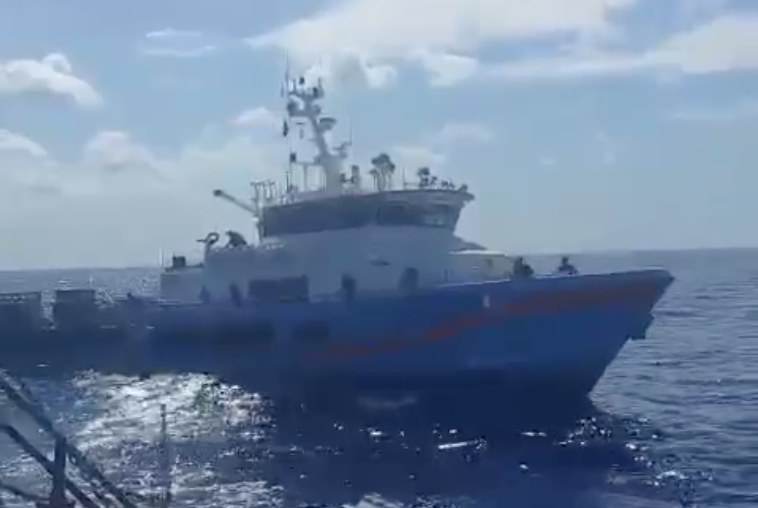
Screenshot of a video people on the fishing vessel made of the Tareq bin Zeyad boat that circled and rammed them.
A coast guard shooting at people in distress
The Tareq bin Zeyad Brigade – commanded by Saddam Haftar, son of Eastern Libyan general Khalifa Haftar – is notorious for its brutality, for obstructing people’s right to migrate, and for numerous illegal pullbacks and human rights violations both on land and at sea. Nevertheless, both Malta and the EU treat it as a coast guard – and intend to further equip and strengthen it in order to bring migrants back: in the same month the Brigade fired on and rammed the migrant boat to stop it from reaching European shores, a formal delegation from both Libyan governments was visiting Europe, meeting with Frontex and the Commission.
Meanwhile, it has become public that the EU plans to finance and build a Maritime Rescue Coordination Centre in Benghazi and to pursue closer cooperation with eastern Libya on “coordination in the fight against illegal migration” – with the Tareq bin Zeyad Brigade explicitly factored in: In June, the head of Tareq bin Zeyad himself, Saddam Haftar, met the Greek Prime Minister in Athens, travelled to Rome for a meeting with the Italian defence minister, and received the Italian intelligence chief in Benghazi. The very militia that fired on these migrants is thus set to receive more money, training, equipment and political legitimacy from Europe – and thereby strengthened, to do exactly what Europe expects of them: keep people from reaching Europe – whatever it takes.
Our demands therefore remain in place: Stop the impunity of state actors in the Mediterranean! Stop collaboration with militia forces and end the Memorandum of Understanding between Italy and Libya! Freedom of movement and equal rights for all.

