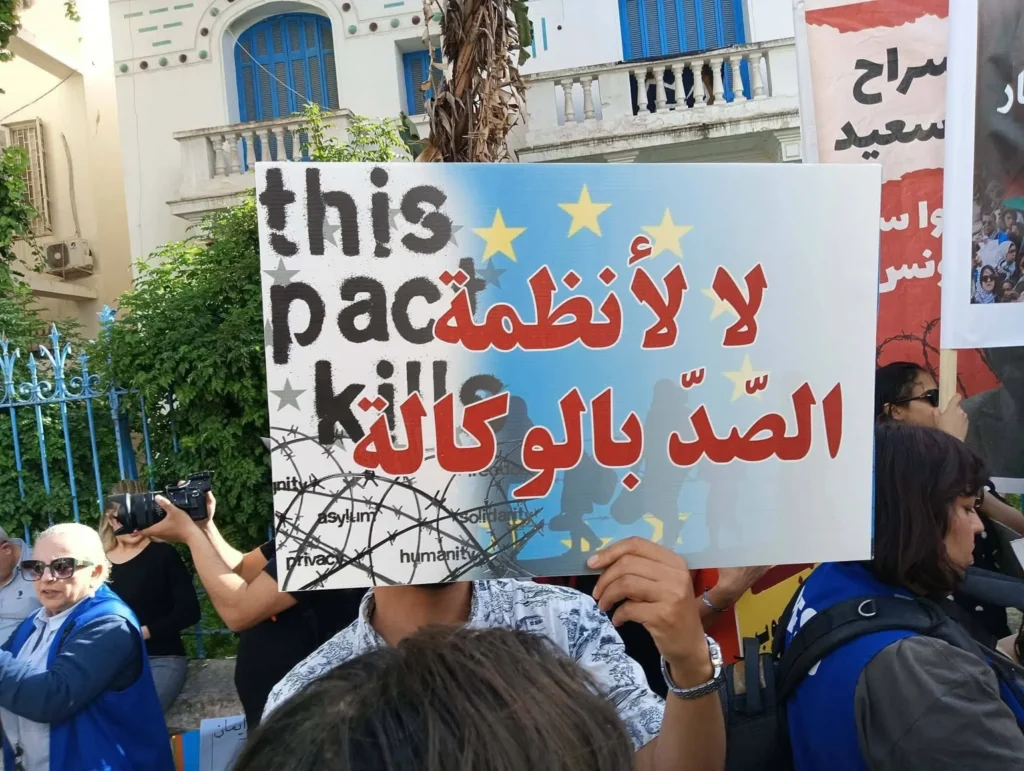
Demonstration in Tunis against CEAS, racism and criminalisation. Source: Alarm Phone
Introduction
In the first half of 2026, Alarm Phone was alerted to 280 boats in distress in the central Mediterranean Sea. In the same period of the year before, we had been alerted to 334 boats on this migration route. In the second half of 2025, a total number of 428 boats reached out to us from this region. According to data by the UNHCR, arrivals to Italy via Libya and Tunisia stood at about 15,800 people at the end of June 2026, whereas in the previous year 33,631 people arrived in the first six months. Arrivals via Libya to Crete were at about 9,000 people at the end of June 2026, making the total number of sea arrivals from Libya and Tunisia to Europe ca. 24,800 people in the first half of 2026.
The vast majority of boats departed from Libya, many of them from Eastern Libya towards Crete, Greece. On this route, there is a lot of traffic by merchant vessels. They sometimes rescued people in distress, but also pushed back some boats in collaboration with the so-called Libyan or the Egyptian Coastguard. The route from Tunisia is almost totally blocked due to extensive drone surveillance, and boats are often violently intercepted by Tunisian authorities. Once intercepted the people are deported to desert areas at the Algerian or Libyan border or put on so-called “voluntary return” flights to their countries of origin.
The IOM estimates that about 865 people have died in this central Mediterranean region during the first six months of 2026. We should emphasise, however, that many deaths or disappearances are never documented, so we have to assume an actual higher death toll. Any statistical count of deaths and disappearances can only ever be considered as a rough estimate, which needs to be treated with caution, and in any case does never account for the countless people whose lives have forever been changed by the loss of their loved ones.
The civil fleet has continued to carry out rescues and remains resilient, despite the ongoing assault on their solidarity at sea. According to our documentation, ca. 65 boats were rescued by the civil fleet in the first half of 2026.
Over the past six months, we have witnessed time and again that boats of people on the move and those of the civil rescue fleet were attacked by Libyan forces and militias. We have also witnessed repeated pushbacks (by proxy) of boats from within the Maltese Search and Rescue zone, something that the documentation of the Malta Migration Archive has also confirmed. Moreover, interceptions by the so-called Libyan Coastguard on the route from Eastern Libya towards Crete increased during the last months after pressure and financial support by the EU.
In this analysis, we provide a comprehensive chronology of the first half of 2026, offering in great detail an account of developments as they unfolded in the central Mediterranean Sea. For lack of comparable existing resources, we are creating our own archive of migrant struggles and acts of solidarity and resistance.
We will continue to stand with people on the move and document the border violence that they face. In our daily practice, we struggle against borders, for ferries, not Frontex, and the freedom of movement for all.
January
In January, Alarm Phone was alerted to 32 boats in distress in the Central Med, among them 19 departing from Libya and 13 from Tunisia. NGO vessels rescued a total of six boats that month – not all of them had alerted Alarm Phone. A further two boats were rescued by merchant vessels. The Italian Coastguard rescued at least nine boats – most of them already close to Lampedusa – and they also coordinated some rescue operations of boats heading towards Sicily or Calabria. Not a single boat was rescued to Malta. We know of no boats rescued by the Greek Coastguard, which would have traveled on the route from eastern Libya to Crete. In total, we know of eleven interceptions by the so-called Libyan Coastguard and five by the Tunisian Coastguard. Unfortunately, we rarely receive reliable figures regarding Tunisian interceptions. We learned of one shipwreck, which was also an Alarm Phone case from Sfax, Tunisia.
On 1 January, Libyan media reported about a drone attack on a boat used by militias and human traffickers in Al-Ajilat, western Libya, which lead to the death of the right-hand man of the Directorate Support militia commander and the injury of the commander. Innocent people on the move were also hit. This Directorate Support, created to fight so-called “illegal migration”, is sponsored by the EU. The European border regime fuels violent competition between armed groups in Libya.
On 5 January, the Ocean Viking was ordered to turn back by the so-called Libyan Coastguard, while about 60 people were in distress at sea. After the attack on the NGO ship by Libyan militias last summer, escalating violence forced the captain to protect his crew and survivors on board.
On 6 January, Alarm Phone published a weather alert for the Central Mediterranean and warned people planning to leave Tunisia or Libya about the dangerous weather conditions.
On 8 January, the FTDES published a declaration against the “Reproduction of Colonial Logic” after racist statements made on a TV program, which openly called for limiting the births of immigrant women in Tunisia and aligned itself with European border externalisation policies and their associated violence and enforcement tools in Tunisia. Also a “repatriation program”, with financial support from the EU, forced many people on the move to sign for so-called “voluntary returns” from Tunisia to their countries of origin.
On 10 January, it was published that Italy will spend three million euros of EU funds to open a “Maritime Rescue Coordination Center” in Benghazi, East Libya.
On 13 January, the second hearing of the trial against seven members of the NGO Mediterranea, accused of aiding and abetting “irregular immigration” with the aggravating circumstance of profit, took place. The trial is linked to the events of August 2020, when the Maersk Etienne merchant vessel rescued 27 migrants from a shipwreck. Awaiting permission to disembark for just over a month, the captain sent a request for medical assistance. The Mare Jonio responded, allowing the people to disembark in Pozzallo. After more than two months, the Maersk company sent a donation to the NGO, also making it public on social media. At the conclusion of the second hearing, the Court of Ragusa ordered the destruction of all wiretaps and chats not relevant to the indictment or expressly prohibited by law. The next hearing was scheduled for 12 May.
On the same day, many departures of boats from the Libyan and Tunisian coast were reported. Alarm Phone was alerted by about 50 people on a boat which left from Zuwara who were in a desperate situation and probably forced back to Libya in the end. The same happened to 88 people in distress between Tunisia and Malta.
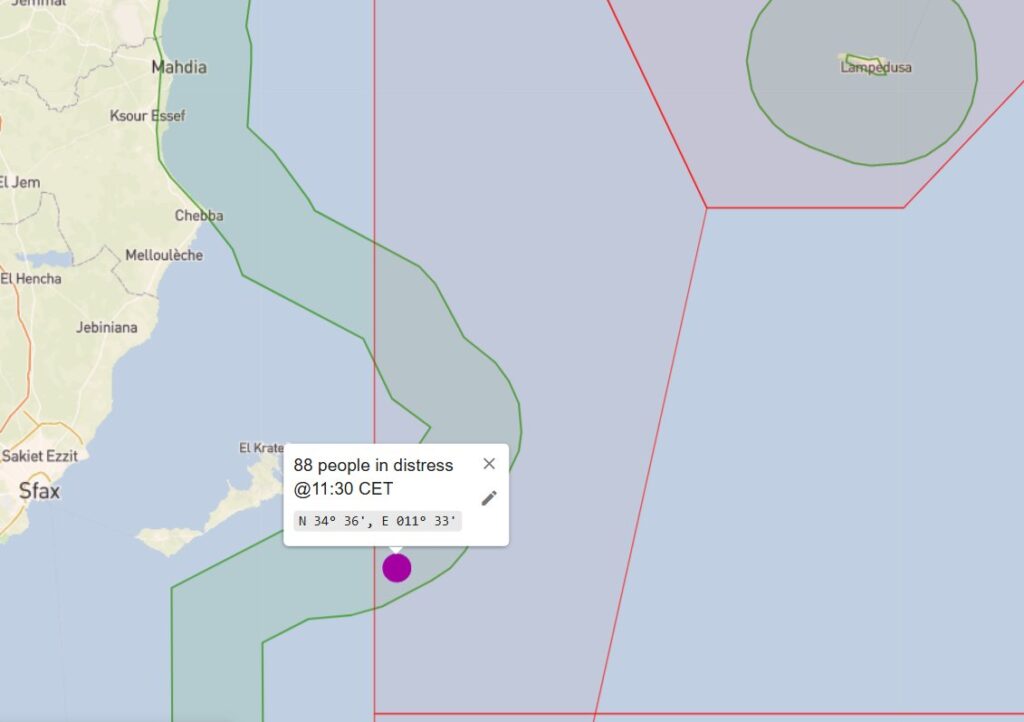
Map showing the position of the second boat. Source: Alarm Phone
On 15 January, media reported that the Director of the Military Intelligence Department of Libya’s Government of National Unity, Major General Mahmoud Hamza, paid an official visit to Valletta to discuss strengthening joint security cooperation with Malta’s military and security leadership.The visit also included field tours of the Special Forces headquarters, training centers, naval forces, and the air wing, as part of efforts to develop security coordination between the two sides.
On 16 January, 44 people who had fled from eastern Libya and were unable to navigate further were rescued by the merchant vessel SIDER, which was heading to Algeria. One day later, following an alert from Alarm Phone, the Ocean Viking evacuated the people – many of them in critical medical condition – from the merchant ship, after Mayday calls by the captain of SIDER to authorities had been ignored.
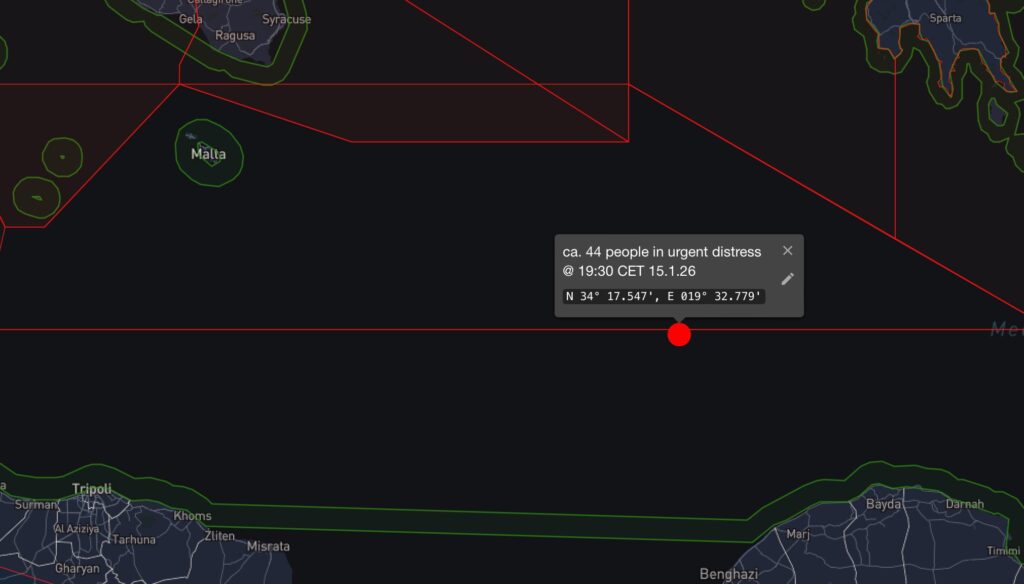
Map showing the position of the boat in distress. Source: Alarm Phone
On 17 January, several Libyan interceptions were reported: 99 people on a drifting boat off the coast of Zliten were forced back and brought to the Tajoura detention center. Two boats carrying 92 and 32 people were intercepted north of Al-Tamini and brought to Tobruk.
On 18 January, Alarm Phone Sahara published a new report. They learned that more than 34,000 people were deported from Algeria to Niger in 2025, more than ever before in recent years.
On the same day, a storm was announced to hit the Central Mediterranean area with winds up to 100 km/h and waves up to 8/9 meters high. Nevertheless, three boats carrying 165 people arrived on their own in Lampedusa.
On 19 January, Alarm Phone lost contact to 45 people in distress who had called us 15 hours before. We learned that the merchant vessel MINERVA SOPHIA was forcing the people back to Libya after having rescued them in the Maltese SAR (search and rescue) zone. We accused Malta of coordinating an illegal pushback.
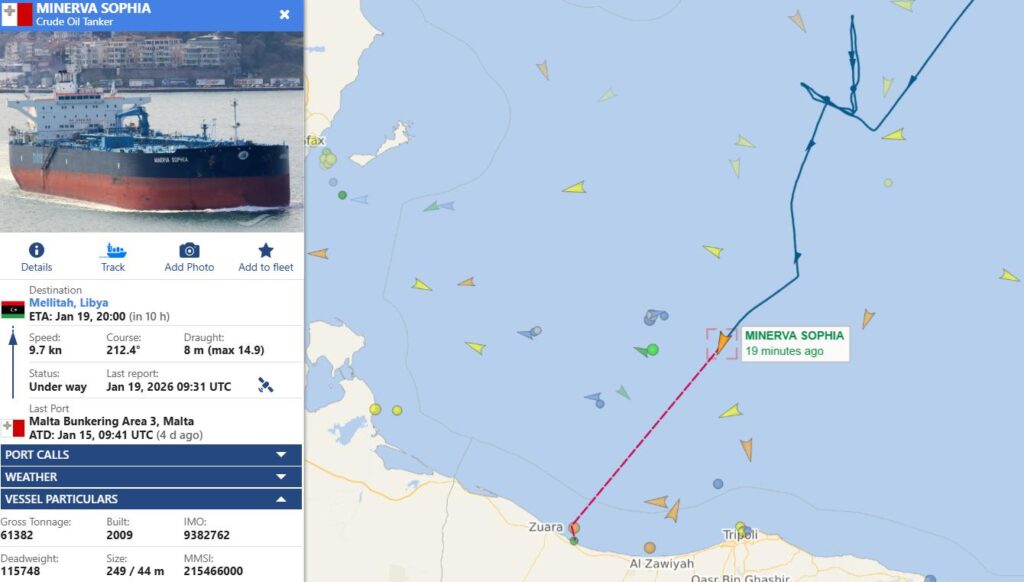
Map showing the track of the merchant vessel. Source: vesselfinder.com
On the same day, Libyan media reported that Prime Minister Abdulhamid Dbeibeh of western Libya had urged Italy and the European Union to provide direct support to his government in dealing with irregular migration, arguing that Libya was carrying a heavy security and humanitarian burden. His remarks came during talks in Tripoli with Italy’s Deputy Prime Minister and Foreign Minister Antonio Tajani, aimed at strengthening bilateral ties and coordinating efforts on shared challenges, according to a government statement. Dbeibeh reiterated Libya’s refusal to become a destination or settlement point for migrants, calling for stronger backing for repatriation and voluntary return programmes to ease pressure on Libyan cities and services.
On 20 January, plans were leaked that the Italian government was preparing a new Security Decree that could significantly change how migration is managed at the country’s borders. The draft introduces a new measure: a temporary ban on crossing Italy’s territorial waters, initially up to 30 days, renewable up to a maximum of six months. This ban could be applied in cases of serious threats to public order or national security, and “exceptional migratory pressure” (sic), international health emergencies, or high-profile international events requiring extraordinary security measures.
Vessels subject to this interdiction may be transferred to third countries with which Italy has agreements, such as Albania. If adopted, the decree would effectively (and relatively quietly) mark a major shift in Italy’s migration policy, significantly expanding the use of third-country deals.
On the same day, Alarm Phone was alerted to a group fleeing Tunisia by boat. Because of bad weather, they were at severe risk. We urged Italian and Tunisian authorities to rescue the people without delay.
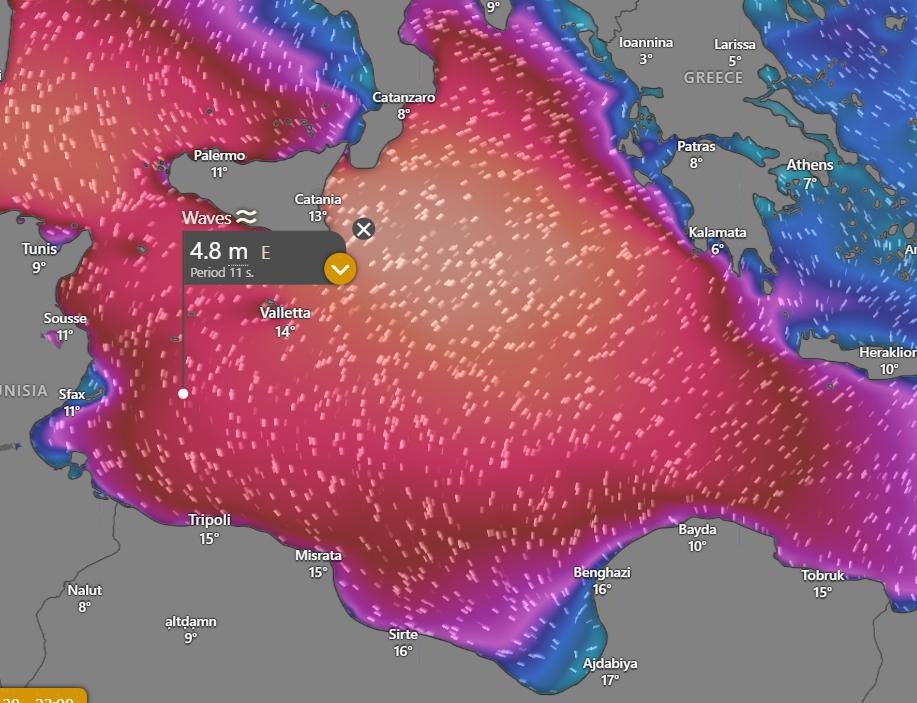
Map showing the bad weather. Source: windy.com
On 22 January, the NGO ship Aurora of Sea-Watch won its court case against the Italian state. The Civil Court of Agrigento annulled a fine and detention imposed on the ship Aurora in August 2023 for bringing survivors to a safe port. In August 2023, after a ~37-hour rescue operation, Italian authorities had ordered them to disembark in a port in Sicily. But due to low fuel after the rescue’s long duration, Aurora would not have been able to safely sail to that port. Instead of assigning them a closer Italian port, the Italian authorities eventually wanted Aurora to go to Tunisia — a whole other country and NOT safe for people fleeing! They sailed to Lampedusa, waiting there for 24 hours. After being allowed to enter the port, the captain was accused of “endangering lives” for not going to Sicily or Tunisia. The court declared that the detention and fine were unlawful.
On 23 January, it was reported that at least 150, maybe even 380 people were missing at sea after leaving Tunisia during the storm Harry. Alarm Phone had been alerted in the days before to three boats which were still at sea. On 25 January, authorities confirmed that one survivor was rescued to Malta, found on the wreckage of a boat. According to him 50 people did not survive. The people started from Tunisia and spent 24 hours in the water. The Maldusa project reported that on 22 January, 61 survivors had arrived in Lampedusa on board of an Italian patrol boat, rescued 50 nautical miles south of the island after being struck by Cyclone Harry.
On 26 January, the Consul General of the Republic of Burkina Faso paid a visit to East Tripoli Immigration Detention Center in Tajoura to asses its conditions, as well as register and issue travel documents to detained Burkinabe migrants. Libyan authorities also repatriated from East Tripoli Immigration Detention Center in Tajoura a group of Somali people.
On 27 January, media reported that Spain plans to give half a million undocumented migrants legal status. Regularization will be available to foreign nationals who do not have a criminal record and can prove they have been living in Spain for at least five months prior to 31 December 2025.
On 28 January, BBC published that Rwanda seeks £100m from the UK over their axed asylum deal. The African nation argued it is owed payments but the UK Home Office said it will fight the case. The statement accuses the UK of breaching the deal by setting out the financial terms of the agreement publicly, failing to make payments totalling £100m, and “refusing to make arrangements to resettle vulnerable refugees from Rwanda”.The previous Conservative government spent some £700m on the Rwanda policy, which was intended to deter migrants from crossing the English Channel in small boats. Only four volunteers arrived in Rwanda when the deal was in force and Keir Starmer said the plan was “dead and buried”, shortly after Labour won the 2024 general election.
On 29 January, a paper by the Danish EU presidency was leaked by the London-based watchdog Statewatch. It envisions dumping migrant sea rescues onto non-European states. The paper proposes creating a “place-of-safety arrangement” that would effectively offshore responsibility for rescued migrants.
On the same day, more details were reported about EU plans for a new Maritime Rescue Hub in Benghazi. InfoMigrants had contacted the European Commission to seek clarification following a report published by the German left-leaning newspaper nd, which claimed that the EU had pledged at least three million euros to support the establishment of the center. The report indicated that the planned MRCC would form part of a broader cooperation between the EU and Libyan authorities on migration management.
On 30 January, Libyan forces conducted raids in Ain Al-Ghazala area targeting locations used for migrant boat manufacturing. The sites were demolished to prevent their further use. In a separate operation, security forces raided a warehouse and apprehended 84 people who wanted to leave by boat. They were transferred to detention in Tobruk.
On the same day, the teams of the Ocean Viking recovered the body of a woman in the Maltese SAR zone, probably one of the hundreds of victims during storm Harry in the week before.
On 31 January, the opening of the trial in Crotone concerning the Cutro shipwreck serves as a reminder of the shortcomings of the Italian authorities. Six people, including coast guards, are charged after the tragedy in which 94 migrants died three years ago off a beach in Calabria.
February
In February, Alarm Phone was alerted to 33 boats in distress in the Central Med, among them 30 departing from Libya, two from Tunisia and one from an unknown place. NGO vessels rescued a total of ten boats that month – not all of them had alerted Alarm Phone. Two boats were taken on board by merchant vessels, in one case 20 survivors of a shipwreck were rescued to Crete, in another case 37 people were forced back to Libya. The Italian Coastguard rescued at least ten boats – most of them already close to Lampedusa – and they also coordinated some rescue operations of boats heading towards Sicily or Calabria. Not a single boat was rescued to Malta. We know of no boats rescued by the Greek Coastguard except the rescue of 20 people of a deadly shipwreck near Crete. In total, we know of 32 interceptions by the so-called Libyan Coastguard and one by the Tunisian Coastguard. Unfortunately, we rarely receive reliable figures regarding Tunisian interceptions. In six of our cases, the outcome was unclear and the boat was missing. We learned of four shipwrecks in February.
On 1 February, Sea-Watch 5 was detained because, after rescuing 18 people, they did not inform the so-called Libyan Coastguard, known for their violent abductions and abuses.
On 2 February, Refugees in Libya, who are in direct contact with civil society in Libya and Tunisia, published that the number of people missing during Cyclone Harry was not 380, but over 1,000. One day before, Ocean Viking had recovered the body of a woman in the Central Mediterranean. She might be one of the people who disappeared during that storm. Two days later, Humanity 1 found two deceased persons floating in the water. They also may have been among the missing people.
On 3 February, Alarm Phone was alerted to 25 people on a boat escaping from Libya. They were in distress in bad weather in the Maltese SAR zone. Their engine was not working and coastguards were not replying. We lost contact to the people and were relieved when one day later we learned that they had arrived in Lampedusa.
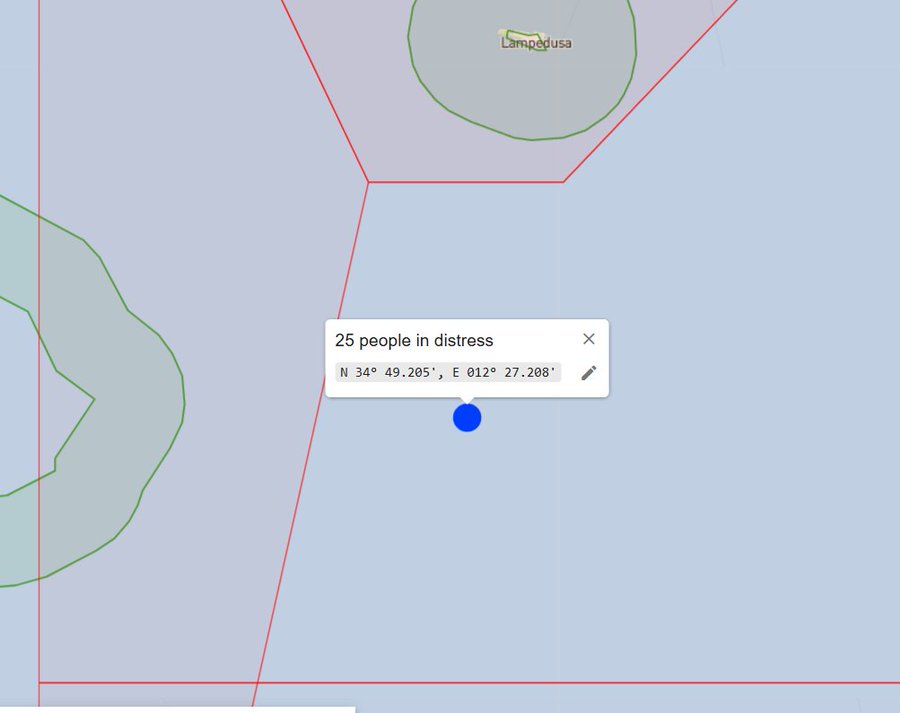
Map showing the position of the boat in distress. Source: Alarm Phone
On 4 February, Alarm Phone published the testimony of a survivor of a group of people who got intercepted by the Tunisian National Guard and were sold to a Libyan militia for fuel.
On 5 February, the so-called Libyan Coastguard intercepted a boat carrying 45 people on the way to Crete and forced them back to Tobruk. Arrivals in Crete from eastern Libya quadrupled in 2025, prompting Europeans to seek closer ties with the authorities in Benghazi to control the borders, following an agreement with their rivals in Tripoli in 2017. Migrants intercepted at sea are systematically imprisoned.
On 6 February, CommemorActions for people who died at the borders of Europe were organised in many countries. Alarm Phone reminded of three boats which disappeared in April 2025 in the Central Mediterranean. More than 130 people remain missing, more than 130 families continue to search for answers.
On the same day, investigations by the media and Sea-Watch showed that Frontex forwards information about people in distress at sea only to the so-called Libyan Coastguard, enabling interceptions and returns to Libya.
On 7 February, Italian media reported that migrant landings resumed in Lampedusa.The boats rescued offshore all departed from Libya (from Zuwara and Khoms). Over the course of a few hours, 160 people had landed on the island.
On 9 February, Refugees in Libya and media reported about a deadly shipwreck: A rubber boat carrying dozens of people capsized off the coast of Libya, leaving at least 53 people dead, including two babies. Only two Nigerian women were rescued during a search-and-rescue operation by Libyan authorities. The vessel, which had been carrying 55 people, overturned north of the coastal city of Zuwara on 6 February. It had departed from al-Zawiya at around 11 p.m. on 5 February, and capsized approximately six hours later.
On the same day, Alarm Phone was called by a group in distress on a rubber boat just 40 nautical miles off Lampedusa, who were struggling in the wind and waves. We were relieved to hear that the Italian authorities confirmed the rescue of the 30 people. They were brought to Lampedusa.
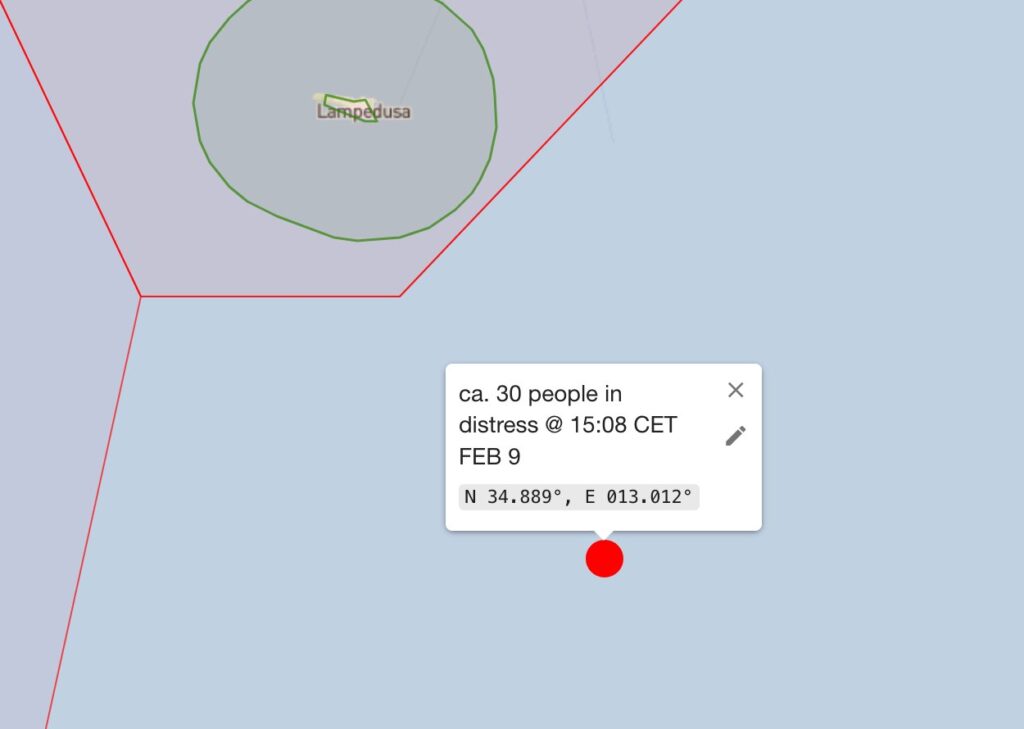
Map showing the position of the boat in distress. Source: Alarm Phone
On 10 February, the EU Parliament adopted changes to the EU asylum procedure regulations to enable faster processing of asylum requests. It also decided that Tunisia is a “Safe country of origin” (as well as six other additional countries). This gives Tunisian authorities a carte blanche to continue their systematic violations against migrants and civil society! MEPs also voted to allow people to be deported to places they have never been to, as NGOs express fears over new ‘safe third countries’ list.
On 11 February, a complex rescue operation took place in the early hours in the port of Pozzallo: 222 people, including 62 minors, were brought to safety after being rescued at sea by the Coast Guard . Arrivals also reached Lampedusa, with 95 migrants disembarking during the night on the island.
On 12 February, media reported on a new decree, escalating Italy’s war on migration: Italy’s far-right government approved a bill introducing new measures aimed at fighting „illegal immigration“, including a so-called “naval blockade” for civil rescue ships trying to reach Italian shores. Instead of receiving protection in a safe port – as required per international law – survivors could be deported to third countries. Conveniently, the EU just voted to make this horror easier than ever: Now, people can be deported to countries they have no connection to whatsoever. But Italy’s draft also plans severe fines for NGOs and possible vessel confiscation.
On 13 February, East Libyan militia leader Saddam Haftar was courted at the Security Conference in Munich. Haftar leads the Tariq Ben Zeyad militia, which has shot people fleeing by sea and killed opposition figures. His visit normalizes extreme violence and is an insult for Libyan activists and refugees.
On the same day, it was published that the Armed Forces of Malta signed a contract for a new surveillance aircraft made in the US. The plane is expected to be “primarily employed in border control, maritime surveillance, maritime law enforcement, and search and rescue”. It would be delivered by German aviation specialists Aerodata AG, with whom the contract was signed.
On 14 February, Italian authorities detained the search and rescue ship Humanity 1 for 60 days and issued a €10,000 fine – after they had rescued 33 people from distress at sea. According to SOS Humanity, this was the third detention of a rescue vessel from the “Justice Fleet” alliance within three months. The NGO-alliance criticises European support for Libyan actors at sea, whom it accuses of violence against people seeking protection and against rescue crews. The detentions are designed to prevent non-governmental search and rescue ships from carrying out rescues – while also pressuring them to cooperate with Libyan actors. (pic in the press release?)
On the same day, Refugees in Libya reported that the Libyan capital, Tripoli, was witnessing attacks and racist practices against refugees, unfolding amid a clear disregard by the Tripoli Security Directorate and the Ministry of Interior. This was not an isolated incident. On multiple occasions, dozens had taken to the streets under the banner of a so-called movement claiming to fight the “resettlement of refugees,” holding gatherings in the city center that appear to have occurred with official approval from security authorities.
On 17 February, a new joint report by the UN Support Mission in Libya (UNSMIL) and UN Human Rights on Libya, „Business as Usual“, was published. The report highlights patterns of human rights violations and abuses perpetrated with impunity against migrants, asylum seekers and refugees in Libya, between 2024 and 2025.
On 18 February, the court of Catania decided to suspend the 15-day detention order and the related fine for Sea-Watch 5. The ship had been detained by the regional representative of the Italian Ministry of the Interior after rescuing 18 people in international waters off the Libyan coast. The crew of the rescue ship had refused to inform Libyan militias about their ongoing rescue operation. Sea-Watch, together with 12 other sea rescue organizations, had joined forces in early November 2025 to form the Justice Fleet alliance and announced that it would cease operational communication with the so-called Libyan coast guard. A week before, the civil court in Palermo had ordered the Italian government to pay Sea-Watch €76,000 in damages. The background to this was the illegal refusal of the prefecture of Agrigento in 2019 to lift a six-month seizure of the Sea-Watch 3.
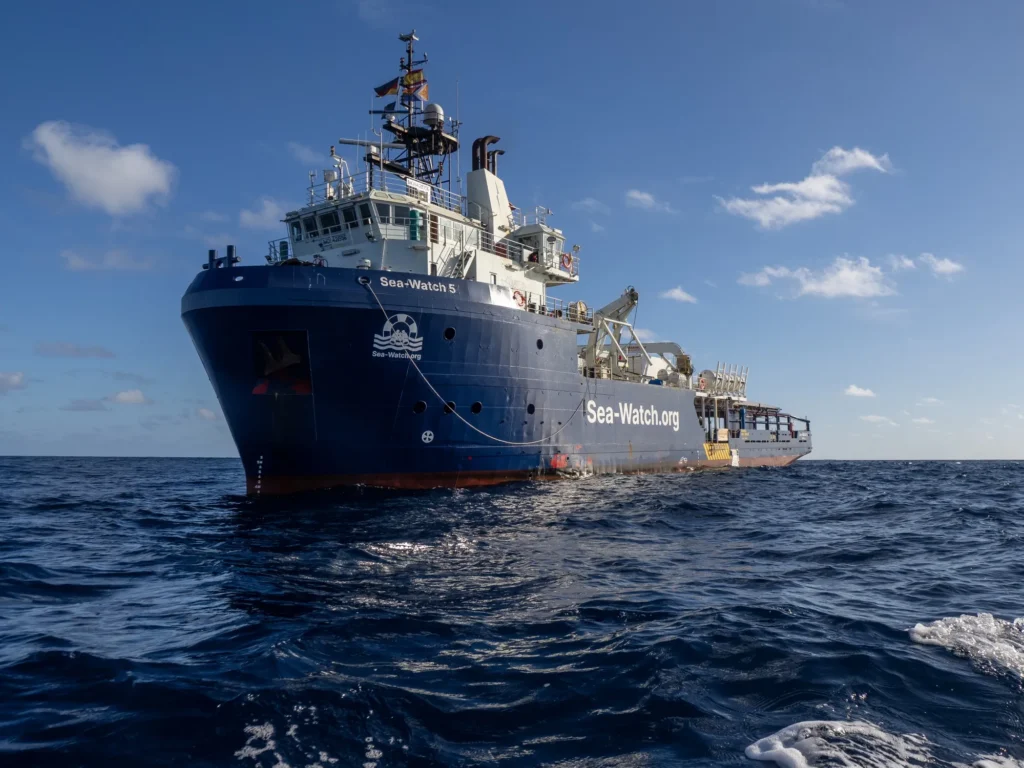
Photo of the Sea-Watch. Source: https://bsky.app/profile/en.sea-watch.org/post/3mf5jqeexrs2p
On the same day, Italian media reported that at least 15 bodies had washed up on the shores of Calabria and Sicily in recent days. Fifteen people who tried to cross the Mediterranean. Fifteen lives that ended at Europe’s borders. And these are only the ones we see. The fact that the bodies have been found on the Thyrrenian side raises suspicion that the attempted crossings may have taken place along the Algeria–Sardinia route, a long and very dangerous passage, especially under extreme weather conditions.
On 20 February, following several shipwrecks in the Strait of Sicily during Cyclone Harry, causing the disappearance of around a thousand people between 14 and 21 January 2026, MEM. MED, ASGI, Mediterranea and Alarm Phone published a joint call. They had sent letters to Italian national and local authorities urging them to immediately activate all of the necessary procedures for the identification of the bodies recovered along the Sicilian and Calabrian coasts. The associations Alarm Phone and MEM.MED reported that they had received numerous reports from family members searching for missing loved ones who left the Tunisian coast during those days.
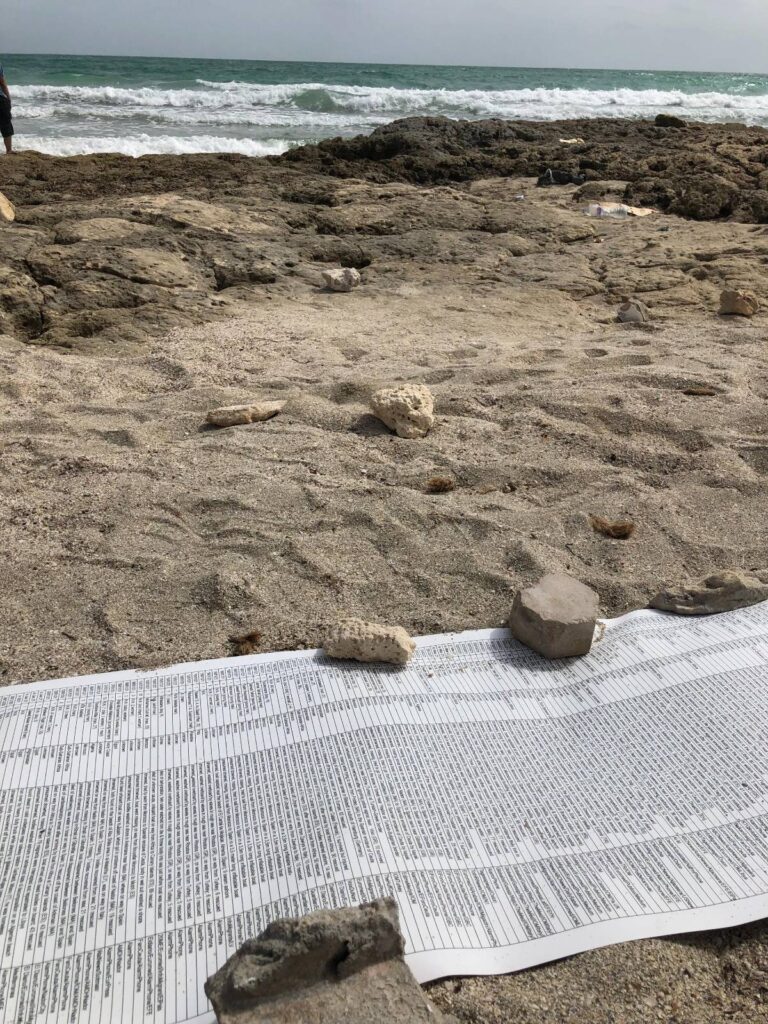
CommemorAction in Zarzis, Tunisia in September 2022. Photo: Chiara Denaro, Alarm Phone.
On 21 February, a deadly shipwreck was reported south of Heraklion: According to media information, 20 people had been rescued and were transported by a nearby container ship to Kali Limenes, while 27 more went missing. The Panama-flagged vessel was able to recover twenty people alive, while the Greek Coastguard and FRONTEX vessels that rushed to the scene recovered three dead bodies. Two more were later found. At the time of the accident, the winds in the area were reaching 6 Beaufort in force and the waves a height of 2.5 meters. The migrants had requested help via 112.
On 22 February, in the waters off Trapani on board the civil rescue sailboat Safira, and together with Refugees in Libya, we commemorated the women, men and children who lost their lives at sea during cyclone Harry.
On 23 February, the Ocean Viking performed the rescue of 97 people, following an alert by Alarm Phone. Later, the plane Albatross of SOS Mediterranée sighted an overcrowded boat in the Maltese SAR region, allowing the Ocean Viking to rescue another 50 people in distress.
On 23 and 24 February, a delegation from the Asylum and Immigration Table (Tai), together with Hon. Rachele Scarpa, carried out a new visit to the centre in Gjader, Albania. What emerged revealed a serious and in many ways paradoxical situation: despite two preliminary references pending before the Court of Justice of the European Union, the government not only had not suspended detentions, but had significantly increased forced transfers from Italian CPRs (Permanent Stay Centres for Repatriation) to Albania.
On 25 February, more than 100 people were dumped in the desert. Alarm Phone was alerted to this group of people who were deported to the border region of Tunisia – Algeria after they had been intercepted on their way from Tunisia towards Europe.
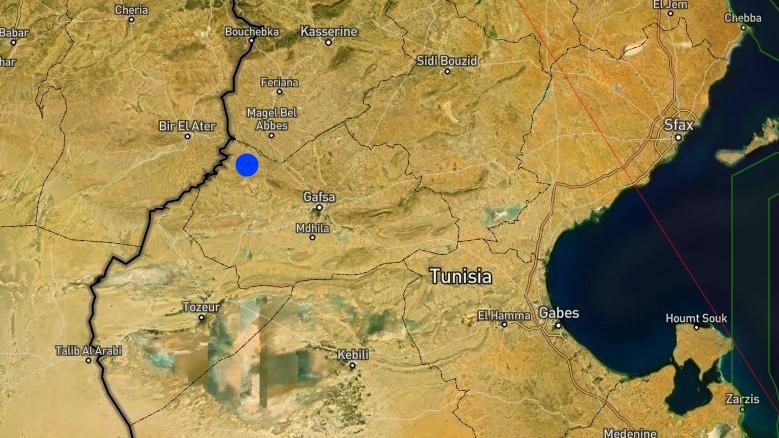
Map showing the position of the people in the desert Source: Alarm Phone
On 26 February, activists from the antiracist association Mnemty were dragged to court again in Tunis. Their member Saadia Mesbah has been imprisoned since May 7 for fighting racism and defending the dignity of people. The merciless European border regime enables this prosecution and its externalisation policies, which actively target solidarity structures and anti-racist activists in Tunisia.
On 27 February, the merchant vessel ALATAU helped to forcibly return 30 people who tried to escape from Libya and had alerted Alarm Phone. We condemn the collaboration with Libyan actors when returning people to the violence they want to flee from!
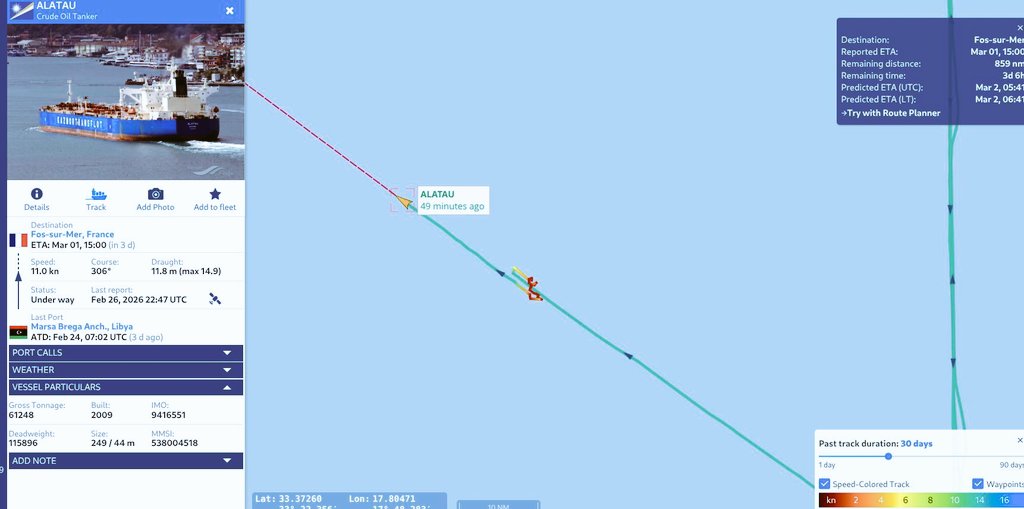
Map showing the track of the merchant vessel. Source: vesselfinder.com
On 28 February, Alarm Phone alerted authorities about 37 people on a boat adrift in Maltese SAR zone. We lost contact to them and were relieved to hear later that they were finally rescued by the Italian Coastguard and brought to Sicily.
March
In March, Alarm Phone was alerted to 58 boats in distress in the Central Med, among them 53 departing from Libya and five from Tunisia. NGO vessels rescued a total of 13 boats that month – not all of them had alerted Alarm Phone. One boat was rescued by a merchant vessel, together with the Greek Coastguard, and one boat was pushed back by a commercial vessel to Libya. The Italian Coastguard rescued at least twelve boats – most of them already close to Lampedusa – and they also coordinated some rescue operations of boats heading towards Sicily or Calabria. Not a single boat was rescued to Malta. We know of one boat rescued by the Greek Coastguard, which traveled on the route from eastern Libya to Crete. In total, we know of 49 interceptions by the so-called Libyan Coastguard and three by the Tunisian Coastguard. Unfortunately, we rarely receive reliable figures regarding Tunisian interceptions. In ten of our cases, the outcome was unclear and the boat was missing. We learned of six shipwrecks in March.
On 2 March, Alarm Phone alerted authorities to a boat with about 100 people who fled Libya to search refuge in Italy. The engine stopped and the boat was adrift but authorities were not intervening. The Civil Fleet tried to convince a merchant vessel to provide shelter, but it was actively hindered by RCC Malta. Italian media reported one day later that the Italian Coastguard had rescued 103 people around midnight to Pozzallo.
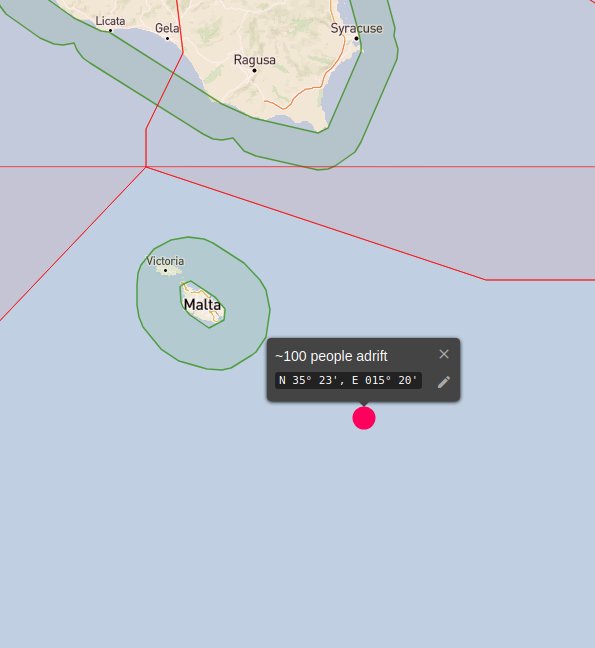
Map showing the position of the boat in distress. Source: Alarm Phone
On 3 March, we learned of several Libyan interceptions off Tobruk, but also in other regions. One of them was a boat with about 25 people who had fled Libya and alerted Alarm Phone.
On 4 March, a document was published which shows that the EU wants closer cooperation not only with West Libya, but also with East Libyan military ruler Khalifa Haftar in order to stop people from seeking protection in Europe already in North Africa.
On 6 March, Alarm Phone was busy with several boats in distress: On 5 March, we had alerted authorities to two boats with around 50 people each, who fled Libya together. The people in one boat reported that the other boat next to them capsized and was not visible anymore. We learned that both boats were rescued by the Italian Coastguard from Malta’s Search and Rescue zone to Augusta on Sicily, while Maltese authorities ignored the distressed.
On the same day, a third boat with about 40 people that had alerted us was rescued by the Italian Coastguard in the Maltese SAR zone and brought to Lampedusa.
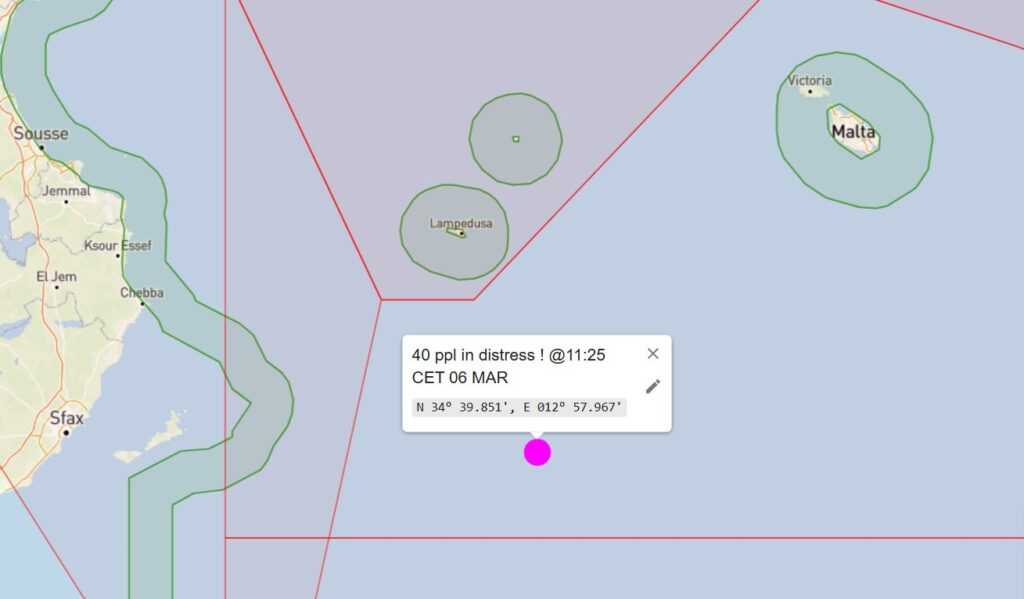
Map showing the position of the boat in distress. Source: Alarm Phone
Another boat adrift, carrying 36 people, who had called Alarm Phone, was intercepted by the so-called Libyan Coastguard.
During the night, the Ocean Viking rescued 36 people from a small rubber boat drifting in the Libyan SAR zone after an alert by Alarm Phone . On their way towards Ancona, they also rescued 64 people from a wooden boat who had alerted Alarm Phone.
On the same day, one of the first interceptions of a boat from Sirte, Libya, was reported: 85 people were pushed back by the Sirte Coast Security Agency and transfered to a detention center.
On 8 March, a boat carrying 35 people, who had alerted Alarm Phone, was spotted by a Frontex aircraft and rescued to Crete by two Greek Coastguard vessels and a Marshall Islands-flagged cargo ship.
On 9 March, members of the EU Parliament adopted new rules for the expulsion of undocumented migrants with a right-wing and far-right majority. Half a dozen member states, including Germany and the Netherlands, already announced their intention to create “return centers” outside the EU’s borders, as will be permitted by the new regulation. A significant tightening of the European Union’s migration policy and the possibility of sending migrants to “return platforms”—detention centers located in non-EU countries—is the gist of the text approved on Monday, March 9, by MEPs in the Committee on Civil Liberties.
On 10 March, Sea-Watch reported that 10 survivors of a boat in distress had been stranded already for four days on the Miskar gas platform in the Tunisian SAR zone. Italy had been aware for days. The people were at risk of another abduction to unsafe Tunisia, like the ca. 28 persons taken from the platform three days earlier. The NGO vessel Solidaire was close, but the weather was too severe for a safe transfer. Only on 12 March, Solidaire was able to rescue the people and bring them to Italy.
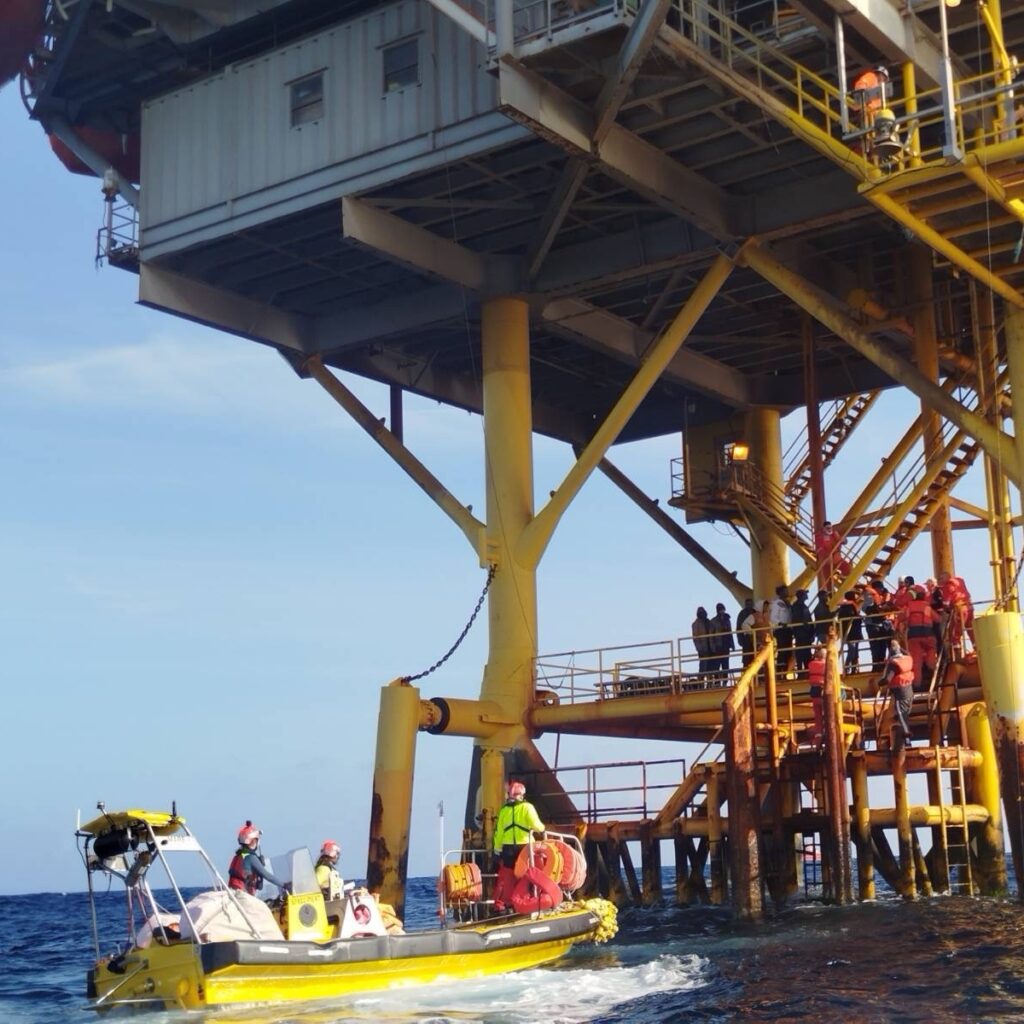
Photo of the Miskar platform. Source: https://x.com/seawatch_intl/status/2032141035883618797/photo/1
On 11 March, 35 people in distress heading toward Crete, who had alerted Alarm Phone one day earlier, were rescued by the crew of the merchant vessel NEXUS. Instead of allowing them to disembark the group in a safe harbor on Crete, the Greek Coastguard threatened to arrest the captain and the crew if they would do so. Knowing that Libya is not a safe place, the captain did not want to bring the group there. We were in contact with the captain, who reported that Greece, Italy and Malta refused responsibility and were in favor of forcing people back to Libya. After huge pressure from the company SUPER BARU, the ship was heading to Libya.The crew was forced to disembark the rescued group in Libya. One day later, family members informed us that they were contacted by their relatives from a detention center in Tobruk. On 17 March, Alarm Phone published a detailed report on this case.
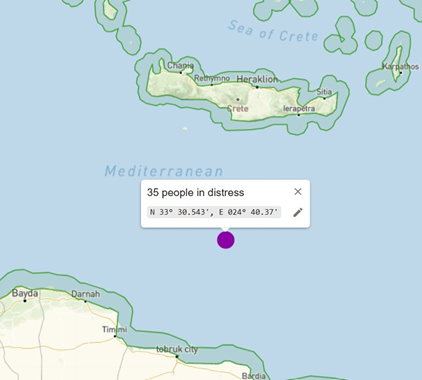
Map of the position of the boat rescued by the NEXUS. Source: Alarm Phone
On 14 March, the Italian Interior Minister revealed that Libya thwarted 2,568 migration attempts while Tunisia prevented 2,528 illegal migration attempts. In a tweet on X, announcing the figures, Matteo Piantedosi explained that this was part of a broader strategy being implemented with Italy’s contribution „to combat human trafficking and irregular migration.“
On 15 March, a boat carrying people on the move heading from Libya towards Italy, capsized off Lampedusa, leaving a child missing. An Italian Coastguard patrol boat rescued 64 people including the child’s mother.
On 16 March, Alarm Phone was informed by a worker on the Miskar gas platform that 71 people were rescued to the platform while 40 were on a vessel nearby, possibly the Maridive 703. We believed this might match the two boats we had alerted about one day earlier where contact was lost. On 19 March, the crew on the Ocean Viking rescued 116 people from the Miskar gas platform. Survivors had been stranded on the platform for four nights after the two boats they were traveling in got hit by a cyclone. They reported spending two nights at sea and losing people in the waves. Following an urgent request by UpRights, StraLi, and MSF, the UN Human Rights Committee issued interim measures, urging relevant authorities to ensure rescue and safe disembarkation. Yet again, people were abandoned at sea while states forgot their legal and moral duties. The Ocean Viking brought them to Italy.
On 17 March, the 123 people rescued by the civil ship Life Support disembarked in the Italian port of Civitavecchia.
On the same day, several people on boats that had alerted Alarm Phone went missing. From a boat carrying 62 people,17 did not survive the storm. The survivors were returned to Libya. The boat shipwrecked when the so-called Libyan coastguard tried to go on board. Reportedly, the bodies of the 17 people who died were left behind instead of bringing them to land to be identified and buried. We lost contact to another boat carrying 38 people. Authorities did not give sufficient info on the fate of the group. We fear an invisible shipwreck due to the non-assistance despite the bad storm.
On 18 March, Italian authoritties ordered the Sea-Watch 5 to sail with 57 people on board to a port more than 1,100 km far away. The crew of the Sea-Watch 5 refused and went to Trapani, demanding permission to enter the port. The survivors were finally disembarked and got the medical treatment they needed.
On 19 March, Tunisian authorities sentenced Saadia Mesbah, an anti-racism activist, to eight years in prison, along with a fine of 100,000 dinars. Additionally, eight volunteers from the mnemty Association received varying prison sentences. The FTDES had published a call „Against the Criminalization of Civil Activism and Human Solidarity“ on 17 March.
On 23 March, Italian voters rejected a judicial reform backed by conservative Premier Giorgia Meloni. The “No” camp won almost 54% of the vote against the government‑backed “Yes” campaign, which secured about 46%. Critics argued that the proposed measures risked concentrating too much power in the executive branch. Opposition parties, civil society groups and legal associations presented a unified front, warning that the reform could undermine institutional checks and balances.
On 24 March, media published that a French judge was probing the former EU border chief for complicity in crimes against humanity. Fabrice Leggeri, now a far-right member of the European Parliament, was accused of tolerating pushbacks of asylum seekers during a seven-year spell as Frontex chief that began in 2015.
On 25 March,we were happy to learn from the media that the Italian coastguard went to a boat in distress that had alerted Alarm Phone the day before and disembarked all 34 people in Pozzallo, Sicily. Sadly, MRCC Rome neither informed a civil rescue ship that was still searching for the boat, nor answered our requests for information.
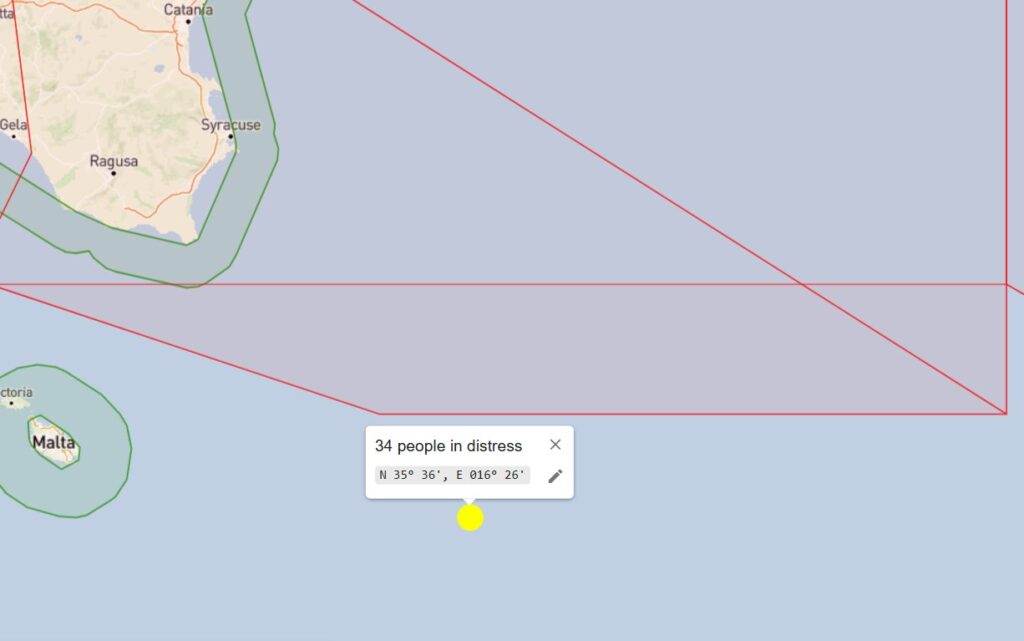
Map showing the position of the boat in distress. Source: Alarm Phone
On 26 March, the EU Return Regulation was approved. MEPs voted a law enabling member states to build deportation centres outside the EU, endorsing talks with non-recognised third-country entities and imposing entry bans on returned migrants. “People will also risk being sent to ‘return hubs’ – offshore detention centres – in countries where they have never set foot. Amnesty International is unequivocal: return hubs carry grave risks of rights violations, cannot be implemented in a human rights compliant manner, and should be rejected in full.”
On 27 March, Alarm Phone was contacted by many worried relatives asking about a boat that left with ca. 17 people from Sabratha four days earlier. We urged all authorities to search for the boat instead of pointing responsibilities at one another. But also one day later we were without news about the fate of this group.
On the same day, testimonies of refugees and lawyers in Egypt were published. According to them, Egypt is systematically arresting and deporting thousands of refugees, regardless of their legal status, in a widening crackdown that has created a climate of terror and left many afraid to leave their homes.
28 March marked the 7th year since the arrival and arrest of the ElHiblu3 in Malta. Over 7 hours, we marked the 7 years that the three young men, who had prevented the pushback of more than 100 people on the tanker El Hiblu 1 to Libya, have been criminalised. We demanded again that the charges be dropped and that our friends be freed.
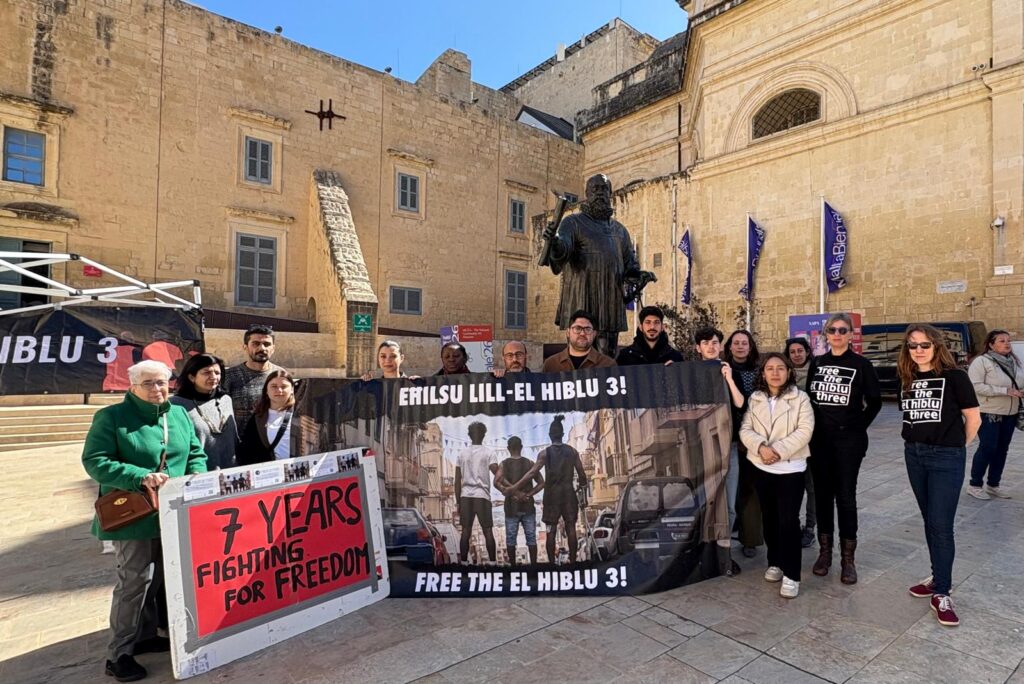
Manifestation in front of the court in Malta. Source: Alarm Phone
On the same day, Aegean Boat Report published a deadly shipwreck south of Crete: In the early hours of 27 March, 26 people were rescued south of Crete, near Kali Limenes, after drifting at sea for six days. According to survivor testimonies, the boat had departed from Tobruk on March 21, carrying 48 people. Only 26 survived. 22 people are reported dead. Survivors described a journey without food or water, lost at sea, exposed to the elements, fighting to stay alive as conditions rapidly deteriorated. They said that those who died during the journey were thrown into the sea. Two young men, aged 19 and 22, have been arrested by Greek authorities and accused of smuggling, facilitation, and manslaughter. Also the media reported about this case.
On 29 March, we received information that a group of 56 people that had alerted Alarm Phone one day earlier after they had left Sfax/Tunisia, was taken back to Tunisia. We received the information that of the approx. 60 people, who were returned to Tunisia, only 16 people survived and 19 dead bodies were retrieved. Despite numerous calls to the Tunisian authorities in the following days, we still don’t know what happened to the missing. This tragedy was by no means inevitable, but is a result of the in/actions of the Tunisian coastgards and its European allies.
On 30 March, a UN investigator’s report on Libya was published. The report on Libya denounces: an entire country is in the hands of armed groups, and Almasri’s return from Italy suggests justice is irrelevant. According to the latest report from the UN Panel of Experts, human trafficking continues to operate “with impunity” in broad daylight.
April
In April, Alarm Phone was alerted to 45 boats in distress in the Central Med, among them 43 departing from Libya and two from Tunisia. NGO vessels rescued a total of nine boats that month – not all of them had alerted Alarm Phone. One boat was rescued by two merchant vessels, then taken over by the Italian Coastguard and brought to Lampedusa. A second boat was saved by a tanker and brought to Crete. People of a third boat were taken on board by a merchant vessel and brought to Egypt. A fourth boat was rescued by a merchant vessel, but later transshipped onto a Libyan patrol vessel and forced back to Libya. The Italian Coastguard rescued at least nine boats – most of them already close to Lampedusa – and they also coordinated some rescue operations of boats heading towards Sicily or Calabria. Not a single boat was rescued to Malta. We know of two boats rescued by the Greek Coastguard, which traveled on the route from eastern Libya to Crete. In total, we know of 59 interceptions by the so-called Libyan Coastguard and one by the Tunisian Coastguard. Unfortunately, we rarely receive reliable figures regarding Tunisian interceptions. In seven of our cases, the outcome was unclear and the boat was missing. We learned of four shipwrecks in April.
On 1 April, a deadly shipwreck occured near Lampedusa. Alarm Phone had alerted authorities to a rubber boat with 75 people. When rescue arrived, eight people had already died, probably of hypothermia and eleven more died before reaching land. Some survivors were in critical condition. Media reported that the Italian Coastguard recovered 19 bodies, some of them from the boat drifting in the open sea. The other migrants lost their lives during the transfer to Lampedusa. Seven people were hospitalized. Survivors told later that the rescued people had departed from Libya three days earlier. They had seen an aircraft flying over them during the first night of navigation and again the following night. On the third day, while they were adrift – the engine had stopped working – they were reached by the Italian Coast Guard patrol boat. According to survivors, all the people aboard the dinghy were alive when they were transferred to the patrol boat. After the transfer, they were made to sit on the open deck, without thermal blankets or any protection from the cold and the rough seas. The people on board were dying one after another.
On 2 April, 44 people who had alerted Alarm Phone one day earlier, stranded on the abandoned Didon oil platform, were rescued by the civil ship Aurora of Sea-Watch. Authorities had failed to rescue them in the five days they were stranded on the platform.
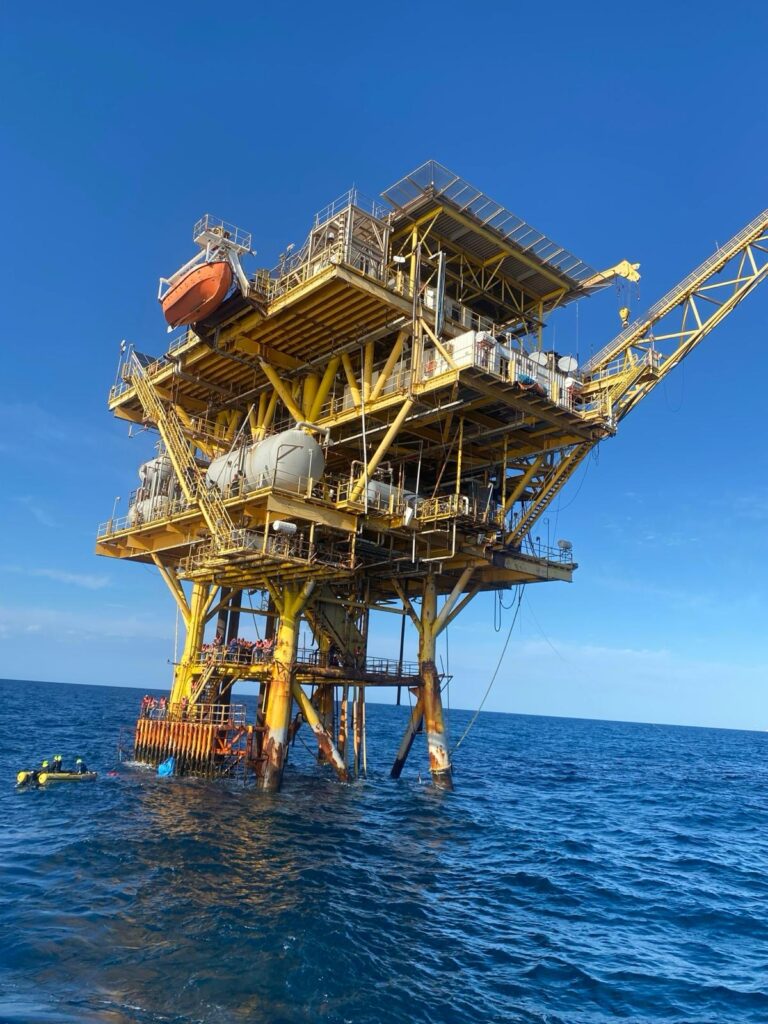
Photo of the Didon platform. Source: https://x.com/seawatch_intl/status/2040120273140072506/photo/1
On 4 April, two merchant vessels rescued 32 people and recovered two bodies. A distress case had been reported by authorities, involving a capsized wooden boat. 105 people had been on that boat, about 71 people likely drowned. Seabird 2 arrived and identified the merchant vessels IEVOLI GREY and SAAVEDRA TIDE near the reported distress location, and both vessels took survivors on board. Radio communications suggest that an unidentified authority, believed to be the Libyan coastguard, had instructed the transfer of survivors between the merchant vessels. Later the Italian Coastguard took them on board and brought them to Lampedusa.
On 5 April, a Frontex drone was forced to ditch at sea after a technical fault. AFM (Armed Forces of Malta) deployed assets to locate and secure the drone. On 14 April, more was reported about this incident, but details remained secret.
On 7 April, IOM reported that nearly 1,000 people had died in the Mediterranean so far in 2026, making it one of the deadliest starts to a year since 2014. Deaths in the Central Mediterranean are up over 150% vs. this time the year before.
On 8 April, an autonomous landing of people on the move in Lampedusa was reported. The boat reached as far as the Favaloro dock.
On 9 April, Alarm Phone was alerted by 55 people in distress at sea near Sicily. The group was adrift and reported water in the boat. Italian authorities told us that an operation was ongoing. One day later, we learned that – after RCC Malta had ignored the distress call for hours – the Italian Coastguard had rescued the boat in critical condition during the night, disembarking the people in Pozzallo, Sicily.
On 11 April, a demonstration took place in Tunis. A powerful crowd filled the streets against racism and fascism, standing with people on the move and African communities targeted by violence.
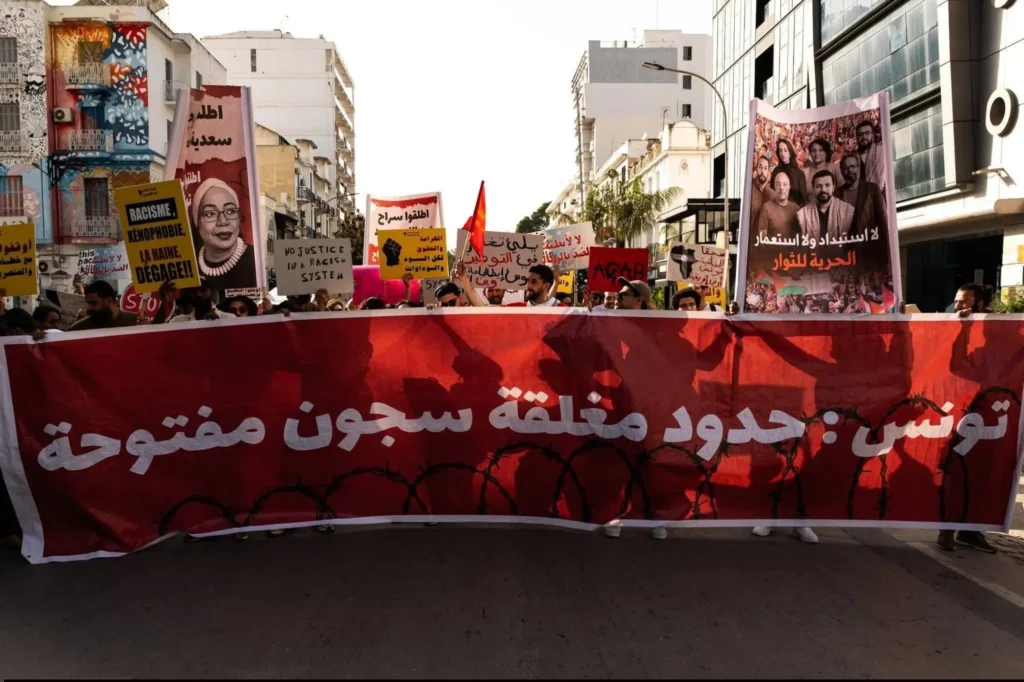
Photo of the demonstration in Tunis. Source: Friends of Alarm Phone
On the same day, Alarm Phone was called by 48 people in distress in the SAR zone of Malta. We alerted RCC Malta twice, but they only responded with silence. We lost contact to the people on the boat. On 13 April, we learned that these people were probably forced back to Libya by Haftar’s militia after a Frontex and a Maltese aircraft had circled over this boat.
On 12 April, media reported that 67 people were disembarked by the Italian Coastguard in Pozzallo, Sicily, during the night. This might be a boat that had alerted Alarm Phone on 11 April from positions between Malta and Sicily.
On 13 April, the rescue ship Aurora was informed by authorities that the ship would be blocked for 45 days because the crew had refused to communicate with the Libyan authorities while rescuing 44 people from the Didon platform.
On the same day, IOM reported that from 5 to 11 April, 708 people on the move were intercepted and returned to Libya. A lot of these interceptions happened between Tobruk and Crete.
On 14 April, the EU military mission IRINI published details on training of militia members from Benghazi. They were “part of the Libyan Navy”, it says, with “no record of human rights violations”. How could they know that they didn’t take part in shootings on NGO or refugee vessels?
On 18 April, Libyan media reported that a migrant’s body washed up on the shore of Tajoura, eastern Tripoli. In the western coastal city of Zuwara, the recovery of migrant bodies had increased dramatically. The Emergency Medicine and Support Center reported that 17 bodies were retrieved from the beaches in just a few days.
On 19 April, a migrant boat capsized off the eastern Libyan city of Tobruk. The Libyan Coast Guard rescued four survivors and recovered six bodies. Search operations for additional survivors continued despite challenging weather conditions.
On the same day, in an act of repression, the treasurer of the Tunisian Forum for Economic and Social Rights (FTDES) was prevented from leaving the country while en route to participate in an event related to the presentation of the People’s Tribunal’s ruling on migration issues. He was served with a summons to appear before the National Unit for the Investigation of Complex Financial Crimes. On the morning of 20 April, the treasurer complied with the summons. He was informed that these measures were part of ongoing investigations targeting the FTDES since April 2025. He answered all questions regarding the Forum’s activities, its sources of funding, and its financial management mechanisms. Finally, he was served with a new summons to appear on 24 April, accompanied by the same documents previously examined by the Research and Anti-Tax Evasion Unit of the General Tax Administration at the Ministry of Finance.
On 21 April, Alarm Phone was alerted by 46 people in distress, south of Crete.The group said they had no food or water and their engine was not working. On the following day, we were informed that the people had been taken on board the merchant vessel CAPE MAYA – heading to Egypt. We hope for their safety but neither Egypt nor Libya are safe for people on the move.
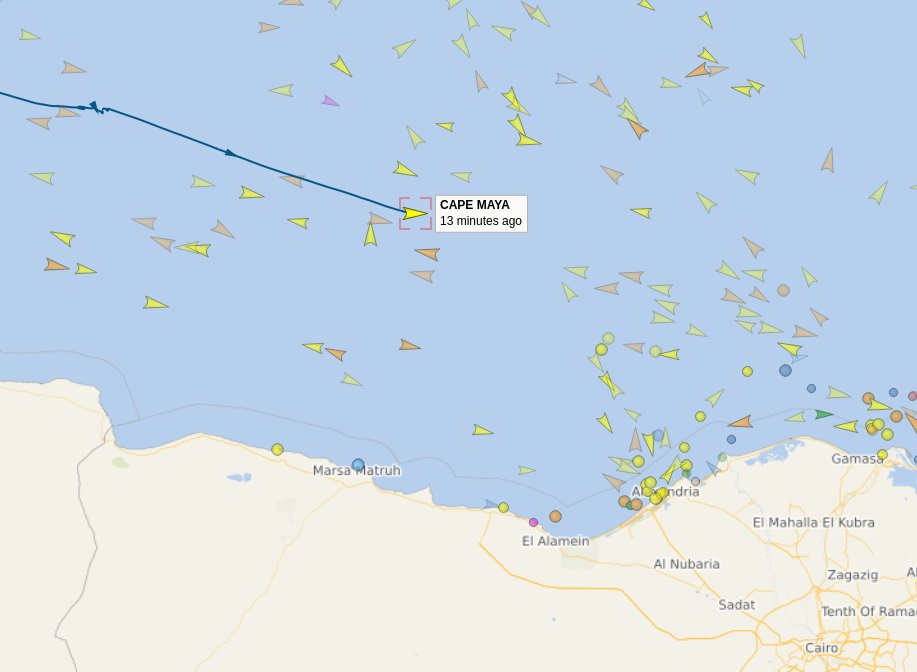
Map showing the track of the merchant vessel. Source: vesselfinder.com
On the same day, the sailing ship Nadir of the NGO Resqship assisted a total of 90 people in distress during three consecutive operations. They first evacuated 47 people from the abandoned Didon platform. While the Nadir’s crew were preparing for the evacuation, a speedboat belonging to the so-called Libyan Coast Guard arrived. In recent months, civilian actors have repeatedly found themselves facing violent confrontation with Libyan militias. Fortunately, the transfer from the oil platform to the Nadir took place safely and without interference. Just a few hours later, the Nadir crew encountered a further 43 people in distress on two unseaworthy boats.
On 22 April, 38 people in urgent distress south of Crete called Alarm Phone. They reported that water was entering the rubber boat through a hole and they feared the boat was sinking. One day later, an officer of the Greek Coastguard told us that everyone of this group was rescued. News articles confirmed a rescue of 38 people by a Liberian flagged tanker. We have not yet heard from the group but believe the information matches. We thank the crew of AMEINON for their efforts!
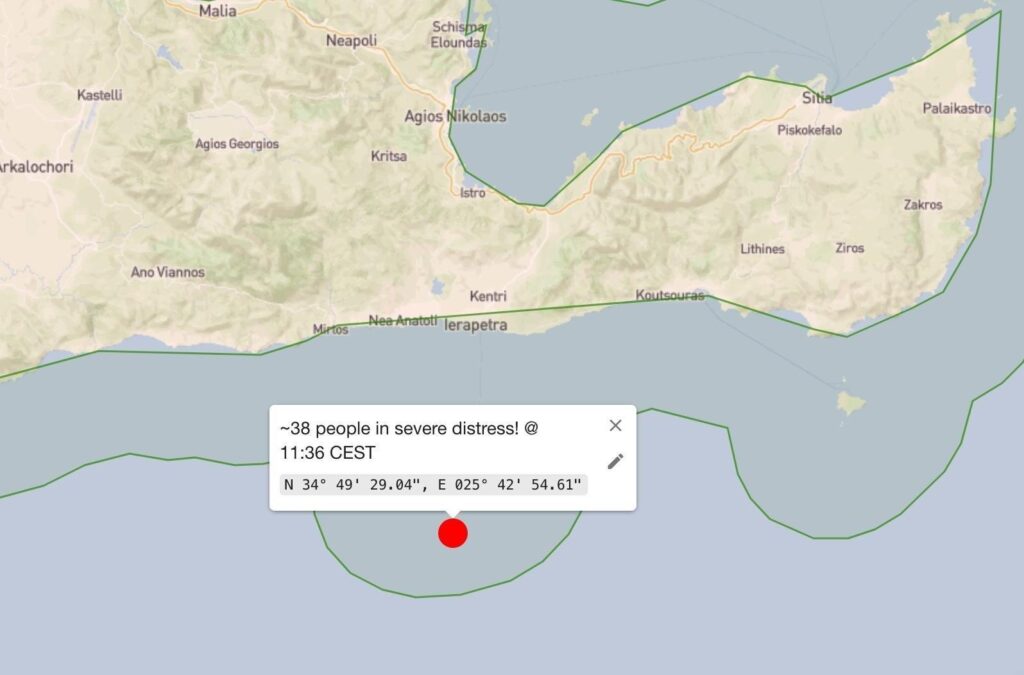
Map showing the position of the boat in distress. Source: Alarm Phone
On 23 April, the Advocate General of the European Court of Justice said that the Italy-Albania protocol was compatible with EU law on return and asylum procedures. The court is examining whether Italy’s migrant detention centers in Albania are legal.
On 25 April, the sailing ship Trotamar III of Compass Collective was detained in Lampedusa after rescuing 18 people. Authorities said that their crew failed to communicate with the Tunisian Coastguard.
On the same day, an official visit of the Greek Foreign Minister Giorgos Gerapetritis to Tripoli was announced to discuss several key issues, especially immigration, regional security, and maritime borders delimitation.
On 26 April, after alerting authorities about a boat 100 km south of Lampedusa, Alarm Phone learned that the group was intercepted by the so called Libyan coastguard and forced back to Libya. We denounced this illegal action in the Maltese search and rescue zone. (map in the link)
On 27 April, Alarm Phone was alerted by 52 people in distress off the coast of Libya. They said they were adrift and reported water coming into the boat. We lost contact to the people. Later we received information that they were taken onboard the supply ship DOENICKE TIDE and then transshipped onto a Libyan patrol vessel, which will bring them to shore. We condemn this illegal interception of people in distress.
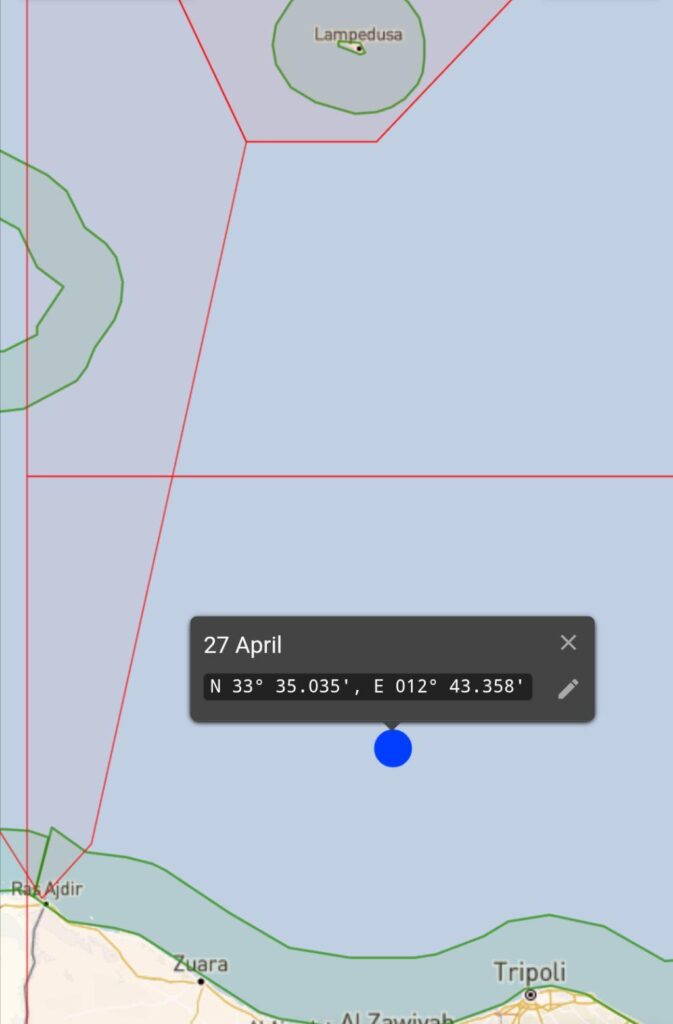
Map showing the position of the boat in distress. Source: Alarm Phone
On the same day, we learned that yet another Tunisian human rights organisation had been suspended for one month. The Human Rights League (LTDH), a 2015 Nobel prize co-winner, is one of the region’s oldest organisations, active during all of Tunisia’s repressive regimes. According to a statement, the League learned of this measure without prior official notification. It considered it an “arbitrary and dangerous” decision, constituting a flagrant violation of freedom of association and a direct attack on the democratic gains for which Tunisians fought.
On 29 April, another shipwreck occurred off Tobruk. Seven survivors were found from a boat of 33 people. They had spent eight days at sea, drifting, fighting hunger and thirst. 18 bodies were recovered. The other eight people remain missing.
On the same day, Alarm Phone was alerted by 60 people in urgent distress off Libya. They were drifting on a boat with a broken engine. One day later, we heard from a relative that the group was intercepted and returned to Libya, the place they had tried to escape from. (map in the link)
On 30 April, we learned that Israeli forces had raided the Global Sumud Flotilla boats near Crete. Seven out of 58 vessels were captured as the flotilla aimed to deliver aid to Gaza against the blockade. Some crew members were kidnapped by Israel in international waters, mayday calls went unanswered.
May
In May, Alarm Phone was alerted to 58 boats in distress in the Central Med, among them 56 departing from Libya, none from Tunisia and for one boat the departure place was unknown. NGO vessels rescued a total of 13 boats that month – not all of them had alerted Alarm Phone. A merchant vessel rescued six people from the abandoned Didon platform and brought them to Italy. The Italian Coastguard rescued at least eight boats – most of them already close to Lampedusa – and they also coordinated some rescue operations of boats heading towards Sicily or Calabria. Not a single boat was rescued to Malta. We know of five boats rescued by the Greek Coastguard, which traveled on the route from eastern Libya to Crete. In total, we know of 12 interceptions by the so-called Libyan Coastguard (but there were probably more) and one by the Tunisian Coastguard. Unfortunately, we rarely receive reliable figures regarding Tunisian interceptions. In seven of our cases, the outcome was unclear and the boat was missing. We know of one shipwreck in the Egyptian SAR zone in May.
On 1 May, the Ocean Viking rescued 25 people from an overcrowded rubber boat in distress with a deflated sponson, just north of the Libyan/Maltese SAR boundary. After three days and four nights at sea without food or water, they were found exhausted, dehydrated, with fuel burns and sunburns. Ancona was assigned as the place of safety, approximately 800 nautic miles away.
On 4 May, a report about the court case against Fabrice Leggeri was published. Leggeri, former executive director of Frontex, is under investigation in France for complicity in crimes against humanity and torture. 2026 is the year when the agency’s mandate will be reviewed. Europe is preparing to grant Frontex even more power.
On 5 May, the activities of Avocats Sans Frontières (ASF) in Tunisia were suspended for 30 days. This constitutes an extremely worrying signal regarding the state of freedom of association and civic space in the country. For more than 15 years, ASF has worked alongside Tunisian stakeholders to strengthen the rule of law, promote access to justice, and defend human rights. Through its work with public institutions, lawyers, and civil society, the organization has supported thousands of people in vulnerable situations. This suspension decision, which ASF considers legally unfounded, comes within a broader context of restrictions targeting Tunisian civil society organizations.
On 6 May, Alarm Phone was alerted by relatives to 40 people in distress south of Crete. We did not reach the group but informed the Greek Coastguard. One day later, we were told on the phone that the Greek Coastguard rescued several boats that could match with this group, and media articles reported the same. We hope they arrived safely.
On 7 May, 270 people on the move arrived in Crete during 24 hours. The Greek Coastguard rescued 142 migrants on three boats overnight, and earlier in the day, another 126 people arrived in two separate boats after leaving Libya. But there were also several interceptions by the so-called Libyan Coastguard on the route from Tobruk.
On the same day, infomigrants reported that the German government raised the security alert level off Libya’s territorial waters. German authorities cited the “persistent threat to civilian shipping” across and beyond Libya’s territorial sea. Officials said Libya’s maritime environment remains ”highly volatile” because large parts of the country lack effective state control, including oversight of coastal and offshore waters. Authorities emphasized that humanitarian and NGO-operated rescue vessels entering Libya’s SAR zone face particularly elevated risks. Humanitarian organizations sharply criticized Germany’s heightened maritime security measures, saying that authorities have ignored years of documented violence by the Libyan Coastguard. The groups also criticized the European Union for continuing to finance and cooperate with Libyan maritime authorities despite acknowledging the risks they pose.
On 8 May, again several Libyan interceptions were reported, two boats on the route from Tobruk to Crete and one in the Maltese rescue zone, where Seabird spotted an empty boat after a Frontex plane was circling above.
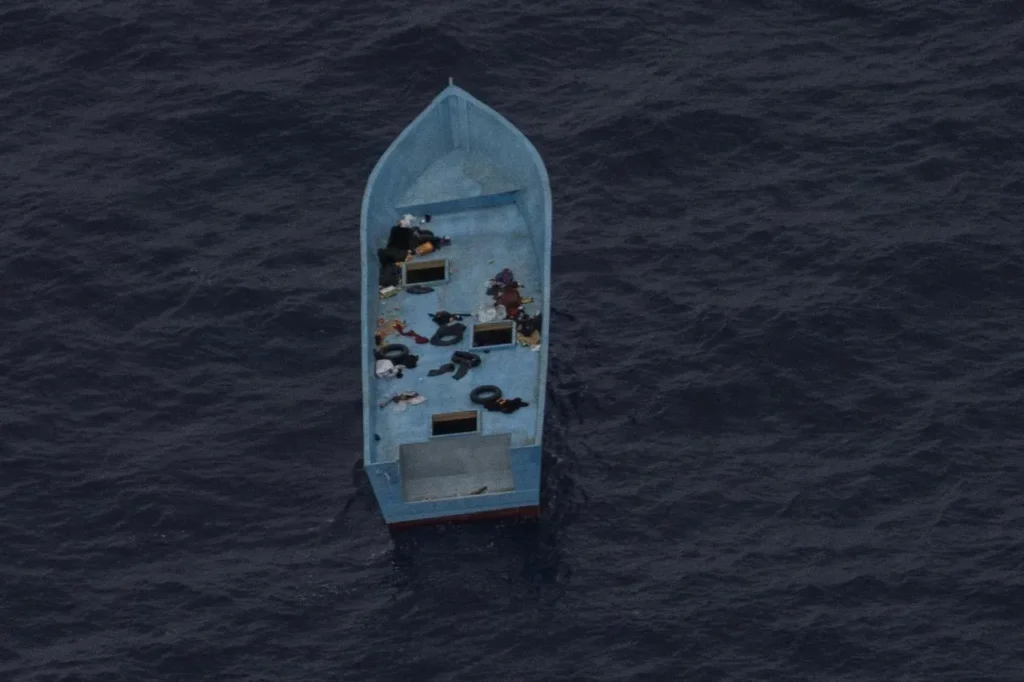
Empty boat spotted by Seabird. Source: https://bsky.app/profile/en.sea-watch.org/post/3mldo62h5ba23
On 10 May, Seabird spotted several boats in distress. One boat was forcefully abducted by Libyan militias, two boats were still at sea in high waves.
On 11 May, the Sea-Watch 5 was being shot at by the EU-funded so-called Libyan Coastguard. The crew just finished rescuing 90 people, but Libyan militias were still following them. They expressed the intent to abduct them to Libya! As Sea-Watch 5 sails under German flag, they demanded immediate action from German diplomats and the Bundestag (German government).
On the same day, Alarm Phone was called by 75 people in distress and alerted authorities. The merchant vessel KILBURN that could have rescued the people left, following orders by RCC Malta. We spoke to the captain of the merchant vessel, who confirmed that they had returned to the boat in distress and would keep monitoring the situation over night. The next morning, the OceanViking rescued the people. They reportedly spent five days and four nights at sea. Some of them suffered severe dehydration. Another two boats were rescued by the NGOs Sea-Eye and Solidaire and Seabird saw a violent interception by Libyan militias.
On 12 May, the Greek Coastguard rescued 38 people who had alerted Alarm Phone one day earlier. They were taken to Crete. We did not reach the group again to confirm, but in our last call on 11 May afternoon, they reported that they saw vessels coming towards them.
On 13 May, the Ocean Viking rescued 56 people from an overcrowded white fiberglass boat in distress in the Libyan SAR zone. One person was found not breathing and taken on board,where their medical team provided emergency medical care. Sadly, a short time later he was declared dead.
On 14 May, Egyptian authorities recovered 17 bodies from a rubber boat found near Sidi Barrani. The victims (mainly of Egyptian nationality) perished at sea during an attempted boat crossing to Greece. The boat reportedly departed from eastern Libya.
On 16 May, Italy opened a criminal investigation against the captain of the Sea-Watch 5 with the accusation of “aiding and abetting unauthorized immigration”. The Sea-Watch 5 had entered the port of Brindisi with 166 rescued people on board. The investigation represents an absurd escalation: Days earlier, a patrol boat of the so-called Libyan coastguard had opened fire on the crew and survivors and threatened to hijack the vessel. The last time a criminal investigation was launched against a civil rescue vessel in Italy was in 2020.
On 18 May, the Global Sumid flotilla was intercepted in Greek SAR by military vessels and Israeli forces borded the first boat in broad daylight. They were on a non-violent, humanitarian mission to Gaza and in international waters. Alarm Phone urged Cyprus and Greece authorities to protect the civilians according to international and maritime law and prevent this unlawful attack. On 20 May, activists reported being subjected to violent abuse after being illegally abducted at sea while attempting to break the siege on Gaza.
On 19 May, the pre-trial of El Hishri started at the ICC (International Criminal Court) in The Hague. El Hishri is one of the people responsible for torture and other crimes against humanity in the Mitiga prison in Tripoli, Libya. But Frontex belongs in the dock as well: for EU-complicity in the ongoing violence against people on the move. “El Hishri at the ICC – EU must stop Complicity!” That was the slogan in The Hague during the vigil by Refugees in Libya, together with members of Alarm Phone, Mediterranea and other associations. Strong testimonies of survivors could be heard in the court room.
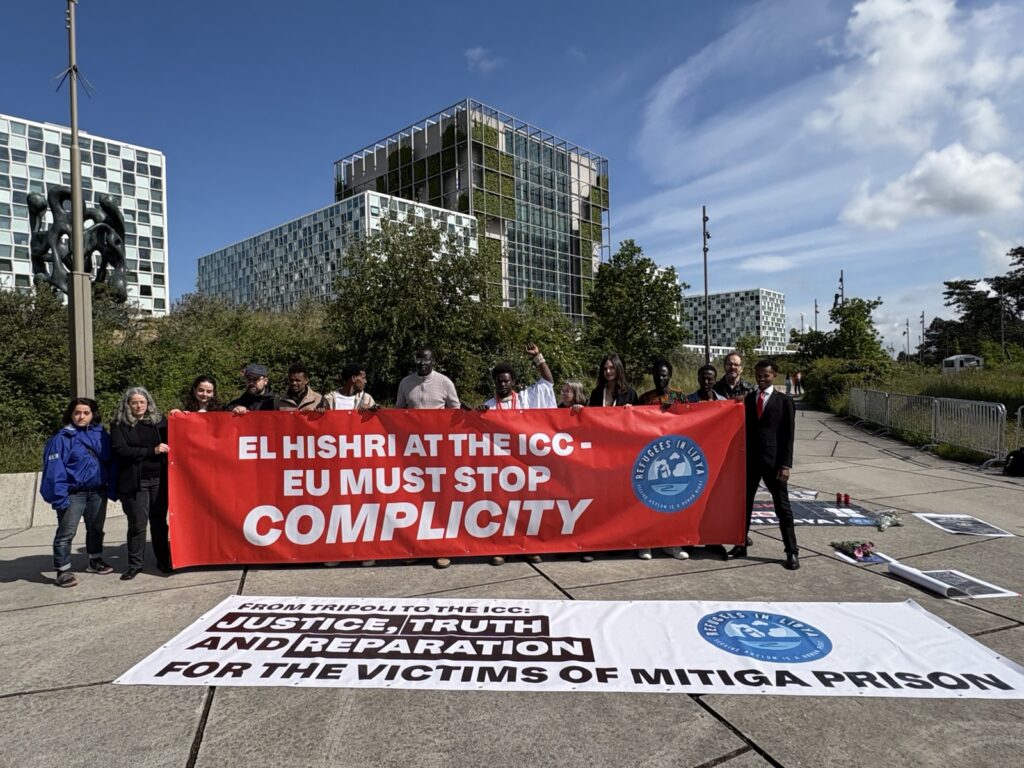
Photo of the manifestation in front of the ICC. Source: Refugees in Libya
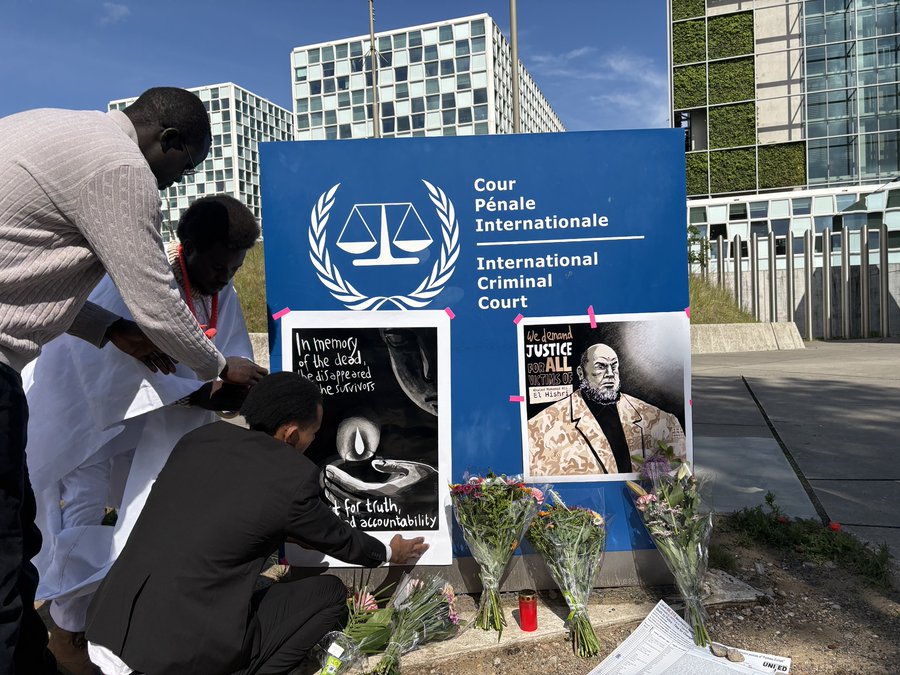
Photo of the manifestation in front of the ICC. Source: Refugees in Libya
On 20 May, the EU signed a deal with Libyan warlord Haftar for its Naval mission IRINI. A document leaked to Statewatch confirmed that the EU has begun collaborating with Libya’s eastern forces on migration control. This collaboration includes training, support and the development of a regional migration coordination centre based in Benghazi.
On the same day, it was published that a camp dedicated to „voluntary return“ had been opened in Amra near Sfax, managed by the Tunisian Ministry of the Interior and the Red Crescent. They have facilitated the return of 4,000 migrants since July 2025.
On 21 May, the Court of Chieti in Italy annulled the 20-day administrative detention imposed on the Ocean Viking in November 2023, together with the related fine and all associated sanctioning measures. The case relates to a rescue operation conducted on 11 November 2023 in the Libyan SAR, during which the Ocean Viking rescued 34 people from a boat in distress after repeated unsuccessful attempts to obtain effective coordination from the Libyan maritime authorities. In its first instance decision, the Court clearly confirmed that the Ocean Viking’s rescue operation was lawful, and that the captain “was faced with the necessity to intervene without delay” to protect human life. It also underscored the absence of effective coordination by the Libyan authorities, recognizing that the Ocean Viking was “the only vessel to intervene” to fulfill the duty to rescue at sea. The judgment also reaffirmed that international maritime obligations under the UNCLOS, SOLAS and SAR Conventions prevail when human lives are at risk, and that sanctions cannot be imposed where state coordination is absent or inadequate.
On 22 May, Alarm Phone could re-establish contact to five people on the abandoned Didon platform who had alerted us one day earlier and said they needed urgent medical care. We learned that the actually six people were rescued by the ASSO VENTICINQUE. MRCC Rome, who was coordinating the operation, confirmed it ordered the merchant vessel to take them to Italy.
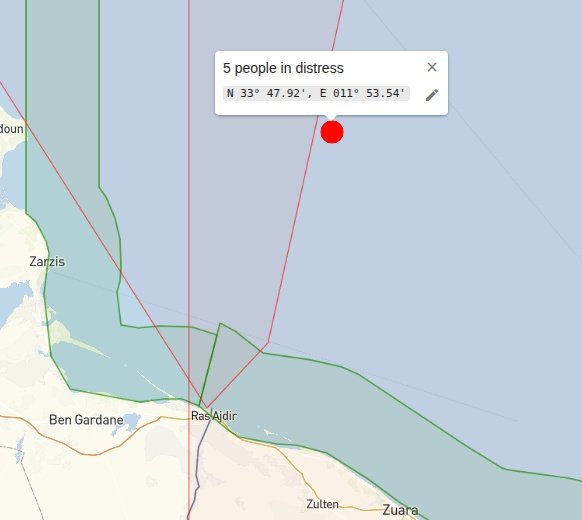
Map of the position of the boat before they stranded on the Didon platform. Source: Alarm Phone
On 23 May, Alarm Phone alerted authorities to 45 people in distress who had fled Libya. We lost contact to the people, but hope they were among those rescued during the night by the Italian Coast Guard and brought to Lampedusa.
On 26 May, the so-called Libyan Coastguard intercepted two boats north of Benghazi and transfered them to detention. One boat carrying 35 people was already 200 nautic miles north-west of Benghazi. The other 38 people had just left from the coast.
On 28 May, Alarm Phone was alerted to a total of four boats travelling from East Libya towards Crete. We were in contact with one of the groups, but could not reach the others. We informed the Greek Coastguard who said they were busy handling the requests. We highlighted the severe distress of one group whose boat was taking on water. The 35 passengers told us that one side of the inflatable boat had collapsed. We learned that another group of 34 people was intercepted by Libyan forces and returned to the place they had tried to escape from.
On the same day, heavy street fighting was reported from Zawiya, West Libya, as rival militias engaged in intense combat following a targeted killing. Tensions reached a breaking point when a member of one local militia was killed by a rival faction. The incident quickly triggered a retaliatory offensive, with the victim’s group mobilizing to seek immediate revenge.
On 29 May, we were informed about four boats with a total of 187 people near Crete and Gavdos, Greece. The groups who fled Libya reported serious distress. We alerted authorities, but we did not get information if these boats were rescued. We know about several Libyan interceptions on this route on 29 May.
On the same day, it was reported that the European Court of Human Rights (ECHR) had received the first two appeals against Italy from two migrants living in Italy who say their human rights were violated because they were the victims of torture by Osama Almasri Njeem, a Libyan general against whom Italy failed to apply an International Criminal Court (ICC) arrest warrant for alleged crimes against humanity last year. After a preliminary examination of the appeals from an Ivorian woman and a Sudanese man who say Almasri tortured them at his migrant detention centre in Tripoli, the court sent them to the Italian government with a series of questions, in order to understand if the case are admissible and to decide if Rome breached their rights.
On 31 May, we learned of a Libyan interception of 38 people 170 nautic miles northwest of Benghazi and another interception of 38 people 120 nautic miles of Sirte.
June
In June, Alarm Phone was alerted to 54 boats in distress in the Central Med, among them 53 departing from Libya, none from Tunisia and for one boat the departure place was unknown. NGO vessels rescued a total of 14 boats that month – not all of them had alerted Alarm Phone. Two boats were assisted by merchant vessels, but then pushed back, one to Egypt and one to Libya. The Italian Coastguard rescued at least three boats to Sicily, and others to Lampedusa that were probably not far from the island already. Not a single boat was rescued to Malta. We know of some boats probably rescued by the Greek Coastguard on the route from eastern Libya to Crete, but did not get numbers. In total, we know of 24 interceptions by the so-called Libyan Coastguard and two by the Tunisian Coastguard. Unfortunately, we rarely receive reliable figures regarding Tunisian interceptions. In seven of our cases, the outcome was unclear and the boat was missing. We learned of one shipwreck in June.
On 3 June, the so-called Libyan Coastguard intercepted several boats on the route from the east of Libya to Crete: 80 people off the coast of Tobruk, 68 people off Bardia, 43 people off Kambut and 39 people off Ras Azaz. All were transferred to detention in or near Tobruk.
On the same day, coordinated hunting operations against refugees and migrants with dark skin escalated in Tripoli. Entire homes and areas of the city were being cleared.
On 4 June, Libyan protesters shut down the UNHCR office in Tripoli over migration issues. As they were blocking the office with sand barriers, raids and chases continued across the city. Propaganda turned people on the move into monsters. Libya Crime Watch (LCW) monitored with grave concern this escalation of serious violations, hate speech, and incitement to violence against people on the move and foreign workers in Libya. Also the headquarters of the UN Support Mission in Libya (UNSMIL) were targeted by demonstrators affiliated with the anti-migrants-resettlement movement. Two days after these incidents, Foreign Minister Al-Baour reiterated the Tripoli government’s rejection of any migrant resettlement programme.
On 5 June, Tunisian civil society organisations and political parties published a statement against the escalation of racism, hate speech, attacks and discrimination in Tunisia, targeting migrants and people from sub-Saharan Africa as well as Black Tunisians, along with the accompanying systematic impunity and the explicit complicity of state institutions.
Between 4 and 6 June, Alarm Phone was alerted to several boats on the route from east Libya to Crete: 38 people were out of fuel in the Greek SAR zone, but the Greek Coastguard only said they were „investigating“. We lost contact to another 36 people south of Crete and do not know if they arrived. Also for two other boats carrying 42 and 36 people we do not know the outcome.
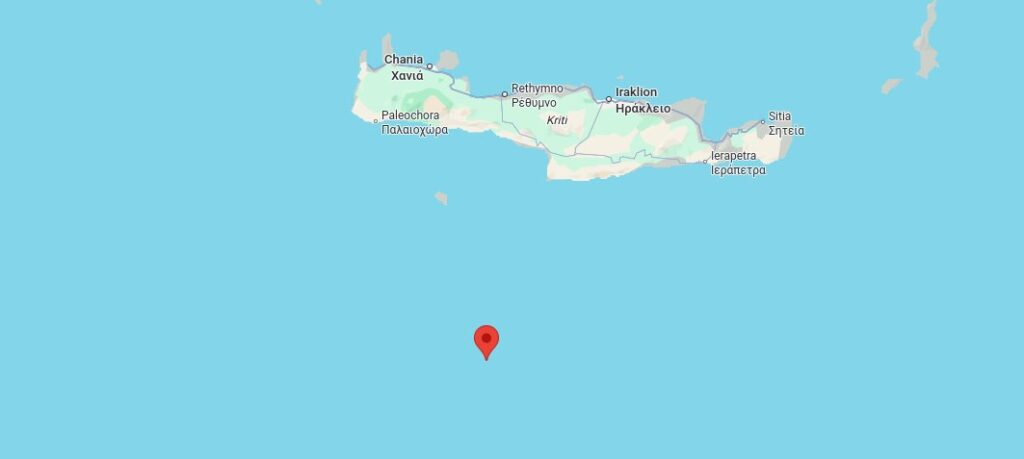
Position of the last boat (36 people). Source: Alarm Phone
On 7 June, a shipwreck off Malta was reported. 53 people were rescued by a fishing vessel. However, at least 11 people died at sea after they fell overboard while attempting to reach the assisting fishing vessel. The dead bodies were recovered by an Italian coastguard vessel that was dispatched to the area. The boat, which had departed from the Libyan coast, was sailing with approximately 60 people on board.
On 9 June, consular representatives of Ghana paid a visit to DCIM East Tripoli Immigration Detention in Tajoura to register detained Ghanaian nationals who are scheduled for repatriation.
On 10 June, the Nadir crew evacuated 51 people from a rubber boat that had set sail from Libya the previous day – including 15 children and minors, 8 women, and 38 men. Many suffered from chemical burns caused by the corrosive fuel-saltwater mixture; some women and girls showed marks of gender-based violence, including torture. The Nadir brought them to Lampedusa.
On 11 June, Alarm Phone learned from JRCC Cairo that the group of about 40 people adrift south of Crete who had alerted us two days earlier, was assisted by the crew of the merchant vessel SOUNION but taken to Port Said, Egypt. We had not heard from the group again. We remain without information about the eight people who reportedly went over board.
On 12 June, the Common European Asylum System (CEAS) came into effect: more detentions, data collection and deportations. The violent and racist border policies of the EU kill thousands of people every year. This European Pact on Migration and Asylum strengthens cooperation with countries responsible for detaining migrants before they reach Europe. In Egypt, where round-ups and deportations of Sudanese refugees are on the rise, the human cost of this policy is already evident. A group of activists travelled to Gjadër, home to the Italian-run detention centers in Albania, a model that has served as a testing ground for the EU’s new asylum rules.
On 13 June, Alarm Phone Sahara (APS) published a report about the last wave of arrests against people on the move in Libya.
On 14 June, we commemorated the Pylos shipwreck in 2023: In the early morning of June 14, the Adriana, on the way from Libya to Italy, sank near Pylos, Greece. Over 600 people lost their lives under the eyes of the Greek Coastguard.
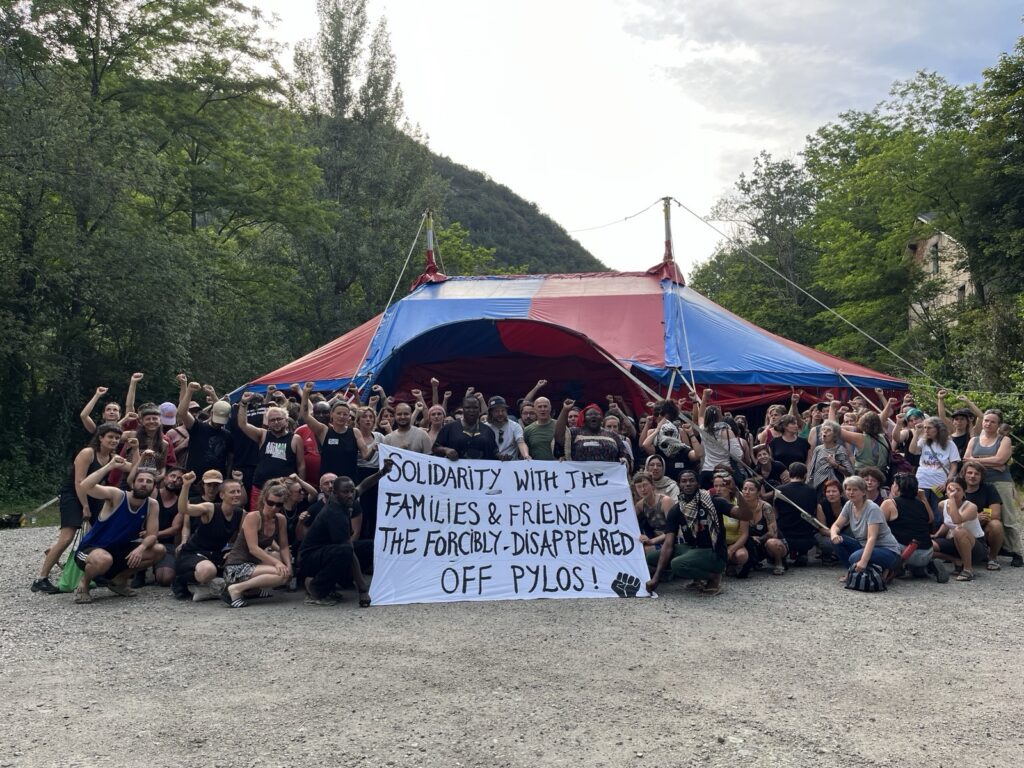
Commemoraction of the Pylos shipwreck. Source: Alarm Phone
On 16 June, the Aurora 2 rescued 40 people from a rubber boat in distress and brought them to Lampedusa.
On the same day, Alarm Phone alerted authorities to a boat carrying 30 people that was adrift 50km off the coast of Tobruk. Water was entering and they could not move anymore. Only one day later, we learned that the people were intercepted by the so-called Libyan Coast Guard.
On 17 June, it was reported on social media that 15 dead bodies had been washed ashore in Al-Khums, east of Tripoli. During the days before, dead bodies were found almost daily on the Libyan coast.
On the same day, media reported that flights from Tunisia carrying migrants returning ‘voluntarily’ were being chartered ‘almost every day’, according to the authorities.
On 18 June, Members of the European Parliament approved a text that facilitates deportations, speeds up procedures, and paves the way for the creation of detention centers in countries outside the borders of the European Union. Among them, Tunisia occupies a central place. For several years, the regime of Kaïs Saïed has gradually transformed itself into a subcontractor of European migration policies. Presented as “strategic partnerships,” the agreements signed with Brussels have primarily made Tunisia an advanced border guard for Europe. In exchange for funding, promises of economic aid and diplomatic recognition, Tunis blocks departures, hunts down sub-Saharan migrants, accepts expulsions and participates in the logic of closure desired by European capitals.
On 19 June, Alarm Phone alerted authorities about a group of 27 people on a rubber boat off Zuwara, Libya. The people reported they were adrift and water was entering the boat. After the Frontex plane Eagle 1 had orbited extensively above the boat in the morning, we could never again reach the group. We assume the people were returned to Libya and fear for their well-being.
On the same day, 59 people were rescued 60 nautical miles off Sicily by the Italian Coastguard and disembarked in Pozzallo.
On 20 June, we learned that a potential maritime disaster was narrowly avoided one day earlier when a small boat carrying 15 migrants capsized off the coast of Khoms. The vessel overturned in the Mediterranean waters, leaving all aboard in distress. Prompt intervention by local fishermen and the so-called Libyan Coastguard prevented any loss of live.
On 22 June, a Tripoli-based court sentenced Almasri, the former commander of the Mitiga prison in Libya, to seven years and four months in prison for “violating detainees’ rights.” Italy had released him from prison, repatriated him to Libya and avoided the International Criminal Court’s arrest warrant.
On 23 June, 42 people in distress in Maltese SAR zone were forcibly returned to Libya. They had alerted Alarm Phone because their engine was broken. They reported people over board and seeing a plane and two boats. The civil plane Seabird spotted this boat together with the so-called Libyan Coastguard on scene, who illegally forced them back to Libya.
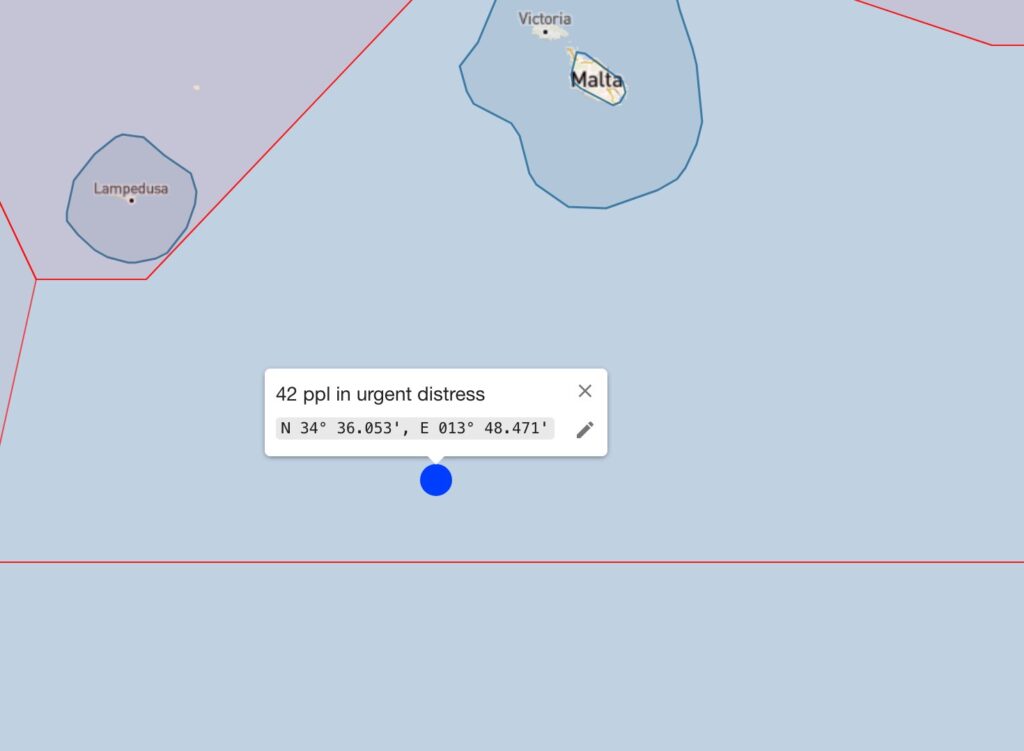
Map showing the position of the boat in distress. Source: Alarm Phone
On the same day, Amnesty International published a report on rival Libyan authorities escalating a racist crackdown involving thousands of arrests, arbitrary detention and collective expulsions of refugees and migrants. According to the report, xenophobic rhetoric from officials is fueling abuses and rising anti-migrant protests. The EU is seeking to deepen migration cooperation with these actors despite a record of grave abuses. It was also reported that the Libyan eastern Government had issued a new decision prohibiting the entry of nationals from Sudan, Eritrea, Ethiopia, and Somalia through all land, sea, and air border crossings. Libya Crimes Watch (LCW) expressed its concern over this decision and published a joint report on the cost of EU-Libya migration cooperation.
On 24 June, Tunisian organisations, associations and political parties published a statement in solidarity with the activist Saadia Mosbah of the association Mnemty who stands with migrants from sub-Saharan Africa at a pivotal moment in Tunisia’s history . The Court of Appeal upheld the 8-year prison sentence against her. At a time when racist violence and hate speech are rising,Tunisia is punishing one of the voices who dared to fight racism.
On 26 June, Amnesty International denounced the 25-year-prison term for the prominent Tunisian human rights defender Sihem Bensedrine as an outrageous injustice. She was convicted on bogus charges in connection with her work as the President of the Truth and Dignity Commission (IVD).
On 27 June, Alarm Phone was alerted by a group of about 50-60 people heading from eastern Libya towards Crete. They reported that their engine was not working and the boat was taking in water. We alerted authorities and observed that the merchant vessel BULL had changed its course towards the boat in distress. The people on the boat could see the vessel and had hope they would be rescued. But 12 hours after alerting authorities, there was still no rescue in sight. The BULL was instructed to only monitor the group, while the so called Libyan Coastguard was ignoring the distress. Eventually, the so-called Libyan Coast Guard intercepted 49 people with the ship BULL monitoring the situation. According to them one body was found; at least one person is missing. We do not know what happened to the survivors afterwards.
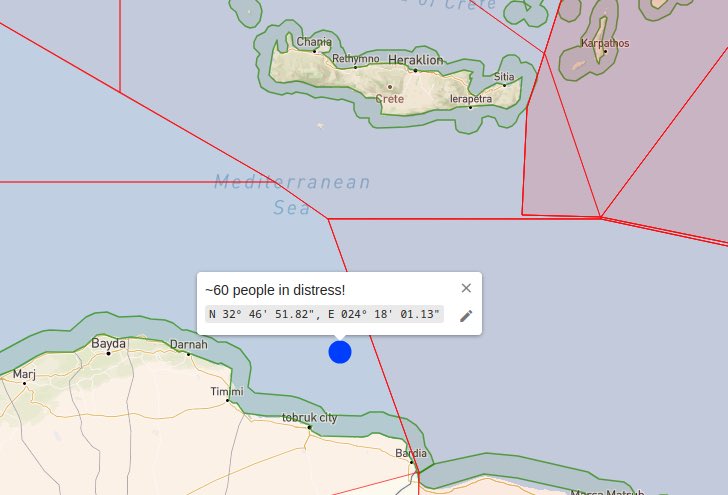
Map showing the position of the boat in distress. Source: Alarm Phone
On the same day, 86 people were disembarked in Pozzallo after rescue by the Italian Coastguard. It was probably a boat that had alerted Alarm Phone in distress near Sicily.
On 28 June, 50 people were intercepted 91 nautical miles north-east of Tobruk and forced back to Libya.
On 30 June, an Italian MEP questioned whether the Italian government was trying to “hide the truth” about conditions at an offshore migrant detention centre in Albania after a delegation she was part of said they were prevented from conducting a full inspection. Cristina Guarda, from Italy’s Greens and Left Alliance (AVS), said staff at the Italian-run facility in Gjadër had refused to give MEPs from the Greens/EFA group key information, such as how many people were being held at the centre, and that they had not been allowed to access their cells.

