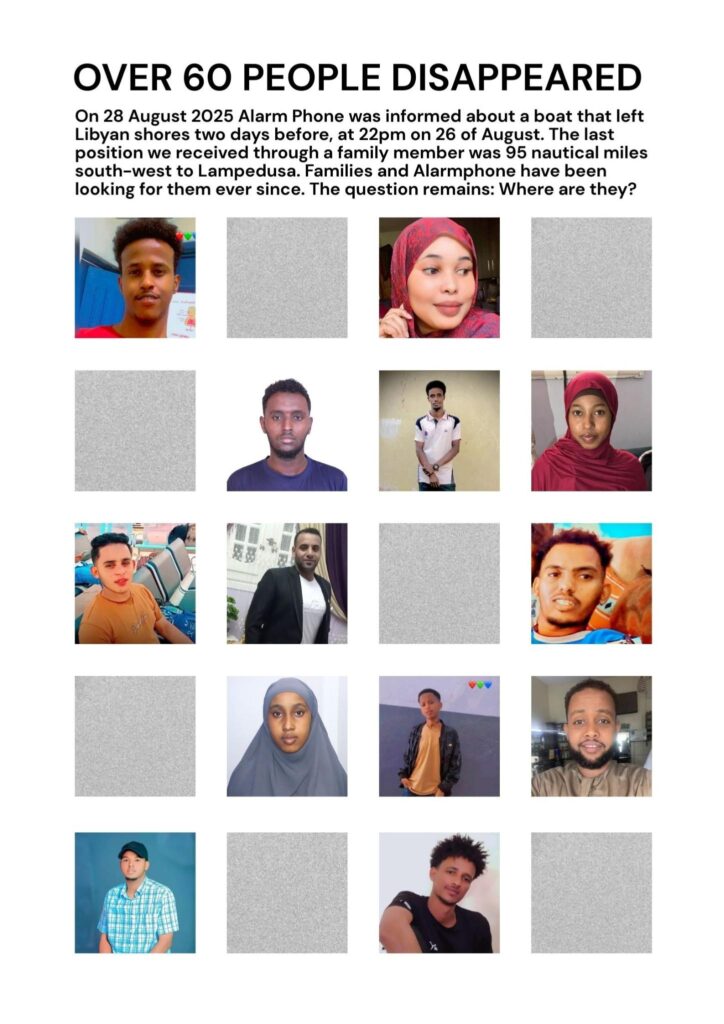
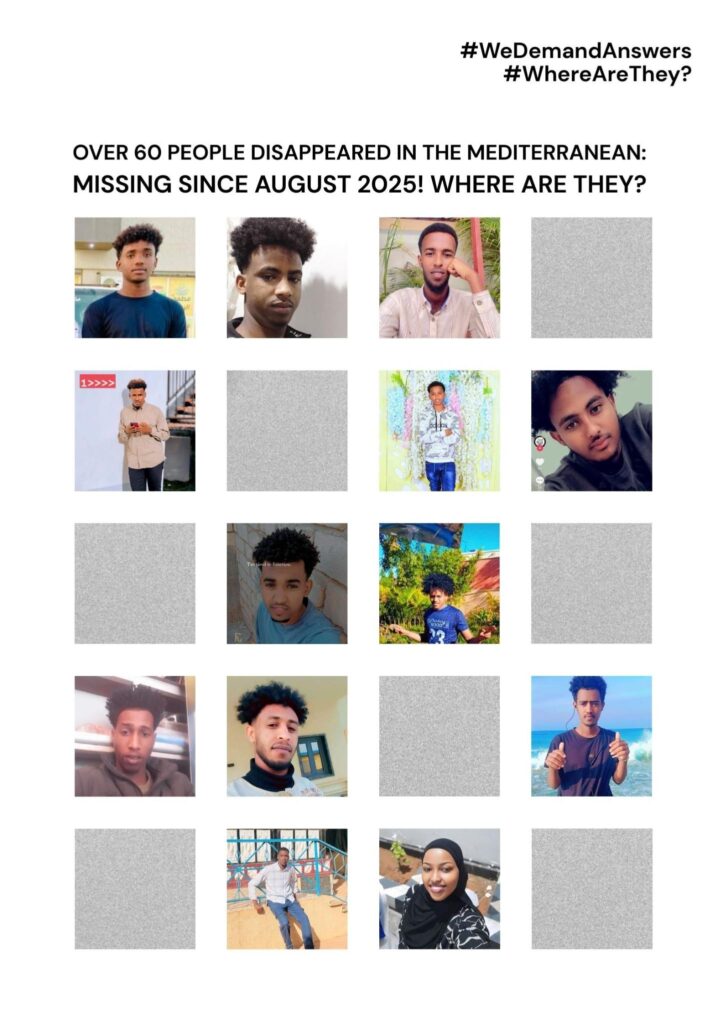
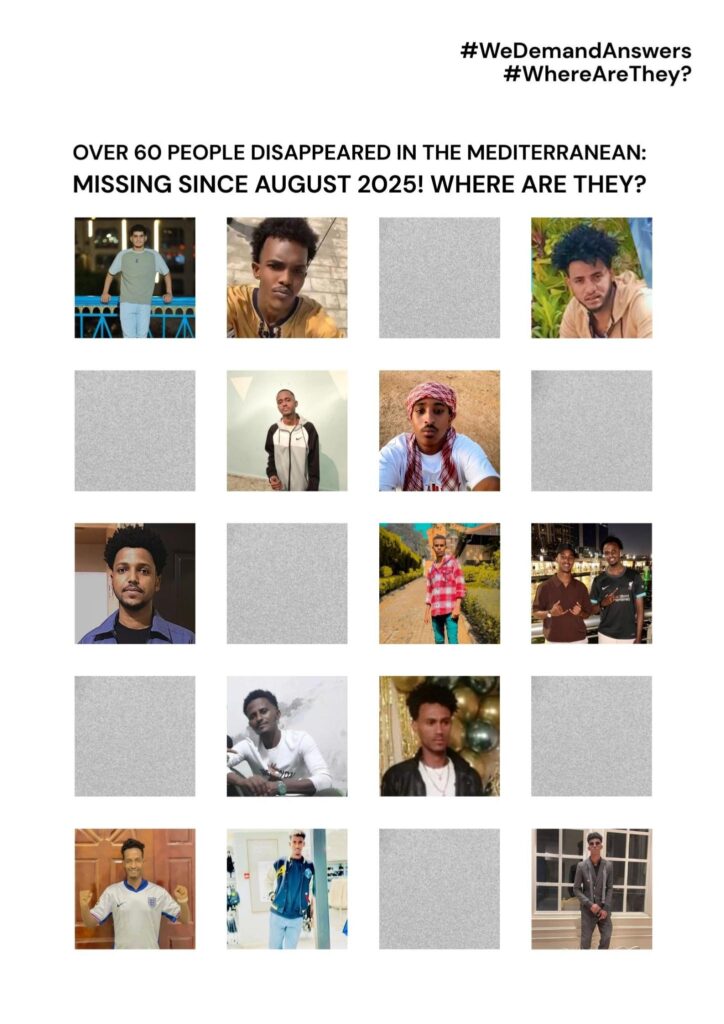
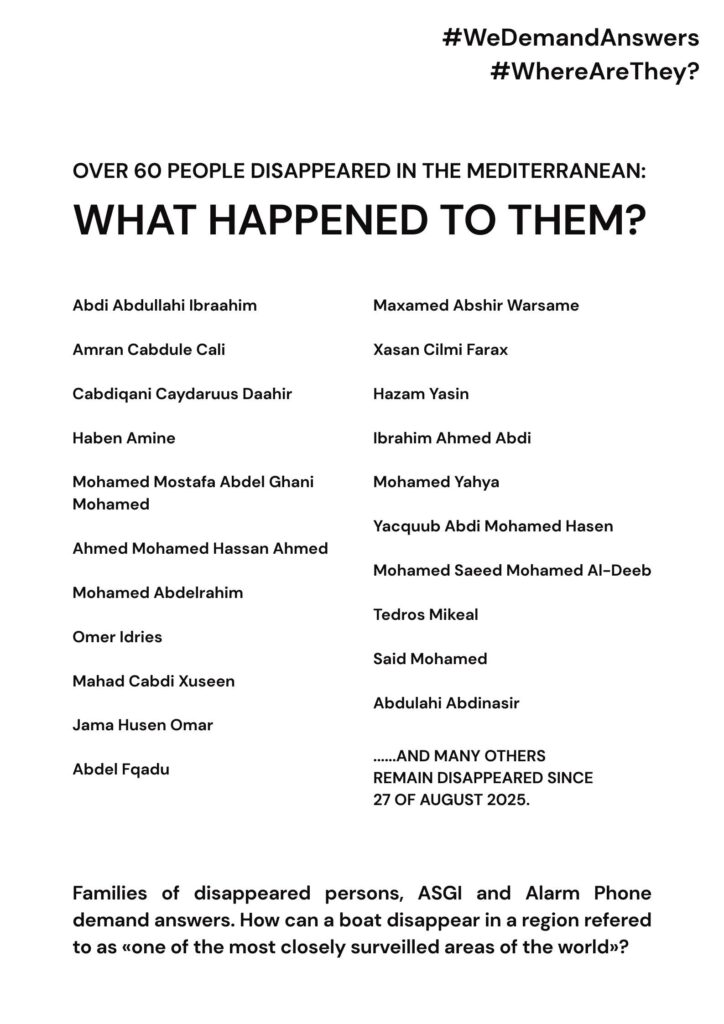
Families of the disappeared, ASGI Medea and Alarm Phone provide an update on the search for truth and accountability.
A year after the boat that left Zuwara on 26 August 2025 lost contact in the Central Mediterranean, the families of the more than 70 people who were on board still have no news of what happened to their loved ones. The uncertainty continues to weigh on families who, day after day, are left without answers.
My sister and I hold the hope deep in our hearts that one day we will be reunited. Even though we cannot see each other today, we firmly believe that one day we will all meet again, God willing. Our hearts are full of hope that we will see our family and loved ones again. Even though we cannot see each other today, we do not lose hope. We hope that they are safe and well. Life thrives on hope. That is why we believe that one day we will see our family and all the people we love again – God willing.
In the attempt to find out what happened, families filed two separate requests for access to documents for defence purposes with the competent Italian authorities — in particular the Italian Maritime Rescue Coordination Centre (MRCC) — in February and May 2026. Both requests sought information on the operations carried out by the Italian authorities following receipt of the distress signal from the vessel.
Both requests were denied on the ground that the documents concern the planning, programming, conduct and analysis of operational activities and that disclosure could potentially harm national security and international relations.
The families, with the support of ASGI Medea, have appealed the second refusal. On 7 of October, the case is scheduled to be tried in court. Among the grounds of appeal, for the first time in a case of this kind, the legal interest to be protected was framed as the right to truth — that is, the right of the families of missing and disappeared migrants to know the fate of their relatives and the circumstances that led to their disappearance
The right to truth is enshrined in international humanitarian law, notably Article 32 of the 1949 Geneva Conventions’ Additional Protocol, which recognizes families’ right to know the fate of missing relatives.
The Inter-American Court of Human Rights significantly expanded this right through its case law on enforced disappearances in Latin America (Barrios Altos v. Peru, 2001), later grounding it in Articles 1, 8, 13 and 25 of the American Convention on Human Rights and affirming both its collective and autonomous nature, particularly regarding states’ duty to investigate (González et al. v. Mexico, 2009).
The European Court of Human Rights has similarly recognized this right in cases on extraordinary renditions, ruling that the truth about serious human rights violations belongs not only to victims and families, but also to other affected individuals and the public at large (Abu Zubaydah v. Lithuania and Al Nashiri v. Romania, both 2018).
In Italy, the right to truth has been recognized in the context of several damages proceedings, including one concerning the Ustica air disaster, as the right of family members to know the truth and to have effective investigations carried out.
In Contrast to that, the Italian state denied to even say if they have any relevant information about this boat. The argument that search and rescue operations fall under military law in itself reveals the ongoing militarization of Europe’s external borders and the perception of Black people of color as threats, instead of recognizing their right to seek safety.
The families still demand to know what happened to their loved ones. The dragging on of the court cases for that many months holds the families in a limbo between hoping to get news one day and having to cope with the fact that their loved ones are still disappeared.
I am a mother who has been carrying the pain of her missing son, Ayuub, for a very long time. My son is missing, and I continue to live between grief, uncertainty, and hope. I still have no clear answer about where he is or what happened to him.As a mother, every day I feel a deep emptiness in my life. I remember my son, his voice, his face, and the last time I knew where he was. One question continues to break my heart:
Where is Ayuub? What happened to my son?
With respect and from the bottom of my heart, I ask the Italian authorities and everyone who may have information about my son and the other missing people to help us find the answers we have been waiting for so long.
Please do not leave us without answers. Families have the right to know what happened to their loved ones. If there are records, information, or evidence concerning the missing people, we ask that they be seriously investigated and that the truth be shared with the families.
I am not asking for anything unreasonable. I am a mother who simply wants to know what happened to her son. If Ayuub is still alive, I want to know where he is and hope that one day I can see him again. If, God forbid, he has died, I still deserve to know the truth and where he ended up.
I hope that the legal proceedings and the upcoming court hearing will help bring the truth to light. I hope that this process will finally give the families the answers they have been waiting for and help ease some of the pain and uncertainty we have carried for so long.
Ayuub is my son. I am still waiting for him, and I still have hope. As a mother, it is impossible to accept his absence without knowing what happened to him.
A mother is still waiting.
A mother still has hope.
A mother simply wants to know the truth about her son.
How is it possible to disappear in the Central Mediterranean — one of the most closely monitored and surveilled areas in the world — especially after a distress signal was received? How is it possible that, as Judith Butler writes, some lives are not even recognised as “lives” in public discourse, and their loss therefore does not generate collective mourning (Judith Butler, Frames of War: When Is Life Grievable?, Verso, 2009)? Families have the right to know the truth about the fate of their relatives, and authorities have a corresponding duty to provide it.
My brother is missing, and our sadness and worry are very great. My heart and my feelings tell me that my brother is still alive. I hope that one day we will hear him speak again and see him once more.
We want answers.