Source : Alarm Phone
1. Introduction
The title of this regional report echoes a slogan we often chant during our meetings within the Alarm Phone network: “Visas for everyone, or visas for no one! For all migrants worldwide! RESISTENCIA!”. “For everyone or for no one” evokes the principle of equal rights, yet what the visa regime produces is precisely a differentiated and racist approach to freedom of movement.
Most of the time, our activist work leads us to denounce the border regime in its most violent manifestations: the thousands of deaths and disappearances, militarisation, repression, criminalisation, etc. See our previous report which analysed the technologies used to prevent free movement of people. Yet racism, discrimination, humiliation and exploitation begin long before one physically crosses the border: it can happen at the door of a consulate, when faced with a pile of documents, or in an email with the subject line: VISA REFUSAL. Administrative violence is another reality of borders. For this reason we have decided to review the visa regime and its history for this regional analysis, which covers the period from September to December 2025.
The passport: the primary tool of border control
The very first obstacle to freedom of movement is the requirement to have a passport. Thus, before addressing the specific issue of visas and their history, it is worth revisiting the history of the passport and the concept of nationality it embodies.
In her book Indian Migration and Empire: A Colonial Genealogy of the Modern State, researcher Radhika Mongia explains:
“ […] the passport as not merely a necessary document for international travel but also one that facilitates such movement, its history reveals that it is born out of an attempt to restrict movement along national lines that are explicitly raced.“
For this researcher
“ […] the history of the modern passport is a history of twentieth-century racism and a history of naturalizing the territorial boundedness of a national space as self-evidently the legitimate abode of certain people.“
So, the modern passport is, after all, a document
“ that has effectively naturalized the ‘‘rule of colonial difference’’ in what one might call the ‘‘rule of postcolonial difference,’’ where the marker of difference is not ‘‘race,’’ but the ‘‘universal’’ category of ‘‘nationality.’’It is therefore no surprise that today different ‘‘nationalities’’ have differential access to mobility.“
Since the establishment of the passport system, this differential access to mobility manifests itself in the requirement, depending on one’s nationality, to hold a visa in order to enter another country legally. The website Passportindex.org, aimed at wealthy investors worldwide, ranks passports. Each passport is assigned a “mobility score“ based on the number of countries to which it grants visa-free access. The site offers advice such as “buying a second home“ in countries with the highest scores in order to obtain citizenship. Unsurprisingly, according to this ranking, people holding a passport issued by a European Union member state can travel visa-free to around 190 countries. For people from African countries, the situation is very different: a Moroccan national can only travel visa-free to 71 countries. A Senegalese or Mauritanian national can only enter 54 countries worldwide without a visa, none of which are in Europe or even within the Western Countries. For a Somali national, only 30 countries are accessible without a visa.
History of the visa regime
‘‘ The history of visas and the current visa regime, it can’t be separated from the development of the nation state system and with that passports and controls at border points, border entry points. However, the current visa regime is kind of a specific tool in response to people from the global south predominantly using their right to freedom of movement and migrating towards the global north. And the visa regime starts to develop in the 1970s which was kind of in response to this movement where people were coming from the south and to the north, migrating to the north and then once there due to the refugee convention and states did not have the right to send them back. According to the international laws which these states in the north had written themselves. […] Visas in that context they are sort of an initial barrier and they’re one of the first tools which externalize the borders from Europe to um well external countries.“ (Source: Interview with a comrade from Alarm Phone in episode 37 of the Chroniques à mer podcast).
As a solidarity network active in both the North and the South, Alarm Phone experiences the visa barrier on a daily basis. Within our collective, the difficulties our comrades from Africa face in obtaining visas determine where we can meet and how we can do so. Thus some of us are witnesses of the discrimination inherent to this unequal visa regime, while others are direct victims of the violence caused by borders when a person decides to cross them without that piece of paper.
Visa refusals, discrimination against African people
Whilst treaties and other official reports from the EU and its member states on “safe, legal and orderly migration“ pile up (all the while (in)securing the border, see our latest report), these same countries refuse to grant visas to people from Africa on a mass scale, and application fees for refused visas are not refunded to them.
Unlike people holding a European passport, for whom a visa application is a mere formality with every chance of a favourable outcome, there is no such equivalent for nationals of many African countries. There is no tourist visa in the sense it is experienced by a European. The Schengen short-stay visa requires proof of sufficient financial resources, stable employment, strong family and property ties, a booked return ticket and confirmed accommodation. Furthermore, visa refusal rates by EU member states’ embassies in Africa are very high and have risen considerably in recent years. An article published on the Afrique XXI website in April 2025, entitled ‘Schengen Visas and Discrimination’, analyses the results of a study:
‘‘ In 2022, 30% of African applications for Schengen visas were rejected by the EU, compared with 18% in 2014. This figure is significantly higher than the overall rejection rate [in the EU] of 17.5% . Some of Africa’s largest economies, notably Algeria and Nigeria, have Schengen visa rejection rates of between 40 and 50 per cent. […] The visa fee paid upfront is never refunded (€90), even in the event of a refusal. The researcher adds that rejections are rarely justified and are often issued at the last minute, preventing applicants from claiming a refund for their return flight and accommodation, two of the main requirements for obtaining the visa.“
These figures do not take into account the invisible screening of all those who have never been able to put together an admissible application. They hide also all the visa applications that are unsuccessful, given the difficulty involved in simply submitting an application (cost, the need to obtain an invitation, the lack of tourist visas, etc. ). The refusal rates apply to a population already pre-screened by precarious circumstances. In other words, the true rate of exclusion cannot be measured.
In the event of a refusal, an appeal is possible within a timeframe of between 15 and 30 days depending on the country. The costs depend heavily on the EU member state concerned and the type of appeal (administrative or judicial). For example, the procedure is in theory free of charge in France and Spain, but substantial fees may apply in other countries such as Switzerland, which charges 200 CHF (almost 217€) for an appeal. In addition to these official costs, there are expenses that are difficult to quantify (solicitors’ fees, translation costs, etc.)
‘‘Migration risk“ as an assessment criterion
Under the Community Code on Visas, consular authorities have broad powers to assess whether a visa applicant intends to return to their country of origin at the end of their stay. This assessment is based on evidence to be provided regarding socio-economic stability, employment, financial means, property, etc. In practice, this so-called ‘‘migration risk“ criterion acts as a structural filter that penalises nationals of the poorest countries, regardless of the individual strength of the applications submitted. According to the researcher Mehari Taddele Maru, who specialises in migration issues, this assessment system :
‘‘ potentially encourages discrimination based on nationality and geographical factors. Under the Schengen visa regime, proof of intention to return to one’s country of origin is often linked to applicants’ economic status and their nationality. With such a flexible concept, the Schengen visa regime allows immigration officials in countries of the Global South to screen visa applicants based on their economic situation and country of origin. However, according to my research, there is no evidence to suggest that a higher rejection rate leads to a reduction in irregular migration or visa overstays. The findings highlight visa policies that disproportionately affect Africans seeking to travel to Europe.“
The legitimacy of this assessment criterion must therefore be called into question, not only because of its ineffectiveness in achieving the desired objective, but also because of its structurally discriminatory and fundamentally arbitrary and racist nature.
A lucrative business for the EU
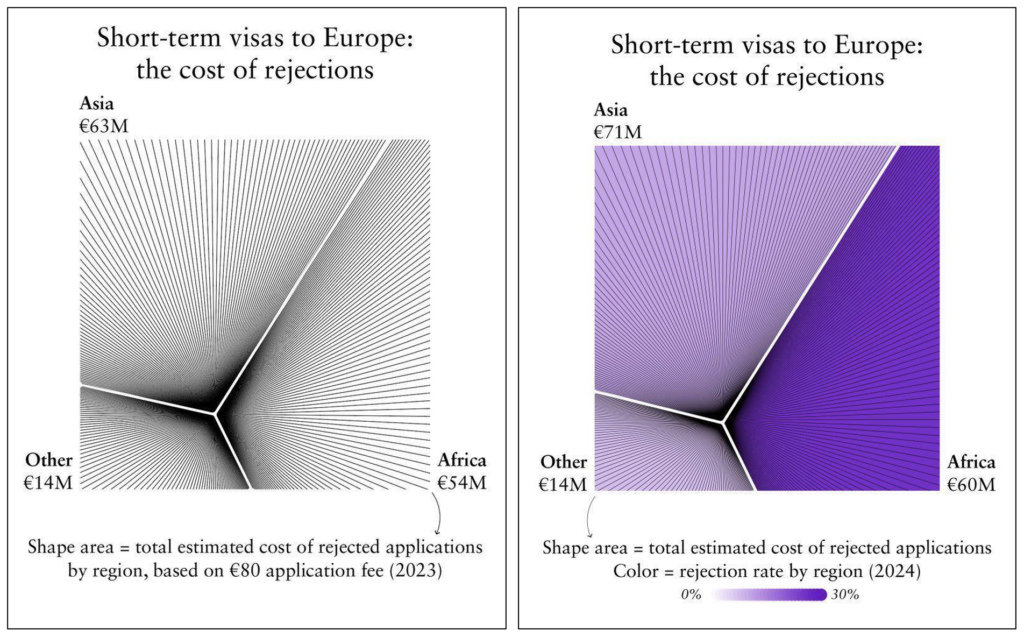
Short-stay visas for Europe: the costs of a refusal in 2023 and 2024. Source: Lago collective
According to another study conducted by the LAGO collective, in 2023 rejected visa applications generated €130 million for the EU’s Ministries of Foreign Affairs. Faced with such a sum, Foresti, the researcher leading this study, states that:
‘‘ we can view the costs of refused visas as ‘reverse remittances’, that is, money flowing from poor countries to rich countries. We never hear about these costs when we discuss aid or immigration; it is time for that to change.“
The term ‘reverse remittances’ sums up the economic violence of the system: whilst the EU communicates extensively about its official development assistance to Africa, it discreetly, and without any possibility of appeal, takes tens of millions of euros directly from the continent’s most vulnerable people.
“The poor’s resources are sent to Europe and in return we’re told ‘you’re not eligible’. We’re not eligible for what? Our money is eligible to fund the running of European institutions, but it’s us as people who aren’t eligible. If that’s the case, in the same way we’ve been made to spend, ’we should also have that money returned to us.” (Testimony from a comrade at AP Sahara, October 2024)
Furthermore, these figures are merely the tip of the iceberg of a system whose profitability relies precisely on its opacity.
Corruption and outsourcing
The money generated by the visa ‘business’ does not stop at the profits officially obtained by the EU’s Ministries of Foreign Affairs. Numerous cases of corruption within the consular services themselves have been brought to light by journalistic investigations and institutional reports.
A report from an inquiry carried out by the French Senate’s Finance Committee, dated 2007, stated that:
“Not a single consulate visited was spared cases of corruption involving officials in connection with visa applications.”
Corruption is, moreover, one of the arguments put forward, alongside that of “service optimisation”, to justify the use of private contractors. All European states have gradually outsourced the processing of applications to private companies such as VFS Global, TLS Contact or BLS International, which are responsible for collecting applications, booking appointments and taking biometric data, whilst the final decision remains the responsibility of the consulates. According to an other report by the French Senate (2015), this outsourcing has become widespread to cope with the increase in applications, and the arguments in its favour are based on efficiency. The same applies to Spain, where outsourcing is said to enable the expansion of the consular network without increasing expenditure on diplomatic staff, and offer additional services such as mobile biometrics or home appointment booking.
However, as highlighted by numerous journalistic investigations in both France and Spain, this transformation has not eliminated the systemic failures. On the contrary, it has instead shifted certain fraudulent practices towards these new intermediaries: resale of appointments, rising costs and greater opacity within the system, contributing to the increased commodification of visa access.
The case of BLS International Services, the sole service provider for visa applications to Spain, is particularly telling. Since 2016, the Spanish Ministry of Foreign Affairs has delegated the receipt and initial processing of visa applications to this private Indian company. From the moment the initial contract was awarded, the decision coincided with revelations in the Indian press implicating the company in a scandal involving the illegal trafficking of personal data affecting politicians and diplomats. The tender process itself had been deemed flawed by the anti-corruption NGO Transparency International. On the ground, particularly in Tangier and Nador, outsourcing has exacerbated the problems rather than resolving them: organised networks monopolise appointment slots to resell them at inflated prices, whilst applicants may pay up to 15,000 euros to obtain a visa. Despite the scandals, the convictions and the repeated warnings, BLS remains to this day the exclusive service provider for Spanish visas in many countries.
What was purported to be a remedy for consular corruption has thus ended up reproducing, in other forms and with new actors, the same predatory logic with the blessing of the states.
Diplomatic blackmail
Visa refusals are also used to exert pressure on states that refuse to repatriate their nationals in an irregular situation. The open letter published on 14 September 2022 by the website Citoyens des deux rives, entitled “Visa policy: discrimination and injustice” and signed by 115 organisations, condemns procedures as “extremely costly and non-refundable in the event of refusal”, “unbearably discriminatory” and also diplomatic blackmail. An article by Cimade on the 2020 reform of the Schengen Visa Code confirms that diplomatic blackmail is a practice not only accepted by European states but legalised by the February 2020 reform.
“The reform reinforces inequalities in freedom of movement through a multi-tiered visa system, directly linked to the degree of cooperation from third countries in readmission processes. (…) Other measures reflect this carrot-and-stick policy, including the possibility of shortening processing times for ‘good pupils’ or of reducing or extending the validity periods of visas.” (Source: Cimade)
And this reform soon gave rise to very concrete situations:
“In 2020, Gérald Darmanin, then Minister of the Interior (…), threatened Tunisia with a reduction in the number of visas granted if Kaïs Saïed, the Tunisian president, refused to take back his nationals who had arrived illegally on French territory. In 2021, the threat was carried out: visa issuance fell drastically in Morocco (-50%), Tunisia (-30%) and Algeria (-50%).” (Source: Afrique XXI).
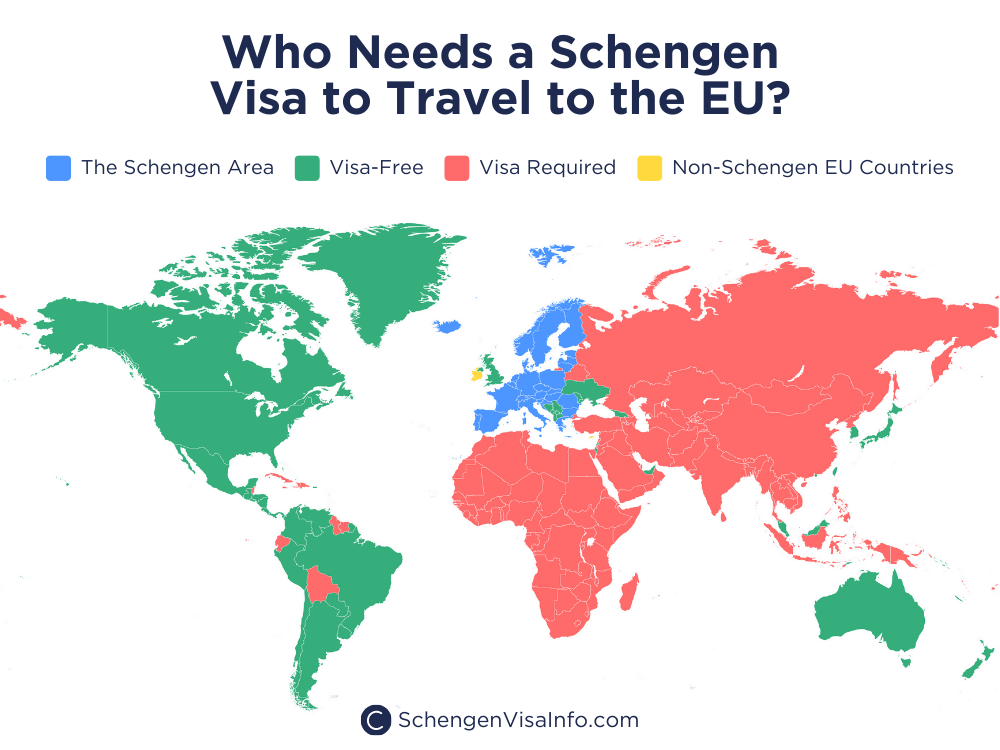
Who needs a Schengen visa to travel to Europe? Source: schengenvisainfo.com
What can we do?
In this introduction, we highlight the profoundly unequal, discriminatory and racist nature of the visa regime, in which nationality – and to an extent social class – determines people’s access to the right to freedom of movement. These inequalities are rooted in a history linked to the development of nation-states and racist ideologies, where passports and visas serve as tools for control and the externalisation of borders. Beyond physical borders, violence is exerted right from the country of departure, during administrative procedures, and through the refusals, humiliation and discrimination endured. The visa system also proves to be a lucrative and opaque mechanism for European countries, marked by abusive practices, corruption, and forms of diplomatic pressure on countries in the Global South.
Sometimes, within our struggles against the border regime, debates arise regarding the relevance of seeking improvements within a border regime that we wish to abolish. For our comrade who spoke with the Chroniques à mer team,
“ The history of visas and the current visa regime, it can’t be separated from the development of the nation state system and with that passports and controls at border points, border entry points. However, the current visa regime is kind of a specific tool in response to people from the global south predominantly using their right to freedom of movement and migrating towards the global north. And the visa regime starts to develop in the 1970s which was kind of in response to this movement where people were coming from the south and to the north, migrating to the north and then once there due to the refugee convention and states did not have the right to send them back. According to the international laws which these states in the north had written themselves. […] Visas in that context they are sort of an initial barrier and they’re one of the first tools which externalize the borders from Europe to um well external countries.”
As a collective fighting against borders, Alarm Phone supports the total abolition of the visa regime. We stand in solidarity with comrades in the Global South who are fighting for improvements, whilst remaining aware that as long as the visa system exists, it will remain a tool for dividing the world. A tool based on the construction of racial apartheid and pitting the mobility of those considered desirable against that of the ‘others’ . Having provided a general overview of the visa system in this introduction, the first part of the report uses figures to demonstrate the direct consequences of migration control policies, with a statistical summary of Alarm Phone’s work in the Western Mediterranean and Atlantic regions. The following sections detail, country by country, the on-the-ground consequences of the visa regime, accompanied by numerous testimonies. In the final section, the sadly long and recurring list of shipwrecks and disappearances reminds us that borders kill every day.
| Note on our terminology:
Our report draws on various sources. We gather information when people contact us via the Alarm Phone number. Various local Alarm Phone (AP) teams in the region document their observations and information on the website. We are aware that we do not have a complete overview of what is happening on the Western Mediterranean and Atlantic routes. Where possible, we have provided links to newspapers and other articles. However, not everything we report is documented in the media. All information without a reference comes from activists in the region. Furthermore, Alarm Phone is a network of volunteer activists and most members of Alarm Phone in the Western Mediterranean and Atlantic region are from West Africa or Europe. Consequently, we are much more integrated into the communities of people on the move from West African countries than into the Harraga communities of the Maghreb. This inevitably leads to an under-representation of the experiences of the latter group. The only way to address this issue is to broaden our scope and work towards building a genuine transnational community of resistance. It is slow and laborious work, but we are determined to see it through. The language we use is important. The words we use are also laden with the weight of their history, and that history is one of power. We constantly strive to see the world accurately and to find the right words to describe what we see. There is no single viewpoint that encompasses everything. To see the world accurately, we need a kaleidoscopic vision. This report is the result of a collective effort. Many of the authors do not write in their mother tongue, and most of the testimonies are also written in a second or third language. We see this as a strength. We do not wish to regulate the language used in our descriptions of people and their environments. Whilst some may be reluctant to use the term ‘Sub-Saharan’ which implies inferiority and prefer ‘Black’ or ‘Black African’, others may reject the implicit racialisation in these terms. Similarly, some of us avoid talking about ‘migrants’ and prefer to emphasise individuality by using the phrase ‘people on the move’, but for others, this language is too pedantic and artificial, and we are proud to be migrants. We have retained, as far as possible, the authors’ various choices of description, particularly where the author is themselves a person on the move. |
2. Sea crossings and statistics
In 2025, 7,442 people in distress were recorded on the Western Mediterranean and Atlantic routes by Alarm Phone, representing a 15% increase in the number of boats compared to 2024 (see Alarm Phone: Western Mediterranean and Atlantic Regional Analysis, September 2024 – February 2025). However, the UNHCR reported ‘only’ 37,080 arrivals in Spain, 42% fewer than the record of 64,318 reached in 2024:
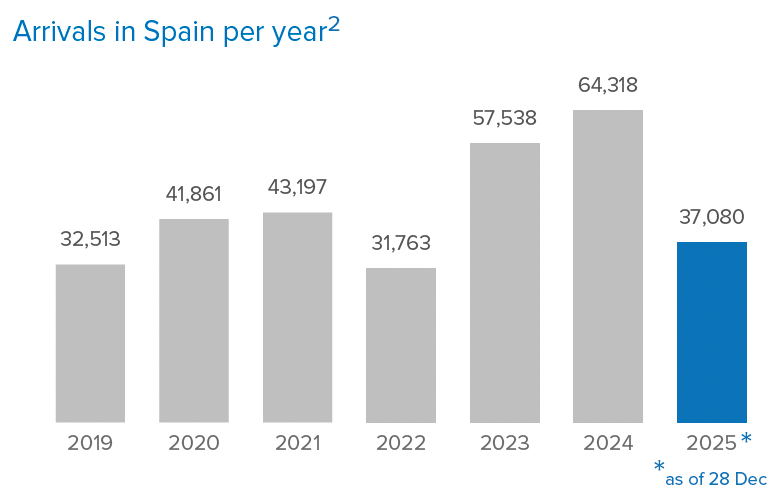
Arrivals in Spain by year. Source: UNHCR Spain Weekly Overview, Week 52 (22–28 December 2025).
Although the number of calls received by Alarm Phone is not directly correlated with the number of departures or arrivals, this discrepancy reveals a stark reality: fewer arrivals do not necessarily mean fewer crossings. Rather, it reflects the growing effectiveness of European strategies of border externalisation and interception, which systematically block, turn back or render boats on migration routes invisible in official records.
In total, Alarm Phone was alerted to 142 crossings in 2025, of which 61 took place between September and December. The main point of departure was Algeria, with 69 boats leaving the Algerian coast throughout the year (34 boats since our last analysis). A total of 71 boats departed via the Atlantic routes (27 boats between September and December). It should be noted that official figures show a sharp increase in November, with 2,714 arrivals via the Atlantic routes, reversing the decline observed during the summer months.
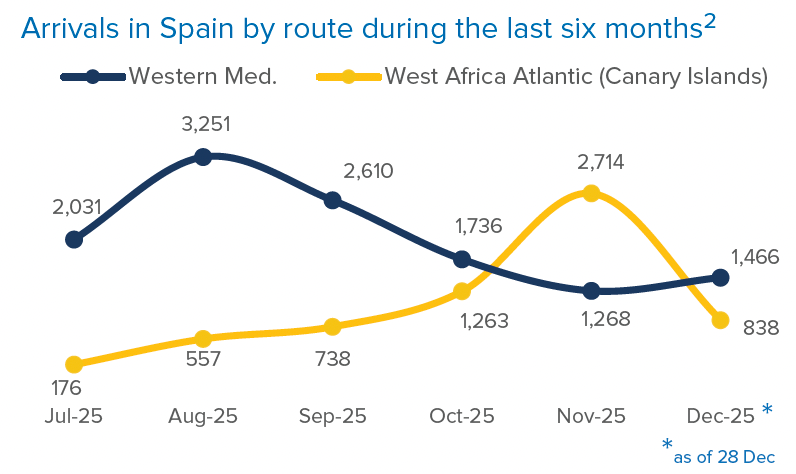
Arrivals in Spain by route over the last six months. Source: UNHCR Spain Weekly Overview, Week 52 (22–28 Dec. 2025).
These figures correspond to the number of calls we received in October and November from the Atlantic coast. Activity on other routes was minimal, with only 2 cases in the Alboran Sea and 3 in the Strait of Gibraltar throughout the year.
15 boats with which Alarm Phone was in contact were intercepted between September and December 2025, marking a sharp increase for the second half of the year. As with the interceptions, the number of disappearances has risen: despite all efforts to gather and organise information, in 59 of our alerts between September and December 2025, the fate of the boats and their passengers remains unknown, accounting for 41% of all alerts received by AP on these routes in 2025. And at least 172 people lost their lives, including 135 in a single tragedy in the spring off the coast of Mauritania (documented by Alarm Phone). The actual death toll is likely much higher, as Alarm Phone only records cases in which it is directly involved. The data reveals a systematic pattern of disappearances: 59 boats have vanished without trace, amounting to around 1,500 people based on the average capacity of the boats. Shipwrecks are underreported, and the increase recorded last year on the Atlantic routes (for example, 2,714 arrivals in November) suggests that people have adapted to interception patterns, but at a far deadlier cost, as the final chapter of this report on shipwrecks and disappearances sadly testifies.
The EU and Spain present the 37,080 arrivals – a significant drop – as a political success. In reality, the data reveals an increasingly deadly border regime: boats continue to set sail in similar numbers, but are intercepted, turned back, or lost. Visa restrictions and externalisation are pushing people towards more dangerous routes, whilst interception agreements ensure they never reach Europe. Disappearance is becoming the norm, a direct consequence of policies designed to stop migration at any cost.
2025 will be remembered not for the reduction in migration, but for the EU’s willingness to let thousands of people disappear in the name of a statistical victory. We will not forget, we will not forgive.
And we will not give up the fight. In solidarity with people on the move, against Frontex and for ferries, against interception and incarceration, and for freedom of movement for all.
3. In the various regions
3.1 Algeria
The two countries that issue the largest number of visas to Algerians are France, and in second place, Spain; these are also the two countries that receive the most applications. France, through its Minister for Foreign Affairs, J.N. Barrot, stated that the visa refusal rate for Algerians in 2025 stood at 31% of applications (January–September 2025), whilst the global average visa refusal rate stands at around 16%. On 2 February 2026, the newspaper El Watan published information from the French Embassy, stating that France had issued 204,248 visas and refused 118,000 applications.
The cost of a visa is around 90 euros per application, regardless of whether it is granted or refused. In 2024, Algerians submitted 352,295 applications for France and 123,991 for Spain. A veritable business has sprung up around this consular money-spinner. The sum that Algerians pour into the French and Spanish consulates is estimated at 46.3 million euros. The service providers responsible for collecting visa applications are TLS, VFS and BLS, and more recently Capago International. The latter, established in 2025, processes visa applications for the French Embassy in Algeria for a fee of €29. The cost of the visa represents half of the Algerian monthly minimum wage (€160 to €170).
Appointments must be booked online via a virtual platform, where applicants must provide a range of details regarding their planned trip. However, the greatest difficulty – and at the same time the greatest humiliation – is being unable to secure an appointment to submit the visa application at these agencies. Very often, the appointment booking system is down, making it impossible to register.
Narratives regarding visas often take off in France, from the French government, but also from French political parties, particularly from the far-right and nationalist parties. The rhetoric centres on the Algerian government’s refusal to take back Algerians who have received an OQTF (obligation to leave French territory), as mentioned in the section on diplomatic blackmail in the introduction.
Added to this is the difficulty of securing an appointment to submit a visa application with the service providers. A few years ago, processing times were three to four weeks; today, it is almost impossible. A visa has become a luxury, and consequently an illicit trade has developed around certain service providers. Today, to secure an appointment with a service provider, one must find the right channels, and this can cost up to 1,000 euros, or almost ten times the cost of processing the visa.
The specific case of Sahrawi refugees in the Tindouf camps: an unrecognised stateless status
The Sahrawi refugee camps were established between 1975 and 1976 near Tindouf, in Algeria, following Spain’s hasty withdrawal from the Sahara, a territory over which it exercised colonial rule. The territorial conflicts that followed caused massive population displacements, leading to the creation of the camps, which are now home to around 173,000 people according to the UNHCR. The inhabitants of these camps have since found themselves in a blind spot of international law. They are not Algerian citizens and are not formally recognised as refugees.
The 1954 Convention defines a stateless person as “any person whom no State recognises as its national”, and in theory provides for the issuance of a protective travel document as well as fundamental rights regarding employment, education, and access to public services. However, these protections apply only to persons formally recognised as stateless by a contracting state, which Algeria does not do systematically. The result is a compound statelessness: without recognised nationality, without refugee status, and without the formal protection provided for stateless persons, the Sahrawis in the camps are neither recognised refugees, nor citizens of a recognised state, nor officially protected stateless persons.
This triple absence makes Schengen visa applications structurally very difficult. Without a valid passport issued by a recognised state, the first consular requirement cannot be met. Without an identified nationality, there is no standard procedural framework for processing the application, nor state contact for consular officials. Without employment, a bank account or property – documents obviously inaccessible to people dependent on humanitarian aid – it is impossible to demonstrate sufficient ties to guarantee return. There is also the preliminary question of the competent consulate: as the camps have no legal existence recognised by the Schengen states, the applicant’s legal residence is itself undetermined.
Fifty years after an incomplete decolonisation, this political vacuum results, for every individual living in the Tindouf camps, in a legal invisibility that makes the visa application process practically inaccessible.
3.2 Morocco
3.2.1 The Schengen visa regime in Morocco: a massive and highly selective system
Repeated refusals despite complete applications
In Morocco, the Schengen visa regime functions as an unequal administrative border, where opportunities for mobility are determined by criteria that are both economic, social, and political. With over 600,000 applications annually, Morocco remains one of the main applicant countries. But behind this massive figure lies a reality of repeated refusals, high costs, administrative opacity, and various forms of exploitation.
For many, the visa experience is not a simple administrative procedure: it is a long, costly, and humiliating ordeal. Long before the physical border, border violence becomes visible at consulates with overloaded appointment platforms, through document requirements, and standardised refusals. The refusal rate remains high, at 20% in 2025 for those who manage to submit an application—meaning roughly one in five people are turned down, even after investing considerable time, energy, and financial resources.
Testimonies from Moroccans and nationals of other countries reveal the same reality: people submitting a complete, well-founded application that meets official requirements (stable employment, regular income, strong family ties in Morocco, no history of irregular migration) are nevertheless refused. The reasons given are formulated in standardised terms: “reasonable doubts as to the intention to leave the country”, “information deemed insufficient”, “justification for the stay considered insufficient”. Perceived as vague, lacking in individualisation and difficult to challenge, these grounds create an experience of administrative opacity that reinforces the imbalance between applicants and consular institutions. The refusal is therefore experienced not merely as an obstacle to travel, but as a challenge to the person’s credibility, dignity, and good faith.
The cost of the visa as a mechanism of exclusion
Applying for a visa represents a significant financial burden, particularly for people from working-class or precarious backgrounds, whether they are Moroccan or nationals of another country. In 2025, consular fees amount to 90 euros (approximately 979 dirhams), which are non-refundable in the event of a refusal. Added to this are the fees charged by outsourced centres such as TLS Contact or BLS International (300 to 800 dirhams), compulsory travel insurance (300 to 600 dirhams) , as well as numerous indirect costs: travel to application centres, printing and translation fees, and the cost of booking tickets or accommodation required to prove the validity of the intended stay. In practice, the actual cost of an application ranges from 1,500 to 3,000 dirhams per person, representing a significant portion of monthly income for many families. Thi may mean seeking help from relatives, dipping into savings intended for other essential needs, or resorting to informal forms of debt.
When the application is refused, all the expenses incurred become an immediate loss, without any clear explanation, which several analysts and civil society organisations describe as a form of reverse financial transfer (as mentioned earlier in the introduction).
Informal economy and exploitation
The saturation of appointment booking platforms has contributed to the emergence of a veritable informal economy. Middlemen manage to secure slots and resell them at exorbitant prices: up to 10,000 dirhams (around 920 euros) for an application to France, and between 1,000 and 3,000 dirhams for other Schengen countries. This situation places many applicants in a position of dependence on informal intermediaries, effectively excluding those who lack the necessary resources, even when they meet all the administrative requirements.
At the same time, private agencies offer paid services: application preparation (1,000 to 5,000 dirhams), fictitious bookings for flights or hotels (100 to 1,000 dirhams), or even false visa guarantees charged at up to 7,000 dirhams. These practices, fuelled by administrative complexity and uncertainty regarding the actual assessment criteria, carry significant risks: an increased risk of refusal, administrative penalties, and financial losses with no recourse. The deliberate scarcity of appointments and the opacity of procedures thus transform access to visas into a market where mobility becomes a privilege reserved for those who can pay.
Increased vulnerability: the case of sub-Saharan migrants
In Morocco, the situation of sub-Saharan migrants raises significant human rights issues. Despite some progress in migration policy, many people continue to face violations or effective limitations on their fundamental rights, particularly regarding access to mobility, dignity and equal treatment.
Sub-Saharan migrants often face structural administrative vulnerability, linked to the precariousness of their legal status and the complexity of administrative procedures. This situation limits their access to rights, including legal mobility procedures such as visa applications.
It is, however, important to emphasise that this population is not homogeneous. Among the sub-Saharan migrants in Morocco, some hold stable, skilled jobs, including within private institutions, international organisations or, in some cases, public institutions. Despite a stable employment situation and complete administrative files, these individuals also face significant difficulties in accessing visas.
Here too, consistent accounts indicate that visa refusals may occur under conditions lacking transparency.
These dynamics are particularly evident in the border regions of eastern Morocco, notably in Oujda and Nador, where sub-Saharan migrants are exposed to more precarious living conditions and heightened forms of control and forced mobility.
In the face of these challenges, civil society organisations and solidarity networks play a vital role in supporting migrants, defending their rights and documenting the problematic practices observed.
Conclusion
As we write this report, the visa regime from Morocco functions as a mechanism of economic, administrative, and social selection. Even a complete application does not guarantee a visa, which reinforces the arbitrary nature of the visa regime. The border is not located solely at the geographical points of entry into Europe, but also in costly and selective administrative procedures that determine access to mobility well in advance, and which disproportionately affect the most vulnerable people.
3.2.2. Tangier
Here is the testimony of a comrade from Alarm Phone living in Tangier, recorded by the Chroniques à mer team in episode 37:
“This year [2025], I was supposed to apply for a visa for Spain. Since February, I’d been trying to get an appointment at an agency. The system managing appointments for Spain, BLS, was down in February and March; it reopened in April. There were appointments available, and I was there for several hours and had the money on me, but they never wanted to help me get an appointment. From then until now, I have the invitation letter from an association in Spain, but I still don’t have an appointment. So it’s frankly impossible to go and apply for a visa because you absolutely must have an appointment. If it carries on like this, the date of the meeting is almost upon us, so unfortunately I won’t be able to leave.”
The general situation for people on the move in Tangier remains difficult. The numerous recent floods have exacerbated the situation for undocumented migrants, who are struggling to access shelter and meet their basic needs. Repression and migration controls continue, and nothing is improving for people on the move. There are few routes to reach Europe successfully and safely.
Whilst individual residents of Tangier may challenge the visa system, activists on the ground are nevertheless afraid to speak out against the prevailing injustice, as they are highly vulnerable to the border regime. The situation is easier for those who have ‘regularised’ status in Europe and in their country of origin, as they are better protected.
In the experience of AP members in Morocco, some countries have a more flexible visa system. For example, visas for Spain have often been easier to obtain, whilst Switzerland has a very difficult visa process with little chance of success. There are similar protocols, but different obstacles depending on the country.
3.2.3. Nador and Oujda
In the north-eastern regions of Morocco, particularly the cities of Oujda and Nador, the reliance on intermediaries in the visa application process is very evident. This situation is primarily due to the geographical distance from major consulates and processing centres, which forces many people to undertake costly, tiring journeys, that are sometimes complex to organise.
For the inhabitants of these regions, applying for a visa is therefore not merely a simple administrative procedure: it often involves a significant mobilisation of financial resources, time, and energy.
This dependency is further exacerbated by the socio-economic vulnerability of a significant portion of the local population. In a context marked by unemployment, precarious living conditions and sometimes unstable incomes, many families find themselves forced to turn to intermediaries, informal agencies, or acquaintances who are supposed to ‘know’ the procedure, in the hope of increasing their chances of securing an appointment or putting together an admissible application. The high demand for movement to Europe – whether for family, professional, medical, academic, or simply travel-related reasons – further exacerbates this situation and fuels a parallel market centred on appointments and administrative support.
Accounts gathered in Oujda and Nador highlight frequent practices of reselling appointments, sometimes at prices far exceeding the official fees. Beyond the financial pressure mentioned above, several people describe the impossibility of accessing the digital appointment-booking platforms themselves, either due to a lack of digital literacy, the scarcity of available slots, or repeated technical glitches. This situation paves the way for various forms of exploitation, where intermediaries capitalise on the difficulty of accessing the system to sell slots, completed forms, or simply assistance with the procedure.
Older people are particularly affected by this situation. In the absence of accessible, transparent and reliable support, they become more dependent on third parties, with an increased risk of errors, additional costs or abuse.
Finally, several accounts highlight a deep sense of humiliation, incomprehension and psychological strain. Visa refusals are often perceived as opaque, insufficiently explained, and experienced as a personal rejection which is all the more painful when families have invested considerable resources in the process. In this context, the visa application no longer appears merely as an administrative formality, but as a genuine financial, administrative and psychological ordeal, marked by uncertainty, information gaps, and multiple forms of vulnerability.
Testimony of F.K. from Morocco, Oujda – Visa application for Germany and Switzerland
F.K. explains that she submitted two visa applications, one for Germany and one for Switzerland. In both cases, she had a complete application. She is an employee and a member of the CNSS (National Social Security Fund), and had provided all the required documents.
Despite this, her applications were refused by the consular authorities. In the case of Germany, the refusal was based on doubts regarding her intention to leave the country before the visa expired. As for Switzerland, the refusal was linked to what was deemed insufficient justification of the purpose and conditions of the stay.
This situation highlights that professional stability and a complete application do not necessarily constitute sufficient guarantees for obtaining a visa.
Testimony of D.Z. from Guinea-Bissau, Oujda – Application for a student visa for Germany
D. explains that he submitted a visa application for Germany for his studies. He had an invitation from a German university, as he was a Master’s student in law in Morocco. His application included all the required supporting documents, as well as a letter of invitation and a financial sponsorship letter.
Despite this, his application was refused. The reason given was insufficient financial resources. He also points out that his student status did not strictly require membership of the CNSS, but that this factor was implicitly taken into account. Furthermore, he was asked to provide proof of local financial support.
This situation shows that, even within a structured and justified academic context, criteria relating to financial resources can constitute a major obstacle to mobility.
General situation at the borders of this region
Some people travel without visas and still choose to take the old migration route linking Algeria to Morocco via Maghnia/Oujda, which remains very dangerous, and even deadly.
At the end of last year, at least 21 bodies were found in the mountains and forests of Ras Asfour, on the Moroccan side of the border. Local groups, such as our Alarm Phone team, the ASMV (Association for the Assistance of Migrants in Vulnerable Situations) and the human rights organisation AMDH Oujda, are documenting the situation at the border and following up on every known incident.
At least 14 bodies were transferred to the Oujda morgue, but identifying them proved very difficult. Some bodies showed visible injuries to the head, limbs and abdomen. Two bodies were in an advanced state of decomposition. A significant number of injured people, suffering from fractures to their upper and lower limbs, were transferred to Al-Farabi Hospital or the University Hospital in Oujda, where they received the necessary treatment before being sent home. Also in early February, another group of victims of this dangerous border crossing was found at the Oujda-Maghnia border, according to local sources from Alarm Phone. Three bodies were found, one survivor was arrested.
AMDH Nador rightly comments:
“Cold and hunger are not the sole causes of this tragedy, but aggravating factors; the main cause remains restrictive migration policies that turn borders into closed and deadly spaces.”
Once in Morocco, many people on the move continue their journey to the town of Berkane, in the north-east of the country. Our local Alarm Phone team is monitoring the situation of new arrivals, and Berkane appears to be a place where people on the move at least have the chance to find shared accommodation within local communities, work, and support from local organisations. However, the sea crossing from the Nador region remains unaffordable for most non-Moroccan nationals, and many people therefore find themselves stranded there, unable to continue their journey. Communities are still living in makeshift camps in the forests around Nador, in very precarious conditions, with the camps having to move deeper and deeper into remote areas due to raids by the authorities.
3.2.4. Laayoune
Situation regarding departures from the Laayoune region
Here is a report from a comrade at Alarm Phone Laayoune:
“The constant trend over the last few months is that there are fewer boats heading for the Canary Islands. Despite the militarisation of the borders, we are also seeing arrivals from the ‘south’ (Mauritania, Senegal, Gambia). But it’s fair to say that sometimes it’s almost impossible. Then there’s the authorities’ crackdown on migrants: arrests, imprisonment, victims of violence against migrants, and the military even firing on convoys, resulting in deaths, injuries and others being arrested and sentenced. This is what we often see in the Laayoune region. There are also boats that have set sail from The Gambia and have shipwrecked here, resulting in casualties, sick people and others in difficult circumstances. So we, as the AP Laayoune team and members of the communities, always provide assistance, we try to help and also support families in obtaining information and also assist with burials or the repatriation of bodies. In conclusion, things have really changed in terms of repression, with heavy sentences being handed down to intimidate others.”
Regarding visas, this comrade reports situations similar to those described in other regions, with the added difficulty that there is no consulate near Laayoûne. People must therefore travel to the major Moroccan cities of Rabat, Agadir or Casablanca to submit their applications. This adds to the cost of the application, as well as the travel expenses and time required for all these journeys. He concludes by saying:
“ Visas, it’s always the same policy, and recently it has been tightened even further. Visa fees have been increased and people continue to apply, but only a minority are granted one. And in the event of a refusal, they are not refunded their money; it is always a scam and theft by the European embassies in Africa.”
3.3 Mauritania
Regarding Schengen visas
According to statistics published on the European Commission’s website, Schengen visa applications submitted in Mauritania doubled between 2014 and 2024, rising from 11,573 to 23,596. At the same time, the percentage of refusals for these applications rose from 17.7% to 32.5%. Today, an applicant in Mauritania has roughly a one in three chance of being refused, whereas the global average is closer to one in six (14.8% refusals). Like other countries in the region, this high refusal rate indicates the racist treatment of Mauritanians applying for Schengen visas.
Schengen visa applications in Mauritania (2024) (according to the European Commission):
Total number of applications: 23,596
Global share: approximately 0.20% of Schengen applications
Global ranking: 53rd country by number of applications
Visas granted: 15,438
Visas refused: 7,429
Refusal rate: 32.5%
In Mauritania, Spain is by far the leading country in terms of applications (17,740), followed by France (4,229) and then Germany (1,627). The diplomatic presence of these countries is concentrated in the Mauritanian capital, Nouakchott, and in the country’s second city, Nouadhibou. In this context, travel can pose a challenge for some sections of the population, particularly for those living in rural areas or in the middle of the country, due to the long distances involved and constraints related to transport infrastructure. However, for people living in coastal areas, consulates remain relatively accessible.
Most popular Schengen countries for applications from Mauritania:
Spain: most popular country (17,740 applications)
France: highest acceptance rate (69%)
Germany: highest refusal rate (49%)
Costs associated with visa applications
The official fees for a Schengen visa vary slightly depending on the embassy. On their respective official websites, Spain sets the price at 80 euros whilst France sets it at 90 euros (99 euros for a long-stay visa). Added to these fees are the costs associated with compulsory medical insurance, as well as the fees charged by application centres or intermediary firms.
Taking all these expenses into account, the total cost of an application can reach around 300 euros. As in other regions, this represents a significant financial burden compared to Mauritanian incomes, which can be estimated at between 100 and 1,000 euros. Indeed, Mauritanians’ incomes vary greatly depending on the sector (public, private and informal). The Mauritanian minimum wage is set at 5,000 MRU (approximately 110 euros). If an application is refused, these fees are not refunded. For applicants, this represents a glaring injustice and a form of neo-colonial economic violence.
From the application to booking an appointment: a labyrinth of obstacles and racism
Before submitting a visa application, the first hurdle is gathering all the necessary documents. In the case of Spain, these are primarily administrative documents: a valid passport, a passport-sized photograph, the application form, biometric data, medical travel insurance and the visa fee. But also, and above all, what the embassy calls “ supporting documents relating to your trip”, that is, the purposethe reasons for the visit (invitation), proof of accommodation (hotel bookings), proof of financial means (bank statements, employment contract, etc.) and proof of return (return flight tickets, marriage certificate, family record book, etc.).
The evidence requirements imposed by EU countries are indicative of an implicit and racist presumption that applicants do not intend to return to their countries of origin.
Once the application has been compiled, an appointment must be made with the embassy to submit it. To secure an appointment at certain embassies, applicants are forced to use banking institutions or private companies that sell their services. To secure an appointment at the Spanish embassy, one must go through BLS International; the appointment itself is free but their “ basic” service costs 770 MRU (approximately 19 euros) and they offer additional services for a fee (form completion – 200 MRU, application tracking via SMS – 70 MRU, photography, etc.).
According to BLS agents, the waiting time for an appointment is 15 days, but the service is often overloaded, and unofficial agencies such as Wassila Conseil or Express Visa resell appointments, guaranteeing a processing time of around one month for approximately 5,000 MRU (approximately 107 euros).
For the French Embassy, before requesting an appointment, you must obtain an access code from the “Banque pour le Commerce et l’Industrie” at a cost of 400 MRU. You must then phone a call centre, which will give you an appointment in exchange for this code. According to on-the-ground accounts, the waiting time for an appointment (online!) can be 2 to 3 months.
Analysis of accounts regarding visa refusals in the Schengen area
Obtaining a visa for the Schengen area is an essential step for those wishing to travel to Europe for family, academic, or professional reasons. However, several testimonies gathered highlight the difficulties encountered by certain applicants, even when their applications appear to be complete and in line with neo-colonial administrative requirements.
The following testimonies illustrate various situations in which visa applications have been refused, thereby raising questions about the assessment criteria applied by consular authorities.
Testimony of F., aged 28, member of civil society – Family invitation to France
F. explains that she has a cousin living in France who sent her an official invitation, duly legalised by the relevant authorities. This invitation also included the provision of accommodation for the duration of her stay.
Despite the existence of this family link and the availability of a place to stay, her visa application was refused by the consular authorities.
This situation shows that the presence of an official family invitation does not guarantee that a visa will be granted.
Testimony of Y., aged 42, lawyer – Experience of international mobility
Y. states that he had previously travelled to Europe as part of his studies, notably to Germany and Italy. At that time, he had obtained visas while residing in Syria.
However, after submitting his visa applications from Mauritania, these were refused on several occasions. In his case, the visa application was rejected four times.
This situation raises questions regarding possible differences in the assessment of applications depending on where the application is submitted from.
Testimony of M., aged 31, shopkeeper – regarding accommodation conditions
M. suggests that the refusal of his application may be linked to the accommodation arrangements planned for his stay.
Indeed, the flat intended to accommodate him, which belongs to his father, was reportedly considered too small to host a guest.
This situation may have negatively influenced the consular authorities’ assessment of the application.
Testimony from A. (member of Alarm Phone Mauritania) – Refusal despite a complete application
A. testifies that her visa application was refused despite having complied with all the required administrative procedures. She submitted a complete application containing all the necessary documents.
This case highlights the sense of incomprehension felt by some applicants when their applications are rejected despite their apparent compliance with administrative requirements.
Conclusion
All these testimonies shed light on the difficulties encountered by certain applicants in the process of obtaining a Schengen visa.
Indeed, several people stated that they had provided all the required documents: bank statement, travel insurance, return flight ticket, professional and family documents attesting to their circumstances, etc.
Despite this, some visa applications were refused without a detailed explanation from the consular authorities.
Intermediary firms, which are supposed to facilitate the process, can in some cases contribute to increased complexity, both in terms of costs and documentary requirements.
These situations highlight the complexity of the visa application process and the concerns raised by the lack of clarity regarding the criteria for acceptance and refusal, even even when applications appear complete and in compliance with administrative requirements.
They reveal practices of racial discrimination and strict control over mobility that form part of a logic of neo-colonial domination. This calls for legal and ethical reflection on respect for the principles of equal opportunities, human dignity, and freedom of movement.
3.4 Senegal
Senegalese nationals applying for Schengen visas are more likely to be refused than those from almost any other African country: almost one in two applications is refused, a refusal rate that has been rising in recent years. According to official statistics from the European Commission, 46.8% of applications from Senegalese nationals were refused in 2024, compared to the overall average rate of 14.8% for all nationalities. That year, approximately 72,412 applications were submitted by Senegalese nationals, resulting in nearly 35,519 refusals.
These visa applications represent a significant financial burden for those seeking to travel through authorised channels, in a country where the average wage is around €192 per month. As mentioned in the previous sections, each application for a short-stay Schengen visa has involved a non-refundable fee of €90 since June 2024, regardless of the outcome of the procedure. Given the high number of refusals, Senegalese applicants have collectively lost approximately €2.93 million in application fees for rejected applications in 2024 alone. This figure does not include the additional costs often required, such as compulsory travel insurance, service fees charged by visa centres, or expenses related to compiling the application.
Access to the application procedures themselves constitutes a major obstacle for applicants in Senegal, with long waiting times for appointments (up to 4 to 5 months for Germany, and around 1 to 2 months for France, Spain and Italy). Here too, European embassies outsource the management of appointments and the submission of applications to private service providers (VFS Global Dakar for France, BLS International for Spain), which further complicates access to consular services. These intermediaries resell appointment slots at very high prices, often between 300,000 and 400,000 CFA francs (over 500 euros), well above the official fees. Several testimonies highlight an opaque sysetm and practices perceived as abusive. An activist from Alarm Phone who wanted to attend a civil society event in Europe explains, for example:
“In my case, I submitted my application to the Swiss embassy and, after providing a thousand and one documents, my visa was refused. The reason they gave me was only this: there is no proof that you will leave the Schengen area before your visa expires. What was strange was that they even suggested I lodge an appeal, knowing full well that the appeal fees are higher than the visa application fees. I didn’t appeal because I was furious with this scam of a system.”
Several people have noticed a tightening of visa requirements and are having their applications refused, even though they had previously been able to obtain Schengen visas. “As for my refusals, it all started in 2022,” says an AP activist who has faced several refusals despite having been granted two Schengen visas to travel to Germany in 2019 and 2021, whose conditions he complied with.
“Now, in 2022, I applied for a visa to go to Germany, and it was refused. The reason was that I was a threat to national security or something like that. There was another Senegalese activist who was due to come with me, and his application was also refused, but on different grounds. They said he didn’t demonstrate sufficient income. So we lodged an appeal together with the German foundation that had invited us, but the appeal was also rejected. In 2023, I applied for a visa for Switzerland, which was refused, and in 2024, my application for a visa for France was also refused. I began to think that all these refusals were linked to my activities in support of the rights of people on the move. But as it’s all rather unclear and we don’t know the exact reasons for the refusals… I realised that all the applications we submitted through our association have been refused. That’s what makes me think it’s linked to our advocacy activities. We lodged another appeal against the latest refusal, and it’s being heard by the court in Nantes (France), but we still haven’t received a response, even after a year. Now I’m feeling discouraged; I’m spending too much energy and too much money, and the money isn’t being refunded. It feels like we’re at a dead end.”
This situation has led human rights organisations in Senegal to launch a campaign to denounce the current policy, which is deemed unfair. The Migration and Development Network (REMIDEV), alongside other civil society organisations, organises an annual walk for visas to highlight the high refusal rates, the financial cost of rejected applications, and the structural barriers to securing appointments. A French participant in the 2024 walk was there to protest against the treatment of his Senegalese wife, who had faced several refusals despite being married to a French citizen. These campaigns aim to draw the attention of the European and Senegalese authorities to the social and economic consequences of visa policies, and to demand greater transparency in consular procedures. Some organisations are calling for reciprocity: if Senegalese nationals continue to face high refusal rates and restrictive procedures from some states, Senegal could consider equivalent measures towards nationals of the states concerned. The Senegalese authorities have repeatedly highlighted the need for a more balanced dialogue with the European Union on mobility policies, and have announced that an electronic visa (e-visa) will be introduced for certain countries such as the United States and France. However, no formal reciprocal restrictive measures of a comparable nature have been put in place to date. The official stance is instead rooted in diplomatic negotiation and migration cooperation, even though internal political pressure on the issue of reciprocity remains a feature of public debate.
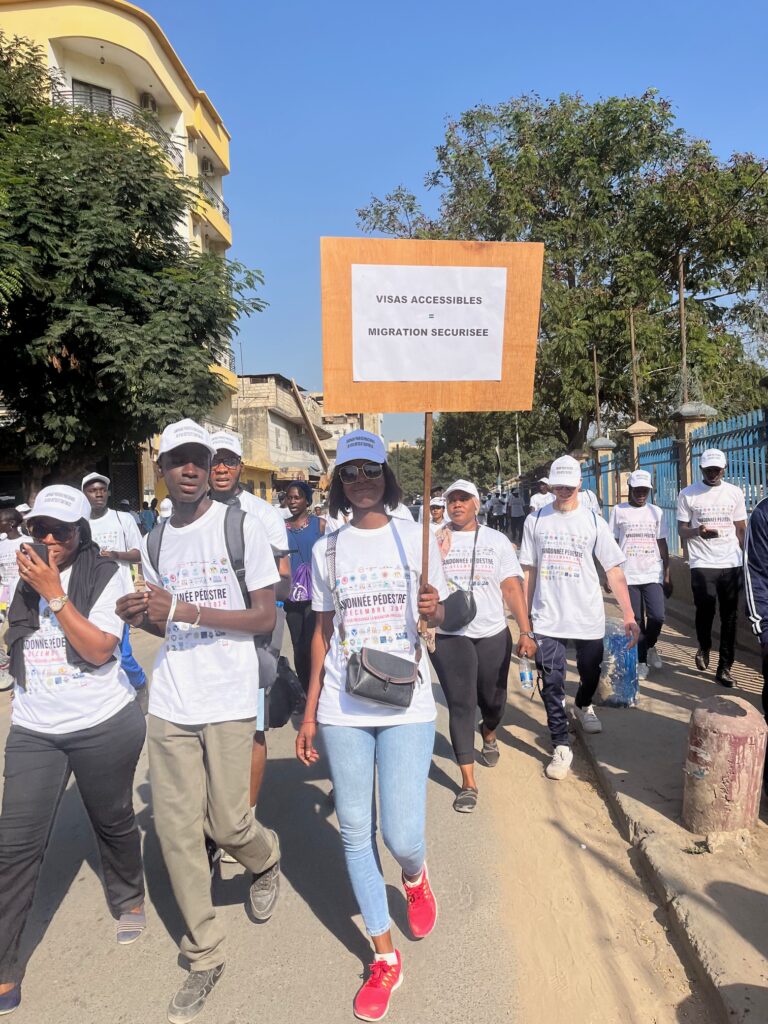
A walk organised as part of a campaign for fair and equitable visa procedures, December 2024, Dakar. Source: Boza fii
Members of the Senegalese association Boza Fii have called on the authorities to change this situation by thoroughly reforming the visa system. In the manifesto “Down with the visa system”, they denounce costly, opaque, and unfair procedures, and call for the simplification of the process, the reduction or reimbursement of fees in the event of refusal, as well as fairer access to international mobility. They also call on the Senegalese and European authorities to guarantee freedom of movement as a fundamental right, and to put an end to policies that drive some applicants to take dangerous migration routes.
3.5 Spain
The Schengen visa regime in Spain
The short-stay Schengen visa (type C) is the most commonly applied for: it allows travel for up to three month within any six month period. As mentioned previously, the official visa fee is 90 euros for an adult. The minimum financial resources required amount to 118 euros per day of travel, or 1,065 euros for the total duration of the stay.
Spain is one of the most popular countries for visa applications, ranking second in the EU behind France. In 2024, it received approximately 1.63 million Schengen visa applications, of which nearly 1.3 million were approved with a refusal rate of around 15.7%. As Spain is classified by the EU as a country “under migratory pressure” consular services are exercising increased vigilance towards certain nationalities, particularly those from North Africa. The geographical disparities are striking. Refusal rates range from under 5% in East Asia to over 35% in Algeria and 20.1% in Morocco. The nationalities most discriminated against by the European Commission’s blind faith in its ‘migration risk’ indicator remain those from the Maghreb countries, with Algeria at the top of the list. Whilst these rates may still seem low, it is worth recalling all the obstacles analysed in the introduction and detailed by comrades on the ground in the various countries of the region. Access to the visa application process itself is impossible for the majority of people.
Based on the field experiences reported in the previous sections, it appears that it might be easier to obtain a visa for Spain than for other European countries. However, this assertion must be nuanced. There is a correlation between the number of applications processed and the number of refusals. The more applications a country receives, the more its refusal rate tends to fall. Caution is therefore warranted regarding the assertion that Spain is more lenient than other European countries.
Corruption schemes
Furthermore, cases of corruption and structural failings within the Spanish consular system seriously undermine the notion of Spain being more accessible than its neighbours. In 2023, the Spanish Ministry of Foreign Affairs conducted an investigation into a corruption scheme at the Spanish Consulate General in Tangier, where intermediaries had free access in and out of the consulate itself, dodging bureaucratic barriers with full impunity. This scandal is not an isolated incident but a symptom of a system rotten to the core.
In Morocco and Algeria, the outsourcing of application processing to private companies such as BLS International (see introduction) has paved the way for the commodification of visa access. For several years now, we have witnessed the transformation of consular appointments into a veritable black market, where intermediaries snap up available slots via dedicated platforms to resell them at exorbitant prices.
In Senegal, victims have paid several million CFA francs to intermediaries who provided them with forged documents attesting to supposed appointments at the Spanish embassy. These fraudulent practices, fuelled by the intended scarcity of slots and the opacity of procedures, lead to the inclusion of fraudulent or falsified documents in certain applications, sometimes without the applicant’s knowledge, resulting in refusals and permanently compromising applicants’ future prospects at all Schengen consulates.
Far from being accidental failures, these “systems within the system” are the direct consequences of a migration policy based on a neo-colonial logic that deliberately creates inaccessibility.
Extraordinary regularisation of migrants in Spain
In the coming months, the Spanish government will carry out an extraordinary and massive regularisation (which could benefit up to 800,000 people) of foreign nationals in an irregular situation. This decision did not arise in a ministerial office or in the mind of a politician in a spontaneous burst of humanism. It is the pressure from collectives of migrants, anti-racists and allies, united under the Regularización Ya platform, who have succeeded, after years of struggle and political strategies, in bending the government to their will. Alarm Phone celebrates this victory and warmly congratulates those who have led this struggle, which will change the lives of thousands of people. Well done!
This victory, significant as it is, will not silence the groups that wrestled this concession from the government regarding the structural racism embedded in Spanish law. The extraordinary regularisation is open only to those who arrived in Spain before 1 January 2026. Those who continue to arrive every day since that date are subject, exactly as before, to the Ley de Extranjería. This “law on the rights of foreigner citizens”, which legalises immediate deportations at the borders of Ceuta and Melilla, criminalises mobility, creates irregularity and condemns hundreds of thousands of people to live in fear and precariousness. For the Regularización Ya platform, the next objective is the repeal of this law.
The organised civil society is not fooled by the contradictions of Pedro Sánchez’s government. Whilst Spain appears to be swimming against the tide of its European neighbours in its migration policy, one must look beyond grand declarations and spectacular measures.
An opening speech, actions aligned with EU migration policy
Behind a progressive rhetoric, carefully cultivated by the Prime Minister, an examination of the Spanish state’s practices reveals a different reality. Since 2006, Spain has contributed to the funding of detention centres for migrants in Mauritania, regularly criticised for their conditions of confinement, and continues to support security measures in the region through funding and significant police cooperation. More recently, agreements backed by the European Union have allocated over €210 million to Mauritania to strengthen interceptions, checks and deportations beyond European borders, whilst Spain has stepped up its partnerships with countries such as The Gambia and Senegal to curb departures, notably through support for local security forces and surveillance measures. This approach is accompanied by recurring violence at the borders themselves, as illustrated by the Tarajal massacres in Ceuta in 2014 and in Melilla in 2022. Far from being isolated incidents, these episodes reveal the consistency of a system based on deterrence, violence and the shifting of migration control beyond its borders. The Spanish state’s actions are fully in line with the European architecture of border control and externalisation. The barriers in Ceuta and Melilla are among the worst manifestations of this.
Neither forget nor forgive for Tarajal. Neither forget nor forgive for Melilla. The extraordinary regularisation will not make us lose our memory. It does not atone for decades of pushbacks, violence and state impunity. It will not succeed in concealing the boats abandoned at sea, whilst the drop in arrival figures is cynically touted as a success of Spanish “migration management”. We do not forget. We do not forgive.
4. Shipwrecks and people missing at sea
As highlighted earlier in the statistical section of this report, fewer arrivals do not mean fewer crossings: how many boats have gone missing? Documenting invisible shipwrecks and people missing at sea is particularly challenging, given the difficulty of finding traces and evidence of these disappearances. Such documentation is also largely unrecognised: unconfirmed disappearances, for example due to the absence of bodies or survivors, do not feature in official statistics.
Border externalisation policies are therefore not only deadly but also invisibilise the crimes against humanity they cause. To quote Rachida Brahim, “race kills twice“. The first form of violence affects a person’s physical integrity, in this case by forcing people to undertake increasingly dangerous journeys. The second form of violence occurs at an institutional level, through impunity.
It is to confront these deadly policies that it is also important for us to dedicate a section of every report to shipwrecks and missing persons, to keep their memory alive, beyond merely the situations we have become aware of through the Alarm Phone emergency hotline. This is also why, every year, CommémorActions are organised in numerous cities – in over 70 cities last February. They combine our grief and our anger, our commitment to honouring the memory of those who lost their lives or went missing in their quest for freedom of movement, and our demands for justice.

Commemoractions in Mbao, February 2026. Source: commemoraction.net
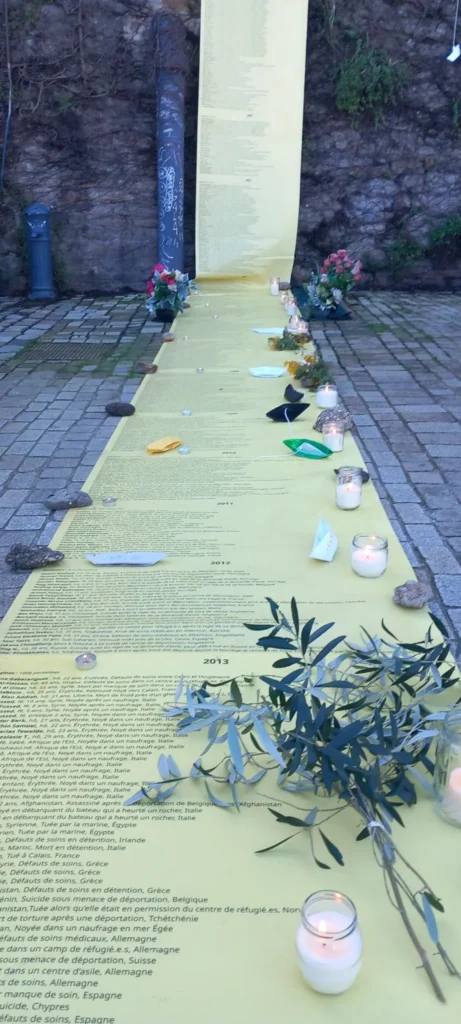
Commemoractions in Douarnenez, February 2026. Source: commemoraction.net
On 26 August, 10 people set off from Tipaza in Algeria. A week later, the authorities are still refusing to provide any information and the group is still missing.
On 3 September, the body of a drowned person was found floating in the waters near Punta Almina on the coast of Ceuta.
On 3 September, 17 days after leaving Algeria for Palma, three people were rescued near Alicante; two of them were taken to hospital. Five people died during the crossing.
On 3 September, a boat that had been adrift for three days near Ibiza was rescued. Two people from the group went missing after jumping into the water in desperation, according to accounts from the six other survivors. The group of eight Algerians had set off three days earlier from Domingo de Cherchell on 31 August.
On 3 September, the body of a drowned person was found floating in the waters near Punta Almina on the coast of Ceuta.
On 3 September, the bodies of seven people who had been onboard various boats were found in Almería, six of them in the waters off Carboneras and a seventh on the beach at Las Salinas de Cabo de Gata in Nijar. The six deceased individuals found in the waters off Carboneras were believed to have been on board a ‘go-fast’ boat on which 26 other people were travelling, who managed to reach Los Muertos beach by their own means. The seventh deceased person was likely on board a boat from which 37 people, including two women and three children, were rescued and subsequently taken into the care of the Red Cross. On 4 September, the body of an eighth person who had been travelling on board one of the boats heading for the coasts of Carboneras and Níjar, and on 8 September, the body of a ninth person, were found in the Torreón de Cabo de Gata area.
On 5 September, two children, Tawfiq and Mohamed, originally from Beni Said in the province of Tetouan, died in the waters off Ceuta after leaving Morocco together. Their bodies were recovered in the Sarchal and Recinto areas by the Spanish authorities and were identified by a relative.
On 3 September, a boat that had been adrift for three days near Ibiza was rescued. Two people from the group went missing after jumping into the water in desperation, according to accounts from the six other survivors. The group of eight Algerians had set off three days earlier from Domingo de Cherchell on 31 August.
On 7 September, a boat carrying 23 people left Bourmedès in Algeria bound for Palma de Mallorca. Two weeks later, there is still no news of the group, who remain missing.
On 10 September, three bodies of people who drowned whilst attempting to swim to Ceuta from Morocco were recovered by the Spanish authorities. One body was found near the coast of San Amaro and two in the Sarchal area. All three were likely under the age of 20.
On 13 September, a boat carrying 13 people who had set off from Bourmedès on 9 September capsized off the Algerian coast. One survivor was brought back to Bourmedès. The other 12 people are still missing.
On 13 September, the body of a person who had drowned was found in the waters off Ceuta near Almadraba beach and the Tarajal border post separating the city from Morocco.
On 14 September, a group of 24 people set off from Ain Taya in Algeria. Six days later, the group is still missing.
On 21 September, a group of 13 people set off from Algeria bound for Palma de Mallorca. Sixteen days later, the group is still missing despite searches by the Spanish authorities, suggesting another unseen shipwreck.
On 25 September, a group of 43 people, including three children, left Boujdour via the Atlantic route. A week later, the group is still missing.
On 26 September, a group of seven people set off from Algeria bound for Palma de Mallorca. Despite searches by the Spanish authorities, three days later the group has still not been found and remains missing.
On 28 September, a boat carrying 27 people left Réghaïa in Algeria for Palma de Mallorca in Spain. More than a week later, the boat remains missing.
On 29 September, the body of a drowned person was found near Chorrillo beach in Ceuta, located close to the Tarajal border.
On 30 September, the body of a drowned person was found in the Sarchal area of Ceuta. 11 bodies were found on the Ceuta coastline in September alone.
On 30 September, the body of a drowned person washed ashore on the coast of Findeq in Morocco.
On 2 October, a boat that had left Algeria on 27 September with 26 people on board capsized. Only seven people survived.
On 3 October, a body was found several miles off the coast of Formentera in the Balearic Islands.
On 8 October, the body of a person floating in the water was found two miles off Talamanca Bay in Ibiza, in the Balearic Islands.
On 10 October, the body of a 23-year-old Algerian man, according to the papers he was carrying at the scene, was found 200 metres off the coast of Playa de la Ribera, in Ceuta, Spain.
On 12 October, a body was found on the shore at Playa del Dosel in Cullera, in the Valencia region of Spain.
On 13 October, a body was found off the coast of Martil in the Tangier-Tetouan region – Al Hoceima region of Morocco.
On 13 October, a body, believed to have been at sea for two months, was found off Cala Murada beach in Palma de Mallorca, in the Balearic Islands.
On 13 October, a body was found in the Rocosa area of Menorca in the Balearic Islands.
On 14 October, a group of 51 people set off from Agadir aboard a rubber dinghy. Their relatives heard from them for the last time two days later, when the boat was 120 kilometres from Lanzarote in the Canary Islands. The people have been missing ever since.
On 14 October, two bodies were found in Ceuta, one washed up on Almadraba beach and the other a mile offshore from the bay.
On 15 October, a body was found off the coast of Juan XXIII in Ceuta.
On 14 October, the body of a drowned person was found on Els Molins beach, seven kilometres north-west of Denia in the province of Alicante, Spain.
On 16 October, 47 people left Boujdour on board a boat bound for the Canary Islands. They have been missing ever since.
On 16 October, several people onboard a rubber dinghy jumped into the water in an attempt to reach a merchant ship 83 kilometres east of the coast of Lanzarote. The ship alerted the Spanish authorities and managed to rescue one person, whilst another was brought to safety by a Spanish rescue vessel. At least two other people are missing at sea after jumping towards the cargo ship. Fifty-five people of sub-Saharan and North African origin, including 42 men, 11 women and two minors, were subsequently rescued and taken the port of Arrecife during the night.
On 18 October, a group of 22 Somali nationals set off from Bourmedès in Algeria bound for the Balearic Islands aboard a fibreglass boat. The group has been missing ever since.
On 19 October, a group of six people left Algiers for Spain. A week later, the group is still missing.
On 20 October, a body was found off the coast of Almuñécar in the province of Granada.
On 20 October, a group of 19 people set off from Mostaganem in Algeria across the Mediterranean Sea. Five days later, the group is still missing.
On 23 October, a boat carrying a group of 24 people was found adrift off the coast of Lanzarote. The group had set off from Tan -Tan, and it is possible that the original group was larger and that some people went missing during the crossing.
On 24 October, a group of 24 people set off from Bourmedès in Algeria. They have been missing ever since.
On 24 October, a group of 27 people set off from Bourmedès in Algeria. They have been missing ever since.
On 25 October, a boat carrying 150 people set off from Jinack in The Gambia and has been missing ever since.
On 26 October, a boat carrying around 100 people set sail from The Gambia bound for the Canary Islands and has been missing ever since.
On 28 October, the body of a deceased person was found in the waters off Cala Rajada in the Balearic Islands, 14 miles from the town, by the Spanish authorities, following an alert raised by a fishing boat. It may be a person who attempted to reach the Balearic coast aboard a makeshift boat.
On 29 October, the body of a drowned person was found 25 miles off the coast of Palma de Mallorca in the Balearic Islands.
On 2 November, the body of a drowned person was found on the coast of Mallorca in the Balearic Islands.
On 2 November, a boat carrying a group of 25 people arrived at Granatillas beach in Mojácar, Almería. The group included one dead person on arrival, as well as 12 injured people, one of whom was taken to hospital.
On 3 November, the body of a person who had likely attempted to swim to Ceuta was found offshore between Almadraba and Tarajal.
On 3 November, the body of a person was found on the cliffs at the port of Carboneras, east of Almería in Spain.
On 5 November, a boat carrying around 200 people set sail from The Gambia and has been missing ever since.
On 9 November, the body of a person was found washed up on Tarajal beach in Ceuta.
On 10 November, a group of around 200 people set off from The Gambia for the Canary Islands via the Atlantic route. Since then, there has been no contact with the boat and the group is missing.
On 12 November, at least one person died onboard a boat intercepted by the Algerian coastguard whilst it was heading for the Balearic Islands after setting off from Tipaza. The five other passengers survived.
On 12 November, 14 people went missing after leaving Dellys in Algeria en route to the Balearic Islands.
On 13 November, a boat heading for the Canary Islands with several hundred people on board capsized off the coast of Nouadhibou in Mauritania. The boat had set sail from The Gambia and spent 13 days at sea before capsizing. The deaths of seven people were confirmed, with others still missing. Several of the passengers were young people from Bonfi, a neighbourhood in Conakry, Guinea.
On 13 November, a person fell overboard during a boat crossing. Their body was recovered by Salvamento Marítimo 55 miles south-east of Cartagena in the late afternoon. 17 other people on board were rescued. The alert had been raised by a merchant ship that very morning.
On 14 November, 12 people set sail from Algeria for Sardinia onboard a boat. A week later, the group is still missing and the Italian authorities are refusing to provide any information.
On 15 November, a boat that had left Algeria on 10 November with 15 to 18 people onboard capsized. Five people lost their lives. The survivors were taken back to and detained in Algeria.
On 16 November, the body of one person was found on the coast of Carnatge, approximately 8 kilometres south-east of Palma de Mallorca in the Balearic Islands.
On 17 November, five people were rescued south of Cabrera, after having been adrift for nine days. The boat had set sail from Algeria with 23 people on board. The missing people are believed to have jumped overboard during the crossing.
On 17 November, nearly 100 people, including around 50 women and a few children, set off from Jinack in The Gambia bound for the Canary Islands. The boat has been missing since.
On 18 November, the body of a drowned person was found on Fuente Caballos beach in Ceuta.
On 20 November, a pirogue carrying 227 exhausted people, some of whom were unconscious, including 12 women and two children, was intercepted by the Royal Moroccan Navy. At least seven people died of cold, hunger and thirst during the crossing and their bodies were cast into the Atlantic. The boat had set sail from The Gambia, picking up its first passengers in Bafaloto, about 20 kilometres from Banjul, and a second group in Barra, bound for the Canary Islands. The group drifted for nearly 10 days in the Atlantic.
On 22 November, a boat carrying 22 people that had left Bourmedès in Algeria on 10 November capsized. Only five people survived and are in hospital in Ibiza. Bodies are still missing.
On 27 November, a body was found off the coast of Benzu in Ceuta.
On 29 November, the lifeless body of one of the passengers on a canoe that had set sail from Senegal for the Canary Islands was found in Félane. 115 people were arrested by police from the Foundiougne and Joal brigades.
On 29 November, a body was found in La Restinga Bay following a report from a villager who had spotted a person swimming in the area. It was Souleymane Foreseri, one of the passengers on the pirogue that arrived in El Hierro that same morning after being rescued less than two kilometres from La Restinga. On 2 December, he was laid to rest in El Mocanal cemetery, in Valverde. 214 people survived, including 22 women and five minors. These passengers reported that three others people died during the crossing.
On 30 November, more than 121 people aged between 15 and 35 were rescued by Salvamento Marítimo 30 km south of El Hierro in the Canary Islands. The group had set sail from Jinack in The Gambia on 21–22 November. Four people on board the pirogue died during the crossing. Thirteen people were taken to hospital, at least one of whom was in a serious condition due to hypothermia.
On 3 December, the body of a drowned person was found off the coast of Benzu in Ceuta.
On 5 December, a boat set sail from Nuimi Jinack in The Gambia, having stopped off at Mbour in Senegal. More than 250 people were on board, including 29 women and children, mostly from sub-Saharan Africa, and 164 Gambians . The boat was last sighted during the night of 5–6 December by fishermen near Mbour in Senegal. Searches were conducted in Senegal, Mauritania, Morocco, Cape Verde and the Canary Islands (El Hierro, Las Palmas, Tenerife), but no trace of the vessel has been found. According to the information gathered, the boat did not reach Spain. All indications are that it sank and that no survivors have been found.
On 8 December, a boat that had set sail from Bourmedès capsized 32 miles off the Algerian coast. A merchant ship raised the alarm upon spotting the wreckage and rescued two people. According to the testimony of these two survivors, the group comprised 22 people, all of Somali origin, including seven young women. Twenty people are therefore missing following this shipwreck.
On 10 December, 89 Senegalese were intercepted by the Mauritanian authorities off the coast of Nouadhibou after seven days at sea. At least four passengers died during the crossing, including a woman and Khadim Ndiaye and Cheikh Ndiaye, from Touba. Two fell overboard due to rough seas; another was found dead after being overcome by fuel fumes whilst seeking shelter from the cold in the compartment containing the fuel cans; the fourth died whilst being taken into care in Nouadhibou, according to the police. The group reported that the boat had set sail from Gambia and that they had turned back after seven days at sea because their supplies had run out.
On 10 December, a boat that had set sail from Zeralda in Algeria bound for the Balearic Islands was found adrift 150 km off the Algerian coast by a Maltese oil tanker. The tanker provided assistance until the Algerian authorities arrived. Of the group of 24 people on board, only ten survived. Among those who died were three siblings, Ranima (aged 12), Zizo (aged 3) and Abdelilah (aged 18 months), who lost their lives during the crossing. Their parents, including their mother who was nine months pregnant, managed to survive but were detained in Algeria.
On 11 December, ten people died in a shipwreck between Algeria and the Balearic Islands – five bodies were recovered and five are missing at sea. Among the victims were five of the six children (all the youngest), three women, one of whom was nine months pregnant, and two men. The boat set sail on 9 December from the coast of Tipaza, with a group of 23 people on board, all Algerian. Thirteen survived, rescued by the Algerian authorities after the wreckage was spotted by a Salvamento Maritimo reconnaissance aircraft.
On 11 December, a group of 17 people set off from from Algiers across the Mediterranean Sea. On 5 January, the group is still missing.
On 11 December, a group of around 10 people left Mostaganem in Algeria for Spain. More than a week later, the group is still missing.
On 11 December, a group of 17 people set off from Algiers on a boat across the Mediterranean Sea. Relatives have had no news and the group has been missing ever since.
On 14 December, the body of one person was found on San Lorenzo beach in Melilla, Spain.
In mid-December, Mohamed Allou, aged 22, went missing whilst attempting to reach Melilla.
On 24 December, Soufiane Bahida, aged 27, also went missing at sea, attempting to swim to Melilla from Nador.
On 24 December, a small boat en route to the Canary Islands, carrying around 200 people, capsized off the coast of Joal, in the department of Mbour, south of Dakar. Twelve bodies were recovered, and around thirty people survived. Many people are still missing.
On 25 December, a pirogue carrying 200 people capsized in Joal, Senegal, leaving 12 dead. 31 people were rescued and detained by the police.
On 28 December, a group of 14 people aboard a small boat left Annaba in Algeria bound for Italy, and has been missing ever since.
On 28 December, a shipwreck occurred in the western Mediterranean. Only two of the 21 people on board survived and were returned to the desert in Niger by the Algerian authorities.
On 29 December, the body of a drowned person was found between Cala Millor and Sa Coma in the Balearic Islands.
On 29 December, the body of a drowned person was found on Calamocarro beach in Ceuta.
On 29 December, the body of a drowned person was found floating in the waters off Punta de n’Amer, on the Balearic Islands route.
On 29 December, a group of 18 people set off from Algiers for Spain aboard a boat across the Mediterranean Sea. Despite searches carried out by the authorities, the boat remains missing. A week after their departure, no arrivals in the Balearic Islands appear to match the description of this group, suggesting another unseen shipwreck.
On 30 December, the body of a drowned person was found on Sarchal beach in Ceuta. The number of people who died on the coast of Ceuta whilst attempting to swim across from Morocco stood at 46 in 2025, more than double the number in 2024. The majority are Moroccan and Algerian nationals. Three of the deceased were of sub-Saharan origin.
On 30 December, 27 people set off from Essaouira in Morocco for the Canary Islands. On 11 January, their relatives have received no news and the group is still missing.

