Content warning: This testimony contains descriptions of racism, kidnapping, physical violence and death of a baby
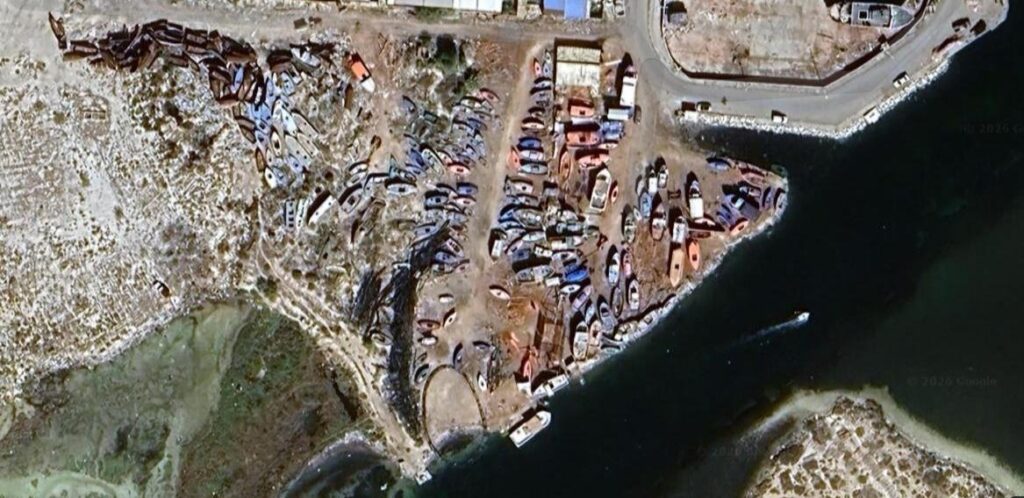
Scrapyard for boats close to the port of Chebba, bearing silent testimony to the amount of interceptions being conducted. Screenshot from google.maps.com
On 15 of January 2026, Alarm Phone spoke with Gimmy, who was able to flee from being detained in Libya after he was deported there from Tunisia. We are very relieved to hear he managed to escape, but are shocked to hear his experiences:
“We departed from the region of Sfax in the evening of 16 December. Besides me there were 51 men, two women and two babies, one was one month old and the other 19 days. In total 56 people on the boat. Most of the people were from Sudan, two from Cameroon and the rest from Guinea-Conakry. We used an iron boat with a 75 HP engine. After around four hours at sea, in the early morning of the next day, the engine broke down after we had made 54 kilometers. We tried to restart it, but it did not work, so after three more hours, the mothers started to call the Tunisian Coast Guard. Once we managed to establish a connection, they asked us who we were. When we told them, they said ‘If you are Sudanese, we are not coming to rescue you.’
We managed to find another phone number of Tunisian authorities, they told us ‘maybe we can rescue you later, when we have time, in the evening or the next morning.’ Indeed, they did not show up.
In the evening, after we were drifting for more than 12 hours, a boat with a single person showed up. The man spoke in French with a Cameroonian person from our group. He left again without saying if he will return and without supporting us in any way.
The next morning at around 4am, the Tunisian coast guard finally showed up, after we had called them four more times. They brought us to the port of Chebba, where they took away all our money, our phones and passports. After four more hours, they announced we would be brought to the border with Libya. The women and children among us started to cry. Buses arrived and we were driven to the Libyan border, where an armed group was already waiting. We were exchanged for two pick-ups full of fuel.
The Libyan armed group brought us to al-Assah camp. Their cars were labeled with “police.” The camp was very full already, there were two parts, a smaller and a bigger one. I was brought to the smaller one, which consists of four compartments. I counted the people when I entered the first day, there were 201 people in this section. Most of them were from Nigeria, but also many people from Somalia, Egypt, Bangladesh and Guinea-Conakry were held there.
The guards demanded 2500 Libyan Dinars for our release (~400 EUR), for others the price was 2000 LYD, from every nationality they asked a different price. Once they realized we did not have any money left, they agreed to let us free for 1000-1500 LYD. Those who could pay were brought to Zuwara and released there. I did not have any money left, so I asked a friend who has a job in Libya. He could not provide 2500 LYD but offered to send me 1000 LYD. But once I paid, they refused to let me free.
All of the guards were Black, too. They came from Chad, Nigeria, Guinea-Conakry or Cameroon and also used violence against us. Their boss was Libyan and he was very violent, he did come every three or four days and beat us one-by-one while saying ‘this is your punishment.’
Initially, we ate one meal every 12 hours, meaning two meals a day. Six people shared a plate for the Africans and three for the Egyptians and Bangladeshis. After the first week, this waschanged to only one meal every 24 hours. This situation created health problems for us, and during these days many people became sick. The mother of the 19-days old baby could not produce enough milk anymore to feed it. One day, the baby died.
The guards told me I‘d have to work four to five months for them before being released. On the 11 January, when they brought us outside to work, I managed to flee. After 25 days in al-Assah, I am now not anymore in direct danger.
This short period was the worst time of my entire life because every day I witnessed unacceptable things with my own eyes: torture and racism towards Black prisoners. For example, during torture, they wouldn’t torture Egyptians or Bangladeshis, for unknown reasons. Now I could flee, but Libya is the most unsafe place for migrants so I don’t know what‘s gonna happen to me today or tomorrow.”
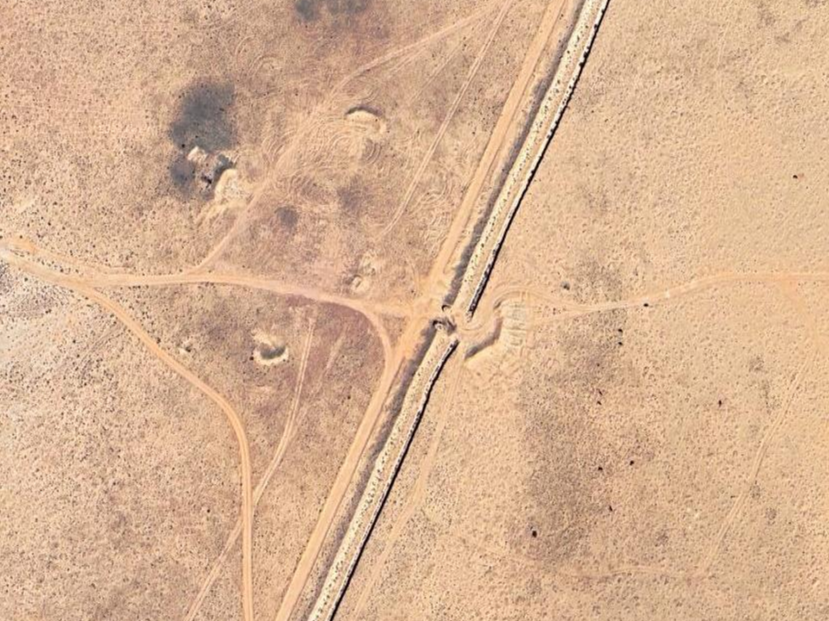
A breach in the sandwall between Tunisia and Libya close to al-Assah, often used to pass people from one side to the other. Screenshot from google.maps.com
Lately, Alarm Phone has been informed on several occasions about these deportations towards al-Assah, directly from the ports of Sfax or Chebba. This despicable deportation regime turns people into commodities, objectifying them as goods, instrumentalised for profit.
The statements made by the Tunisian Coast Guard to not save people from Sudan are outrageous and the effectively delayed rescue for around 18 hours directly exposed 56 people to death.
Gimmy identified the armed group responsible for the violence inflicted on the Libyan side by recognising the logo and the cars they used as the Libyan Border Guard. This group is part of the Ministry of Interior and therefore under direct control of one of the EUs preferred partners in border externalisation, the Government of National Unity.
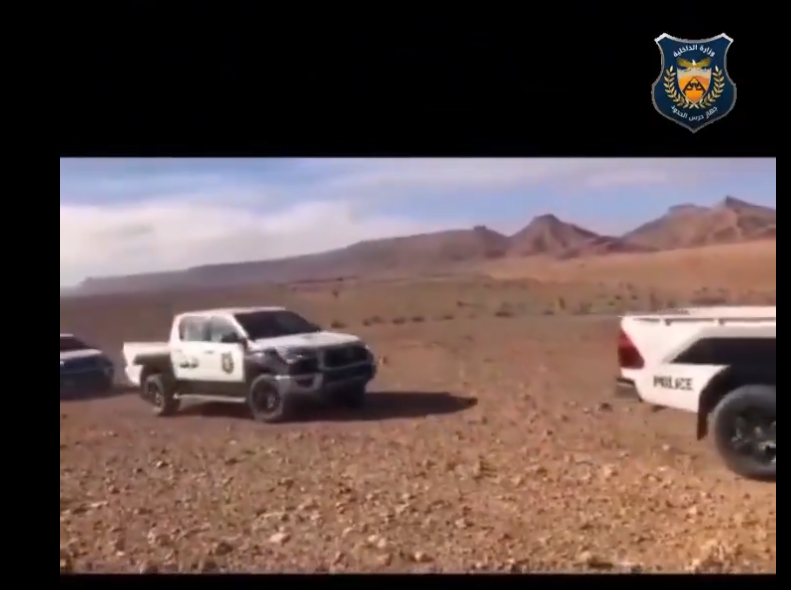
Image showing the logo and cars recognised by Gimmy, identifying the Libyan group as Libyan boarder Guard (MoI). Screengrab from Twitter
This is yet another example how the externalisation of Europe’s border regime creates a system where ruthless groups can thrive and even get financed or equipped, as long as they manage to hinder people from moving north. The anti-Black racism motivating the different forms of violence mentioned, once again gets instrumentalised by Europe, even rewarded and increased. With lots of rage Alarm Phone will continue to struggle against this regime.

