Families of disappeared persons, ASGI and Alarm Phone demand answers: How can a boat disappear in a region refered to as «one of the most closely surveilled areas of the world»?
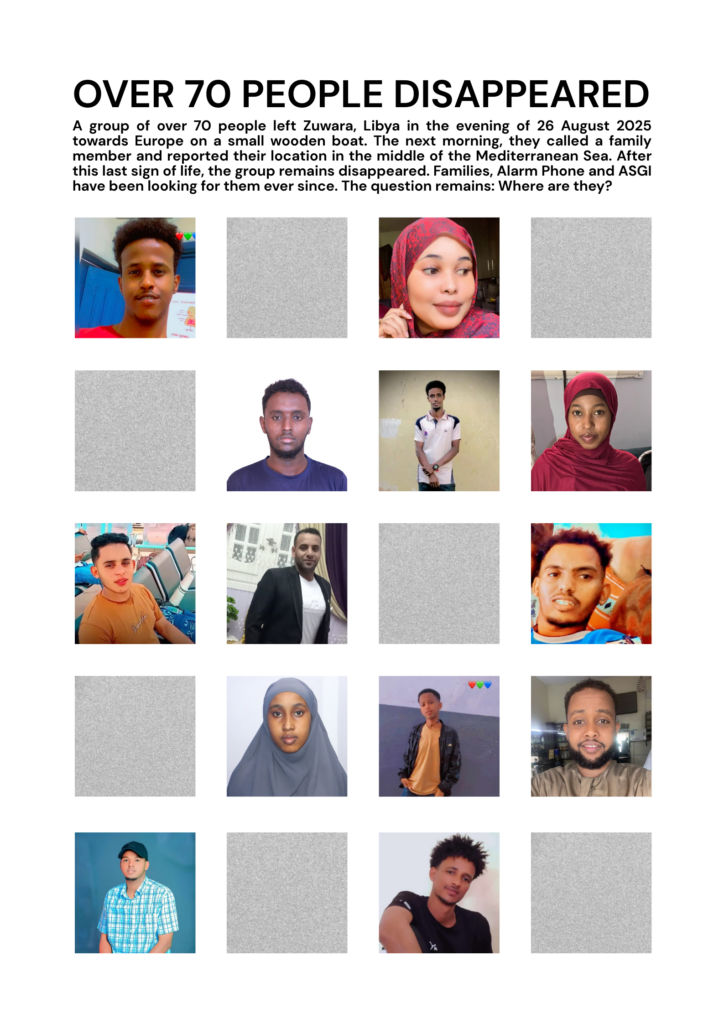
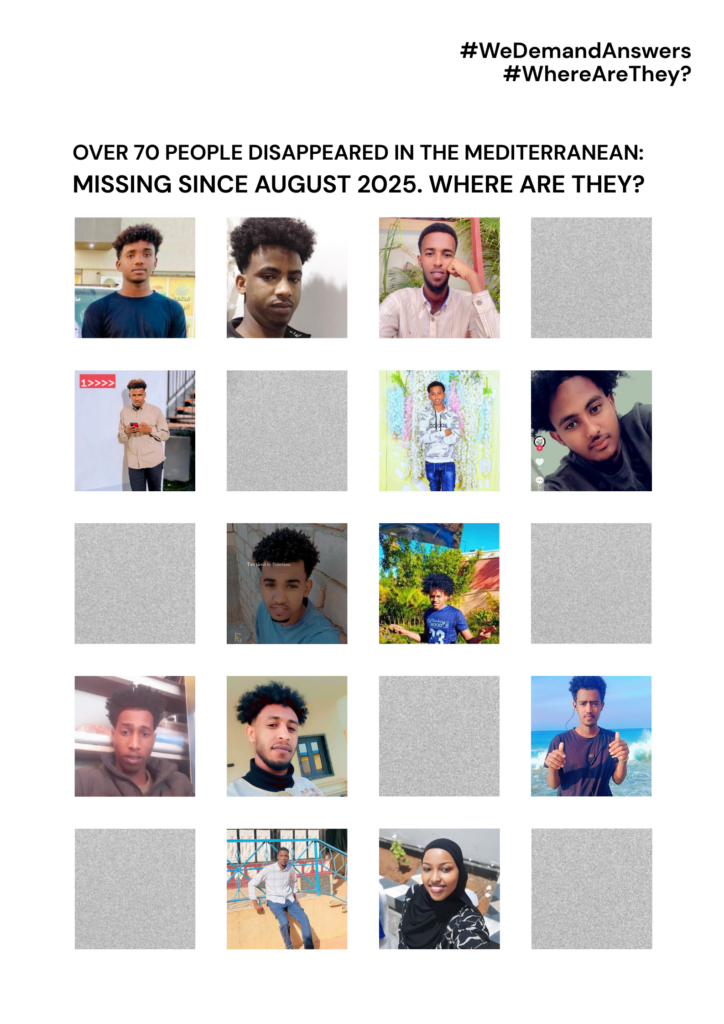

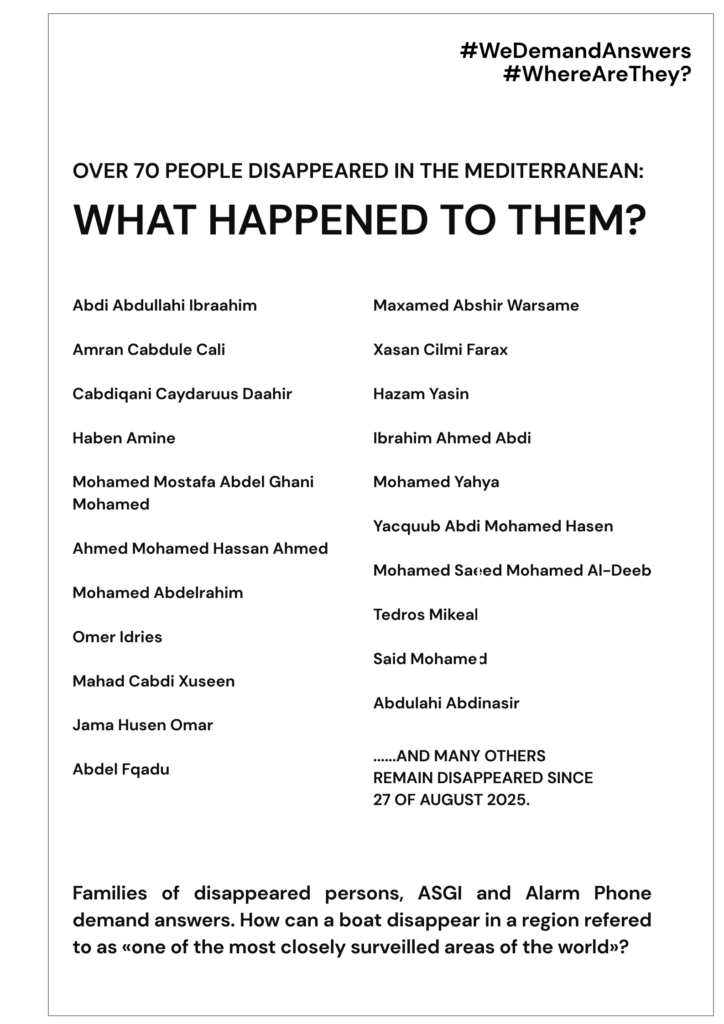
A few hours after midnight on 28 August 2025, Alarm Phone was informed about a boat that had left the Libyan shores two days earlier, at 22pm on 26 August. A relative managed to receive a position (N 034°00’19.33″ E 011°53’42.491″ @ 07:55 CEST 27 AUG), that is 64 nautical miles north of Zuwara and 95 nautical miles south-west to Lampedusa. He also tells us most of the people on the boat are from Somalia, while others are from Egypt, Eritrea, Pakistan and Bangladesh. After trying several times to reach the boat via their satellite phone number, Alarm Phone alerted all relevant authorities about the lack of news from the group at 03:39 CET 28 August. Without updates, we at least know authorities can find out the location of the phone during its last connection to a satellite from the phone company «Thuraya».
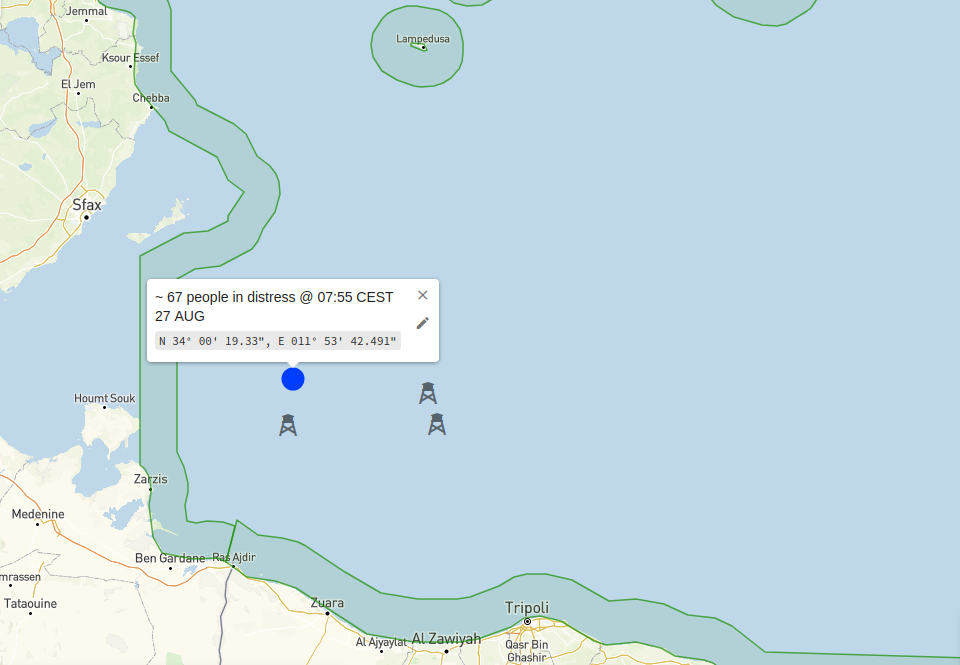
The location of the group in the morning of 27 August, its last trace. Screenshot taken by Alarm Phone.
During 28 August, Alarm Phone tried to get information from the so-called Libyan Coast Guard which was not answering the phone. According to the information we managed to receive, no such boat was returned to Libyan shores the days before. Since many different armed groups carry out interceptions and manage camps or prisons where people on the move are held captive, we cannot know with certainty that the group was not brought back to Libyan shores. Still we believe we would have gotten a sign by now if they were returned, because the armed groups would have reached out to the families to extort ransoms for the release of their relatives.
On 29 August, Alarm Phone was repeatedly in contact with MRCC Tunis, which after some time and consultations told us they did not rescue or intercept any group in the previous days. Alarm Phone continued calling the satellite phone number of the boat until 30 August, but could never reach them.
Soon, unconfirmed hope spread, suggesting that the boat had been rescued by either Sea-Eye 5 or Sea-Watch 5 which were both operating in the area at that time. Sadly, shortly afterwards it became clear the NGOs rescued different boats. Sea Watch 5 rescued 65 people on 26 August,[1] while the group we were looking for was still at sea. Sea Eye 5 rescued 144 people from a wooden boat on 31 August,[2] as both NGOs confirmed, neither of them could match the boat we were looking for.
Also, no boat arrived to Lampedusa on their own means or through rescue by the Italian Coast Guard and not to Malta either.
The question remains: where are they?
More and more families got in touch with Alarm Phone and ASGI Medea in their search for missing loved ones. An extensive list of passengers was created with information on 73 people. During the weeks and months after the disappearance, several family members received calls from European phone numbers, mostly Italian ones, sometimes from Germany or north-America. If picked up, there was silence on the other end, and the numbers could neither be called back, nor identified. In September, one family was called by their relative who reported being in an Italian prison on an island whose name he did not know. Also this number could not be called back or identified. Whether he was on the same boat as the other missing persons could not be confirmed.
Obviously, these calls ignited lots of hope but also questions about the fate of the group, even if nobody answered on the other end of the line. We often hear about such calls to families of missing persons, even in relation to other cases of missing groups. We have no certainty, we can only deduce that missing persons are not behind these calls. . With modern e-SIMs it is nowadays possible to get a mobile number from almost any country without being physically in that place. If it were the disappeared people, why do they not speak or find another way to get in touch with their families?
Either way these calls have a cruel function, namely to create lots of hope to be in touch soon with the missing loved one, without ever fulfilling it. As it is not possible for us to track back the numbers to the callers, they do not provide any trace about the whereabouts of the disappeared group.
On 4 February, families of disappeared people and ASGI Medea filed a request for access to documents for defence purposes to the Italian Coast Guard, in order to ascertain what actions were taken following the report of the vessel in distress.
The right to truth, which is primarily based on international humanitarian law, coincides with the right of family members to know the fate of their relatives (Articles 32 and 33 of the First Additional Protocol to the 1949 Geneva Conventions) and with the corresponding obligations of the parties involved in international armed conflicts to search for missing persons.
In the context of migration, as also recognised by the Council of Europe and various United Nations bodies, the right to the truth is an expression of the right to life (Article 2 of the ECHR) and also includes the right of family members to receive information about the fate of their loved ones.
The loss of a loved one, or the pain of not knowing what happened to them, can have an agonizing effect on a family. (…) Families have the right to participate in investigation, to reparation and to know the truth about the circumstances of death and location of the remains of their family member(s).
– Unlawful death of refugees and migrants, report of the Special Rapporteur of the Human Rights Council on extrajudicial, summary or arbitrary executions, Agnes Callamard
Authorities should initiate the search and investigation ex officio as soon as they become aware of or have indications, through any means, that a person has been subjected to disappearance. The burden of proof should not be on the victims or relatives. (…) States parties must ensure that the relatives of disappeared migrants, their representatives and any other person with a legitimate interest, irrespective of where they reside, are able and supported to gain access to information without delay and to take part in all stages of the search and investigation if they so wish.
– General comment No. 1 (2023) on enforced disappearance in the context of migration
The Assembly recalls that, pursuant to Article 2 of the European Convention on Human Rights, member States have a duty to prevent violations of the right to life and to investigate any cases of unnatural death or unlawful killings; it is on this basis that they must define how they tackle the issue of missing migrants, refugees and asylum seekers. The Assembly expresses its sympathy and solidarity with the families of the missing and acknowledges their legitimate quest for information. It recognises the right for adults to choose to not divulge their whereabouts to their families, but also the importance for families to know whether their relatives are dead or alive
– Council of Europe, Parliamentary Assembly, Resolution 2569 (2024) Missing migrants, refugees and asylum seekers – A call to clarify their fate
What happened to the boat that left Zuwara on August 26? What happened to the people who were on board? Families demand to know the truth. We have the right to have answers and families have the right to know what happened to their relatives.
We want answers.


____
[1] https://bsky.app/profile/en.sea-watch.org/post/3lxeshk44us2u
[2] https://bsky.app/profile/sea-eye.org/post/3lxry7jsymk2l

