Intro
In the second half of 2025, Alarm Phone was alerted to 428 boats in distress in the central Mediterranean Sea. In the prior six months, January to June 2025, we had been alerted to 334 boats on this migration route, which means that over the whole year of 2025, a total number of 762 boats reached out to us from this region. According to data by the UNHCR, arrivals to Italy via Libya and Tunisia stood at about 66,200 people at the end of 2025, which is nearly identical to 2024.
The vast majority of boats departed from Libya.
The IOM has estimated that 1,314 have died over 2025 in this central Mediterranean region. We should emphasise, however, that any statistical count of deaths and disappearances can only ever be considered as rough estimates, which need to be treated with caution. Many deaths or disappearances are never documented and so we can expect a higher death toll.
The civil fleet has continued to carry out rescues and remains resilient, despite the ongoing assault on their solidarity at sea. Alarm Phone is a member the Civil Maritime Rescue Coordination Centre. According to them, ca. 280 boats were rescued or assisted by the civil fleet in 2025.
Over the past six months, we have witnessed time and again that boats of people on the move and those of the civil rescue fleet were attacked by Libyan forces and militias. We have also witnessed repeated pushbacks (by proxy) of boats from within the Maltese Search and Rescue zone, something that the documentation of the Malta Migration Archive has also confirmed.
In this analysis, we provide a comprehensive chronology of the second half of 2025, offering in great detail an account of developments as they unfolded in the central Mediterranean Sea. As nobody else is doing so, we need to create our own archive of migrant struggles and acts of solidarity.
We will continue in our struggle alongside people on the move and document the border violence that they face. In our daily practice, we struggle against borders, for ferries, not Frontex, and the freedom of movement for all.
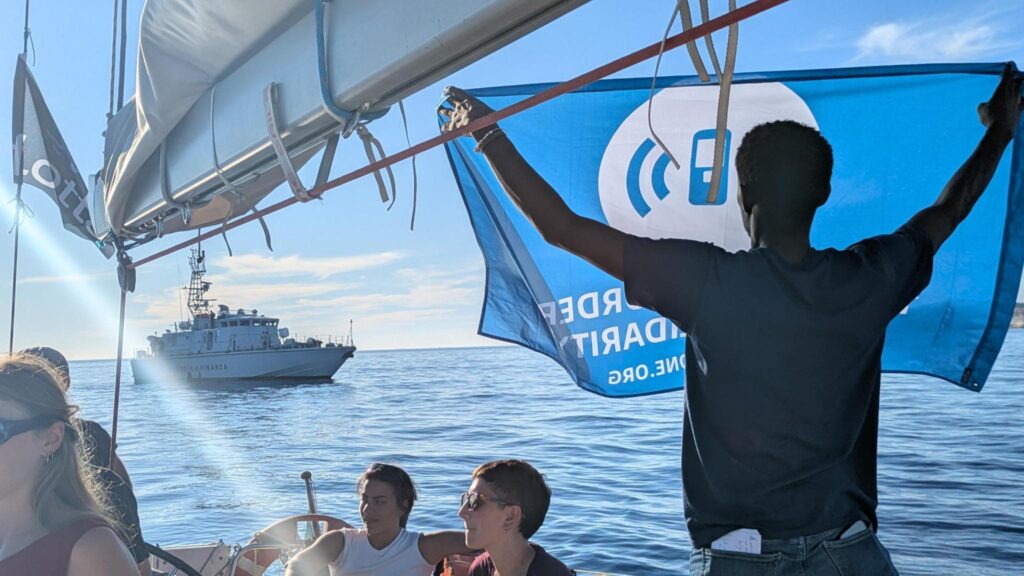
Alarm Phone boat at the f.lotta boats parade on 14 September 2025 near Lampedusa. Source: Alarm Phone
July
In July, Alarm Phone was alerted to 62 boats in distress in the Central Med, among them 55 departing from Libya and seven from Tunisia. NGO vessels rescued a total of 20 boats that month – not all of them had alerted Alarm Phone. A further two boats were rescued by merchant vessels. The Italian Coastguard rescued at least 37 boats – most of them already close to Lampedusa – and they also coordinated some rescue operations of boats heading towards Sicily or Calabria. Not a single boat was rescued to Malta. We know of three boats rescued by the Greek Coastguard, which we assume to have traveled on the route from eastern Libya to Crete. In total, we know of 18 interceptions by the so-called Libyan Coastguard. Unfortunately, we rarely receive reliable figures regarding Tunisian interceptions. Of the three shipwrecks we learned of in July, one was an Alarm Phone case from Sfax, Tunisia.
On 3 July, the NGO TOM (tuttigliocchisulmediterraneo) reported that two iron boats in the Central Mediterranean, carrying 60 and 52 people and close to sinking, had been ignored by authorities for many hours. Only their sailing boat Garganey VI responded, rescuing the first boat and assisting the second until the Italian CG eventually arrived.
On 4 July, Refugees in Libya (RiL) published a manifesto and launched a campaign to stop the renewal of the Memorandum of Understanding (MoU), signed between Italy and Libya in February 2017 on „fighting illegal migration“. This agreement, with the support of European Union funding and coordination by Frontex, has trained, financed and equipped Libyan forces who have systematically abducted, arbitrarily detained, tortured, enslaved, killed and raped people on the move.
On 5 July, Libya’s Ministry of Interior announced a plan to activate more assets to intercept migrants on the route from Libya to Italy and to Greece. On the same day, the so-called Libyan Coastguard intercepted 39 people off Tripoli and stopped a boat off the coast of Tobruk, carrying 37 people.
On 6 July, Alarm Phone was alerted by relatives about 500 people on their way from eastern Libya to Crete. 430 people were rescued south of the small island Gavdos. According to the Hellenic Coastguard, more than 750 people were rescued that day, with the survivors being transferred to Crete. Again on the following days, Alarm Phone received even more calls from boats on their way to Crete. Authorities in Greece said that more than 1,200 people on the move had been detained on the islands of Crete and Gavdos over the course of three days, following a surge in arrivals from Libya.
On 7 July, Libyan authorities shared a video of a „nice“ interception of 20 people near Zawiya. As part of the so-called summer security plan, they intercepted 54 people near Garabulli, capturing them and sending them back to detention and torture.
On the same day, Alarm Phone was alerted to two boats in distress on the way to Sicily, one carrying about 40 people, the other one 37. Both boats were eventually rescued by the Italian Coastguard.
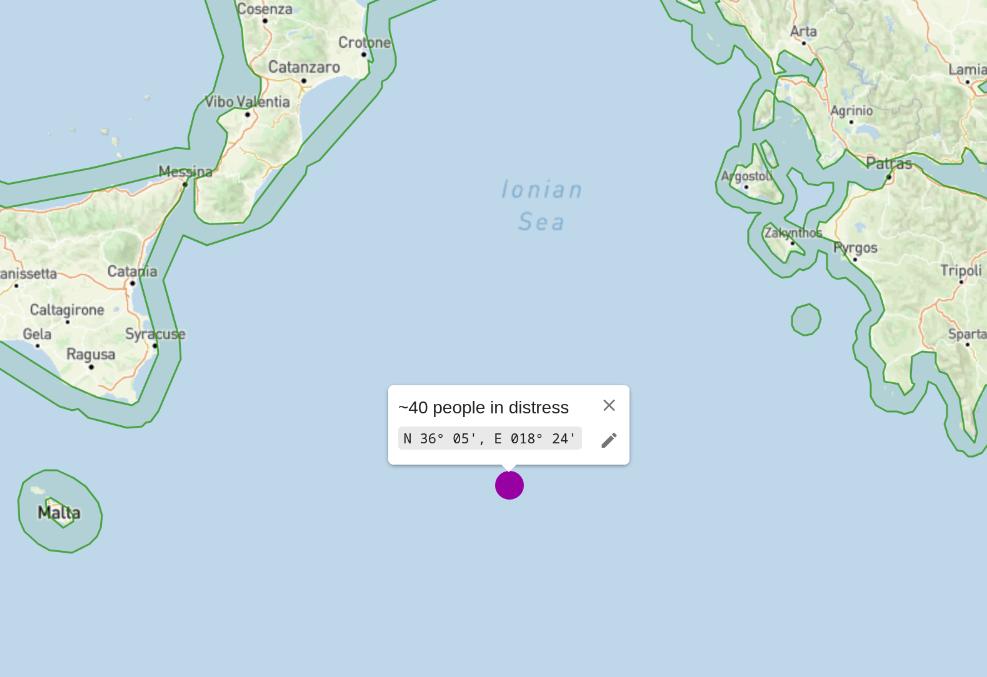
Map showing the position of the first boat. Source: Alarm Phone
On 8 July, the Libyan capital Tripoli hosted a high-level meeting on cooperation in migration, in the presence of the European Commissioner for Home Affairs and Migration, Magnus Brunner, Italian Interior Minister Matteo Piantedosi, the Maltese Minister for Home Affairs and Security, Byron Camilleri, and the Greek Minister for Immigration, Thanos Plevris. The day before, the arrival of the European politicians in Benghazi had been blocked by Libya’s eastern-based government, which accused the delegation of violating national sovereignty, bypassing diplomatic protocols, and ignoring entry procedures for foreign officials.
On 9 July, after it had been published that 7,336 refugees had arrived on Crete and Gavdos in the first half of 2025, the Greek government announced to suspend asylum applications for people arriving from Nort Africa for three months. All migrants crossing by boat from Libya would be detained without the possibility of filing a request for international protection, a violation of EU migration law.
On 10 July, Alarm Phone was alerted by 37 people, who had fled from Tobruk towards Crete. They had been drifting in the Egyptian SAR zone until the merchant vessel NORTHERN LIGHT rescued them. However, one person went overboard. The merchant vessel continued towards Egypt, which is not a safe port for these people.
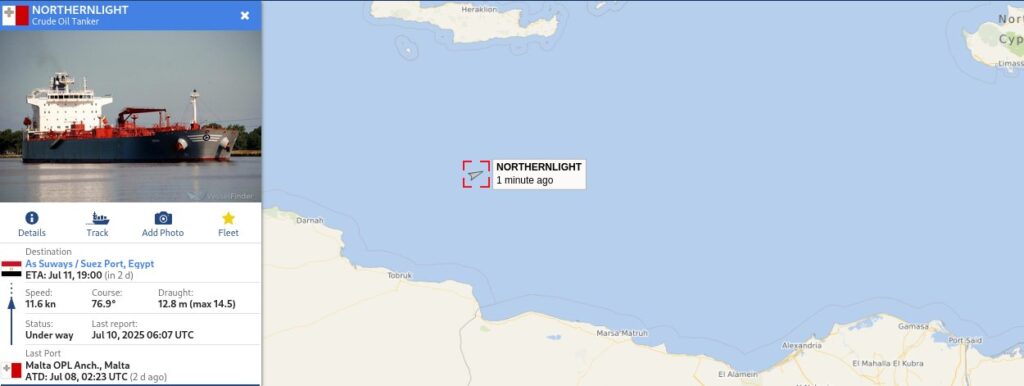
Map showing the position of the merchant vessel NORTHERN LIGHT. Source: Vesselfinder.com
On 11 July, a group of 50 people was rescued by activists of the Louise Michel. No state actors, but the civil fleet responded to the distress alert by Alarm Phone.
On 12 July, the Maldusa project reported about a boat, carrying 63 people, which had departed from Sfax, later ran out of fuel and drifted in international waters. Frontex spotted them and not only alerted the European authorities, but also the Tunisian Coastguard. Both coastguards arrived on scene. The need to prevent interception to Tunisia prompted some people to jump into the water and swim to the Italian coastguard vessel. All the women and children remained on the boat and, according to witnesses, were intercepted and deported to the Algerian desert. Only 27 people reached the Italian ship and were then disembarked in Lampedusa. At least three people drowned and one ore two went missing. The Humanity 1 was on its way to the distress case and denounced the behaviour of the Tunisian Coastguard.
On 13 July, 40 people on a boat in distress alerted Alarm Phone. The boat was stabilised by the NGO ship Aurora until the Italian Coastguard arrived and brought them to Lampedusa.
On 15 July, Alarm Phone alerted authorities to a group of about 40 people in distress off Libya, whose boat was taking in water. Later we spoke to the people again and learned that they were intercepted and brought back to Libya, from where they had tried to escape.
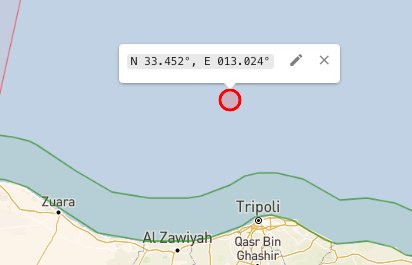
Map showing the position of the boat. Source: Alarm Phone
On 16 July, the Italian Minister of Interior celebrated that 12,338 people had been intercepted by the Libyan authorities since the beginning of the year. On the same day, the so-called Libyan Coastguard intercepted 118 people on an overloaded fishing boat 50 nautical miles north of Sirte. They were transferred to a detention center. The people had alerted Alarm Phone.
On the same day, the crew of the NGO vessel Aurora supported about 150 people in distress and took them on board after Alarm Phone had alerted about the boat. Only after many hours of negotiations with Italian authorities, they were allowed to bring them to Lampedusa instead of the further port of Pozzallo.
On 17 July, Sea-Watch did an action in response to the demand by Frontex to pay €11,000 in court fees: They converted the amount of money into life jackets and placed 700 of them in front of the Frontex office in Brussels to remind them of their actual job or to otherwise abolish themselves. In April 2022 Sea-Watch had filed a lawsuit for the release of information on an illegal pullback they had documented on July 30, 2021.
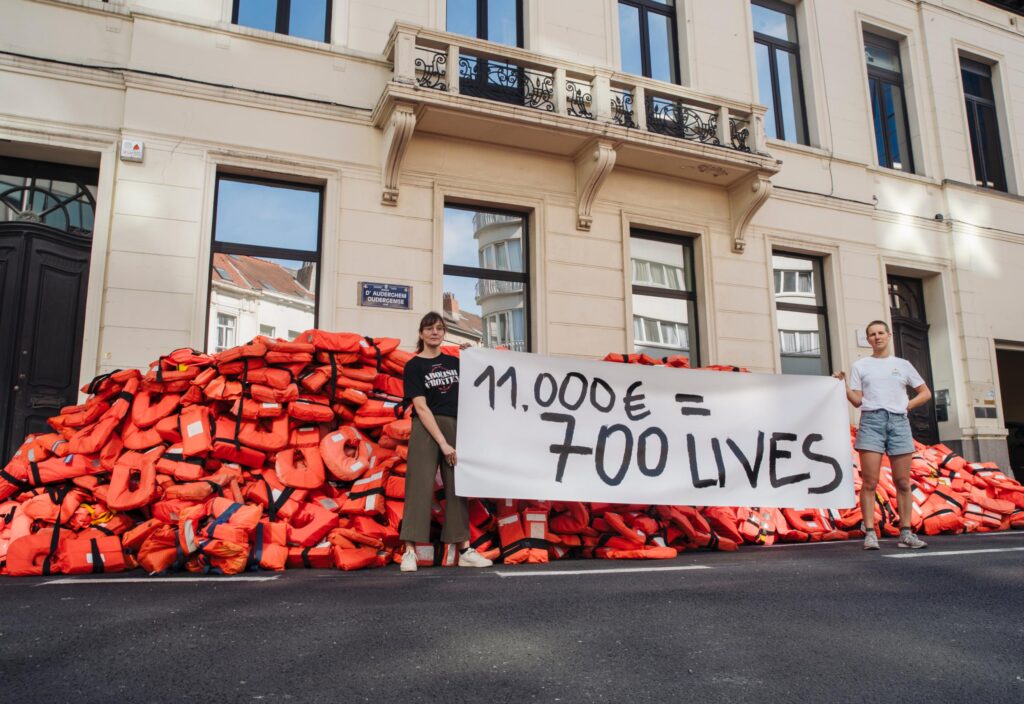
Action of Sea-Watch in front of the Frontex office in Brussels. Source: Sea-Watch
On the same day, it was reported that Libyan General Almasri’s “associate” Khaled al-Hishri, called al-Buti, was arrested in Germany upon his arrival at Frankfurt airport. Like for Almasri, who was arrested in January, but released and brought back to Libya by the Italian government, the International Criminal Court (ICC) had issued an arrest warrant for al-Buti because of serious crimes against prisoners in Libya.
On 18 July, the crew of Humanity1 rescued over 40 people who were severely weakened and exhausted after at least five days at sea. Malta once again refused coordination – despite the case reportedly being deep within the Maltese Search and Rescue (SAR) zone. The Italian authorities assigned Bari as Port of Safety – almost 800 km far away. The overcrowded fibreglass boat had been reported by Alarm Phone.
On 19 July, Alarm Phone was alerted by about 60 people at severe risk of drowning south of Crete. The so-called Libyan Coastguard told us they sent a patrol boat, but even throughout the following day, the people in distress remained adrift around the same location. We received no further info about any SAR operation regarding them. Another 80 people had been intercepted west of Tobruk by the so-called Libyan Coastguard the day before, military police raided an area in Tobruk, apprehending 93 people on the move, and Greece started arresting people who arrived from Libya and setting up additional detention spaces.
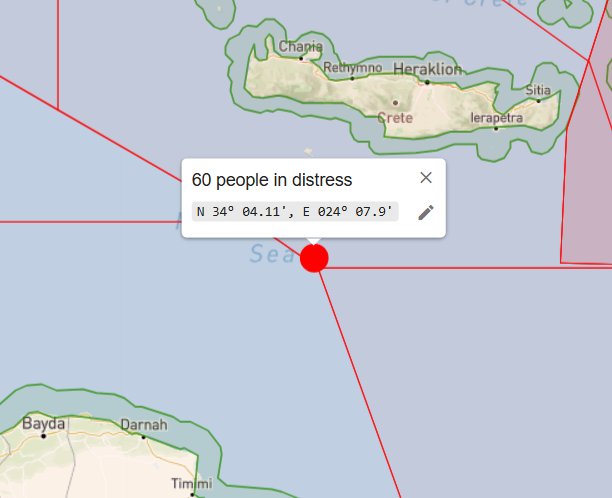
Map showing the position of the boat at risk of drowning south of Crete. Source: Alarm Phone
On 20 July, 700 Sudanese people were dumped in the desert by Libya’s so-called Anti-Illegal Immigration Agency in eastern Libya with military vehicles and it was announced that they would be deported. It remains unclear how and to whom they were handed over.
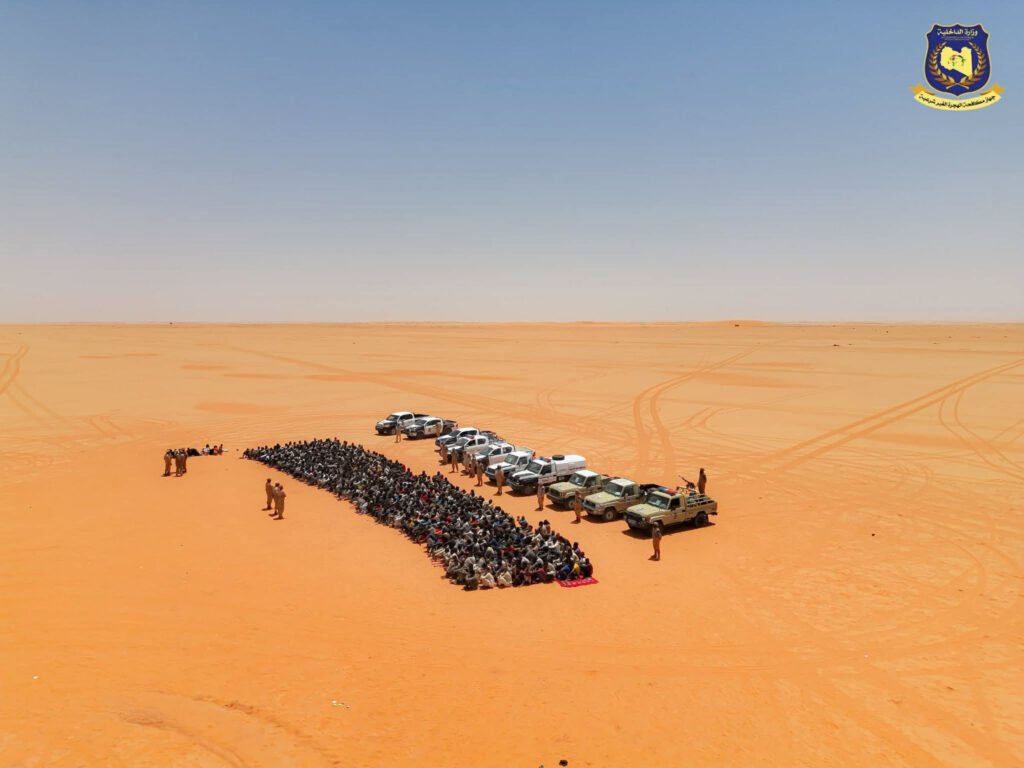
People dumped in the Libyan desert. Source: https://bsky.app/profile/brirmijihed.bsky.social/post/3lufheouo2c2r
On 21 July, Alarmephone Sahara was informed about a group of six people who had been intercepted at sea and were deported to the desert on the Algerian border by Tunisian security forces.
On the same day, the Minister of the Interior, Mr Bruno Retailleau, welcomed his Tunisian counterpart, Mr Khaled Al-Nouri, to Paris, accompanied by the Tunisian Ambassador to France and a high-level delegation. One of the main topics of the meeting was “migration management”.
On 22 July, it was reported that more than 1,200 people on the move had arrived in Lampedusa since 20 July. Another 155 people on two sailing boats were rescued by the Crotone and Bari coastguards. The Aurora was detained for 20 days by Italian authorities.
On 24 July, a boat carrying about 80 people sunk off the coast of Tobruk. At least 18 people died and 50 others went missing.
On the same day, Alarm Phone was in contact with 24 people on a boat adrift between Libya and Greece. They reported that they could see a big ship near them. We could observe that the merchant vessel MAERSK IZMIR had changed it’s course. On the next day, the Greek Coastguard confirmed that the group was rescued by this merchant vessel.
On 26 July, Alarm Phone was alerted by a relative of 43 people who had left two days before from Benghazi and reached the shared SAR zone of Italy/Malta. They had no drinking water left and said five children were unconscious. Before the weather was deteriorating further, the 45 people were rescued and brought to Sicily.
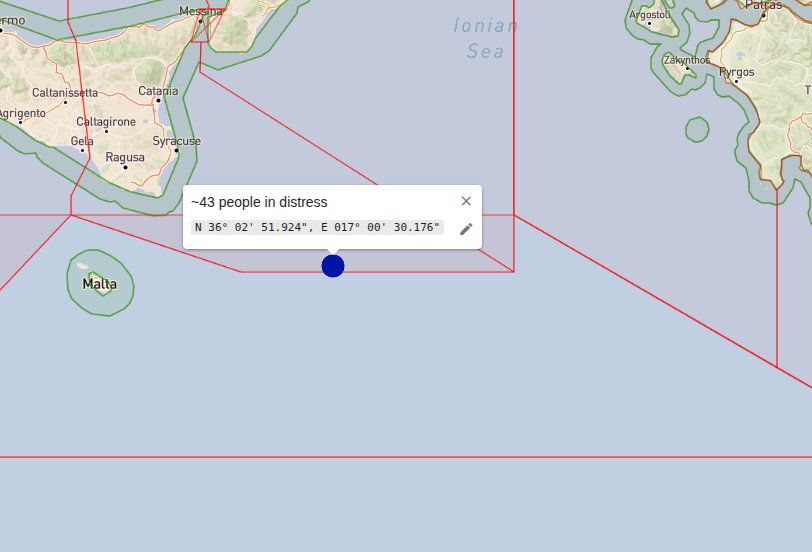
Position of the boat which left from Benghazi. Source: Alarm Phone
On 29 July, it was reported that on the weekend before, Libyan authorities had rounded up and detained over 1,500 so-called irregular migrants living in the east of the capital, Tripoli.
On 30 July, Sea-Watch reported about a boat that capsized during a rescue by the merchant vessel PORT FUKOKA. The people fell into the water and after the rescue it became clear: two children were dead and one person went missing, with the survivors on the merchant vessel. The Italian authorities were trying to prevent them from being brought to Italy. Furthermore, there was a threat that the so-called Libyan coastguard would kidnap the people and take them to Libya. One day later, the people, among them the two deceased children, were still on the PORT FUKOUKA, moving slowly north. The Ocean Viking was close and offered medical support, e.g. for a pregnant woman, and transshipment, but Maltese and Italian authorities were not responsive. Only on August 1st, the pregnant woman whose water had broken on board the commercial ship was finally evacuated to Lampedusa with her husband. The others were brought to Pozzallo on Sicily.
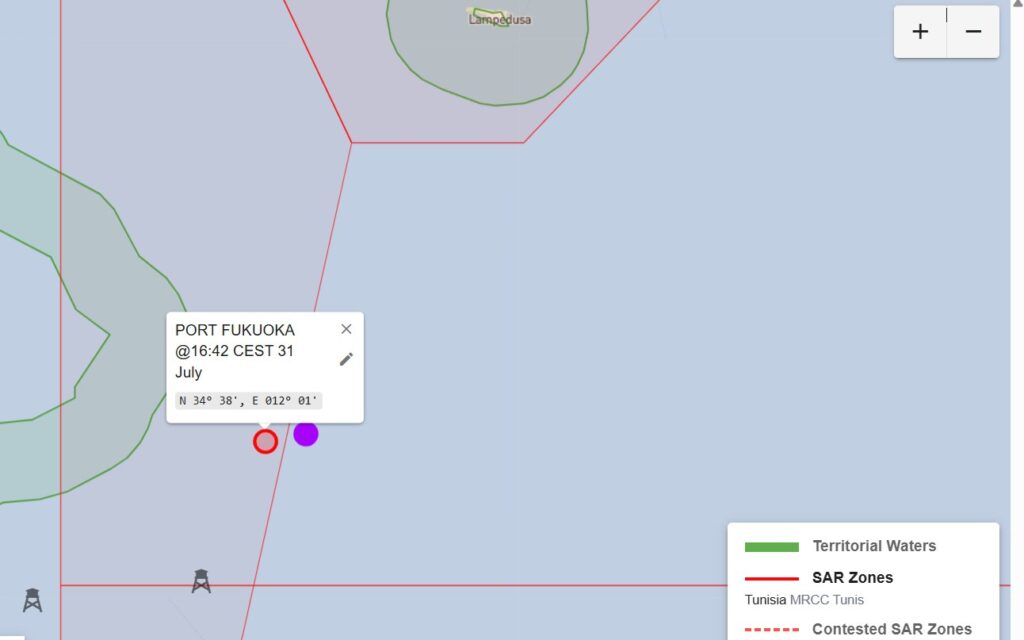
Map showing the position of the boat and the merchant vessel PORT FUKOKA. Source: Alarm Phone
Also on 30 July, Libyan coastguard officers started training on the Greek island of Crete as a plan to strengthen the cooperation of the two countries to stem a surge in arrivals.
On 31 July, the NGO ship Nadir rescued people from a shipwreck. The crew of the Nadir located the boat in high risk of sinking, after being informed by the plane of Sea-Watch. The 36 people including babies and pregnant women had been at sea for six days in up to two meter high waves. They reported that over a dozen people had gone overboard, one of which they saw drown. Hours later the Nadir crew was able to rescue twelve more survivors from the water. Three people were believed to be still missing. The crew of the NGO boat Trotamar III joined the search while European authorities remained inactive.
On the same day, Giorgia Meloni travelled to Tunis to talk more about interceptions and deportations according to the EU-Tunisia deals.
August
In August, Alarm Phone was alerted to 85 boats in distress in the Central Med, among them 71 departing from Libya and 13 from Tunisia. For one boat the departure place is unknown. NGO vessels rescued a total of 18 boats that month – not all of them had alerted Alarm Phone. Two boats were rescued by merchant vessels and we also know of one autonomous arrival. The Italian Coastguard rescued at least 42 boats – they often rescued boats when they had almost reached Lampedusa, and they also coordinated some rescue operations of boats heading towards Sicily or Calabria. No boat was rescued to Malta. We know of two boats rescued by the Greek Coastguard, but there were probably more on the route from eastern Libya to Crete. One boat was rescued by a Frontex ship. We know of 31 interceptions by the so-called Libyan Coastguard. About Tunisian interceptions we rarely receive reliable figures – we only know about three, but for sure there were many more. We learned about three shipwrecks in August.
On 1 August, the European Court of Justice issued its ruling on safe countries, declaring that the designation of a third country as a “safe country of origin” must be subject to effective judicial review. Moreover, the sources of information on which this designation is based must be accessible to the applicant and to the national court or tribunal. A Member State may not include a country in the list of safe countries of origin, if that country does not offer adequate protection to its entire population. Precedeing this ruling was the case of two Bangladeshi nationals, who had been rescued at sea by Italian authorities and taken to a detention centre in Albania, where they lodged an application for international protection, which was rejected. The applicants challenged the rejection decision before the Rome District Court, which made a reference to the Court of Justice in order to clarify the application of the safe country of origin concept.
On 2 August, the NGO vessel Ocean Viking received an alert from Seabird regarding a distressed boat with 37people on board in international waters in the Libyan SAR zone. After the competent authorities gave their approval to proceed, the crew rescued the people. Soon after, a Libyan coastguard vessel ordered them to leave the area, but the Ocean Viking took all survivors on board. Italy assigned them the port of Ravenna, 1,600 km away, for disembarkation.
On 3 August, Giorgia Meloni was notified of the decision by the Ministers’ Tribunal in the Almasri case. The judges dismissed her case because she “was not informed in advance and did not agree with the decision taken” (to release Al Masri and let him return to Libya). But she wrote: “I reiterate the correctness of the actions taken by the entire Executive, whose sole guiding principle was the protection of the safety of Italian citizens.” Lam Magok, member of Refugees in Libya, was one of the many victims of Al Masri’s torture and denounced the government. “We hope that the prosecution will reopen the investigation on the ministers Nordio and Piantedosi”.
On 4 August, an Italian court suspended the detention of the rescue ship Aurora, which had been blocked in port and deliberately prevented from saving lives for 18 days. The verdict confirmed what should have been obvious: The Aurora was unlawfully detained for complying with the law at all time — rescuing 70 people in distress at sea and bringing them safely to Italy. The court made clear: Aurora carries out life-saving operations. Deliberately keeping the ship in port not only poses a serious threat to the protection of life at sea but also may violate international human rights.
On 6 August, it was reported that 96 people died in a boat sinking in the Gulf of Aden on the route to Yemen. The boat was carrying around 200 people, mainly Ethiopian nationals – many of them are now trying to reach Yemen by sea.
On the same day, Greek media reported that the Greek Navy will continue to operate in the Libyan Sea to monitor Greek maritime zones. Although the deployment initially responded to a surge in migrant boats departing from Tobruk toward Crete and Gavdos, Athens considers the continued naval presence essential, especially as Ankara and Libya dispute Greek maritime zones south of Crete.
On 7 August, Italian authorities detained the monitoring aircraft Seabird of the NGO Sea-Watch in a blatant attempt to hide the violence, illegal pushbacks and human rights abuses happening at sea.
On 8 August, the Sea-Watch 5 witnessed how six (!) Libyan militia boats – funded by EU – illegally forced two boats with dozens of people in distress back to Libya. Some people were in the water.
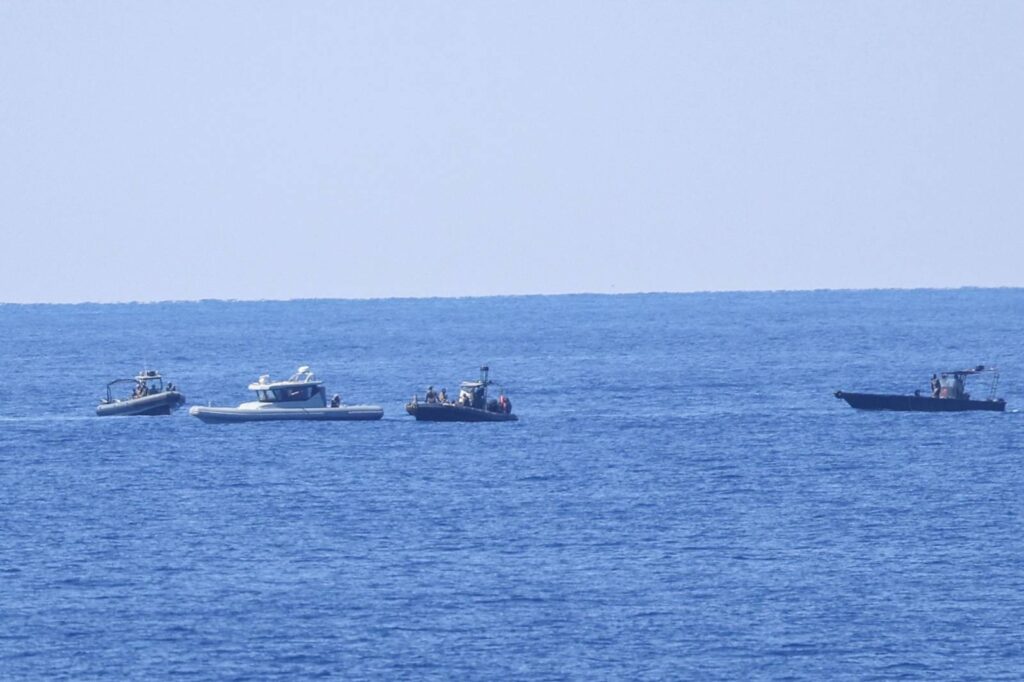
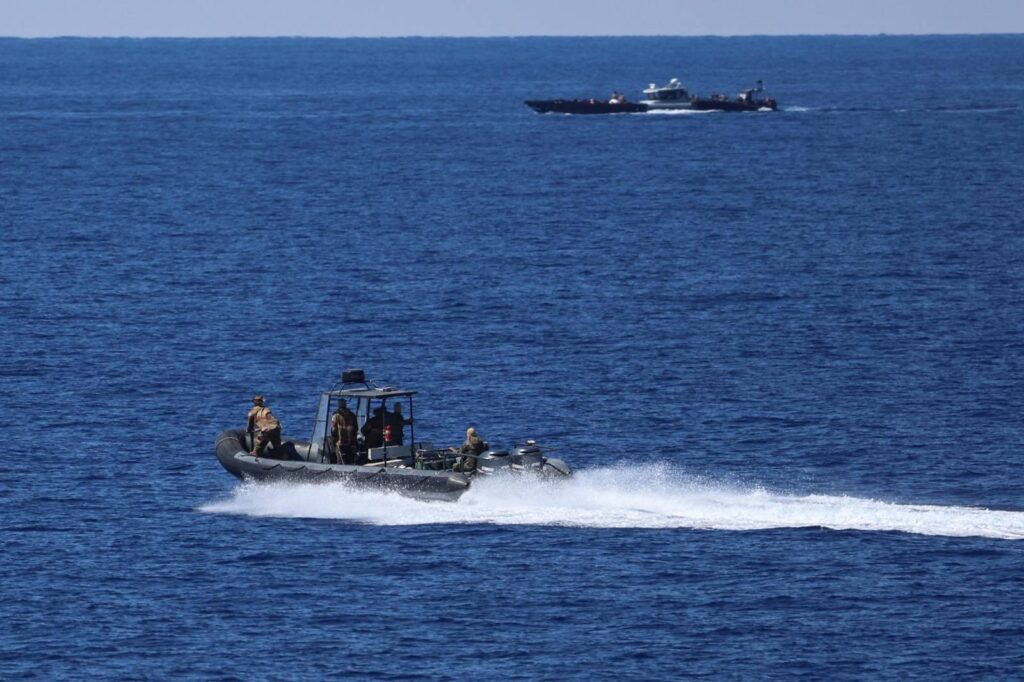
Photos of the six Libyan militia boats. Source: https://x.com/seawatch_intl/status/1953850929792364919?t=dYzqVGZ3OKvBfudk_Y1JqQ&s=09
On the same day, three people went missing from a drifting boat off Lampedusa. Exhausted by their long period at sea, three people jumped into the water hoping to reach a distant boat. The 50 survivors were rescued by an Italian patrol boat and taken to Lampedusa.
On 9 August, a CommemorAction was organised at the Transborder Summer Camp in France, with the participation of Alarm Phone. We thought of those who died at Europe’s borders and those who were killed by racist police violence. We renewed the promise to continue in our struggle for justice and freedom of movement for all.
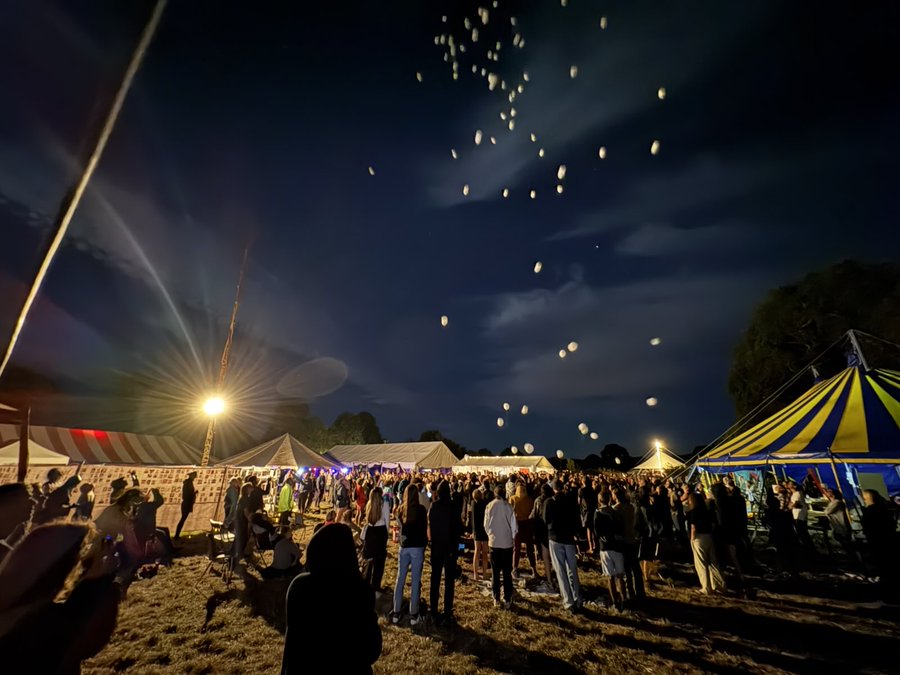
CommemorAction at the Transborder Summer Camp. Source: Alarm Phone
On 11 August, the Sea-Watch 5 rescued two boats in distress with a total of 73 people on board. After rescuing 67 people on the morning of August 11, a pregnant woman’s water broke on the civil rescue ship Sea-Watch 5. Although the woman experienced rare complications that required urgent medical care on land for the survival of her unborn baby, no coastal state initiated a medical evacuation for hours. At just before 7 p.m. CEST, Italy finally carried out the medical evacuation. The previous night, on Monday, another six people were rescued from distress at sea.
On 12 August, Seabird 3 spotted a deflated rubber boat in severe distress with one person already in the water. A Libyan militia in contact with Frontex took them to an abandoned oil rig. We fear that later they were forced back to detention in Libya.
On 13 August, it was reported that at least 20 people were killed after a boat had capsized off Lampedusa. Rescuers recovered 20 bodies and operations were continuing, according to initial reports by Ansa news agency. Between 70 and 80 people were believed to have survived.
On 14 August, 156 people on the move disembarked in Lampedusa after three boats were rescued overnight. Two more boats, carrying a total of 50 people, arrived in the morning.
On 16 August, the crew of the rescue ship Humanity 1 rescued over 130 people from two fibreglass boats in distress in international waters. „Both boats had set off from Libya during the night and were spotted by our crew with binoculars from the top deck.“ The Italian authorities assigned the port of Naples – over 750 km away from the location of the rescue – as a place of safety for the survivors rescued from distress at sea.
On 17 August, Alarm Phone was alerted by 39 people close to the Greek mainland. They had left from Libya, their engine was not working any more, five people were severely sick and two people had died reportedly. One day later, the Greek Coastguard told us that the group was rescued and brought to Kalamata.
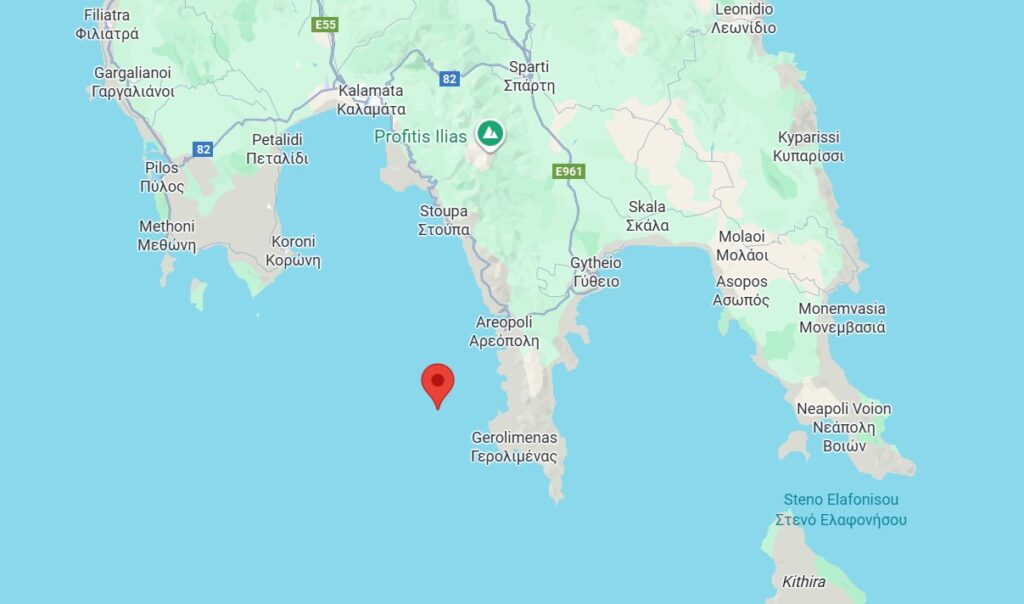
Map showing the position of the boat in distress. Source: Alarm Phone
On 18 August, three Palestinians were stopped by a Frontex patrol boat while on a jet ski off the coast of Lampedusa. They reported that they had departed from Homs, Libya. They were taken to the hotspot in Lampedusa.
On the same day, Alarm Phone alerted about a boat with 41 people in distress. The merchant vessels Coe Anna and Bernhard Schulte had turned towards the case. Authorities confirmed one day later that the boat was rescued to Sicily.
On 19 August, the rescue vessel Mediterranea received an SOS from Alarm Phone for a boat carrying 45 people in distress in Libyan territorial waters. The crew asked Libyan authorities for permission to enter. After two hours they got a radio VHF call by so-called Libyan Coastguard that “another boat was going to rescue”. Later Alarm Phone was told by a relative of someone on the boat that the group was returned to Libya and imprisoned in Al-Zawiya detention center.
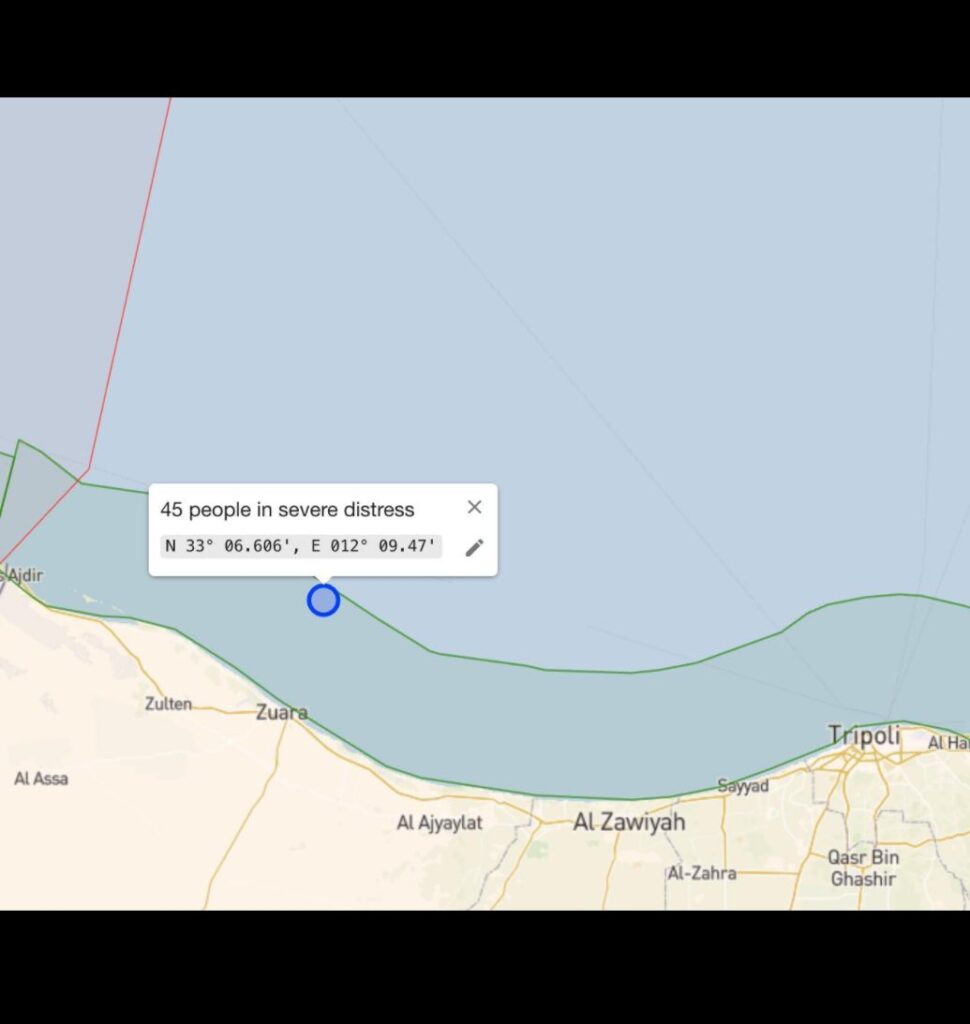
Map showing the position of the boat in distress. Source: Alarm Phone
On the same day, Alarm Phone was in contact with about 42 people in the SAR zone of Malta. They reported having been at sea for three days and running low on fuel, food and water. A merchant vessel who offered to intervene told us that they were told by the Maltese authorities that the “case ceased” and received instructions to NOT provide assistance but continue on their way. We could not reach the people any more, MRCC Rome refused responsibility and Malta did not act either. On the next day, we were informed that the group was intercepted inside the Maltese SAR zone and forced back to Libya.
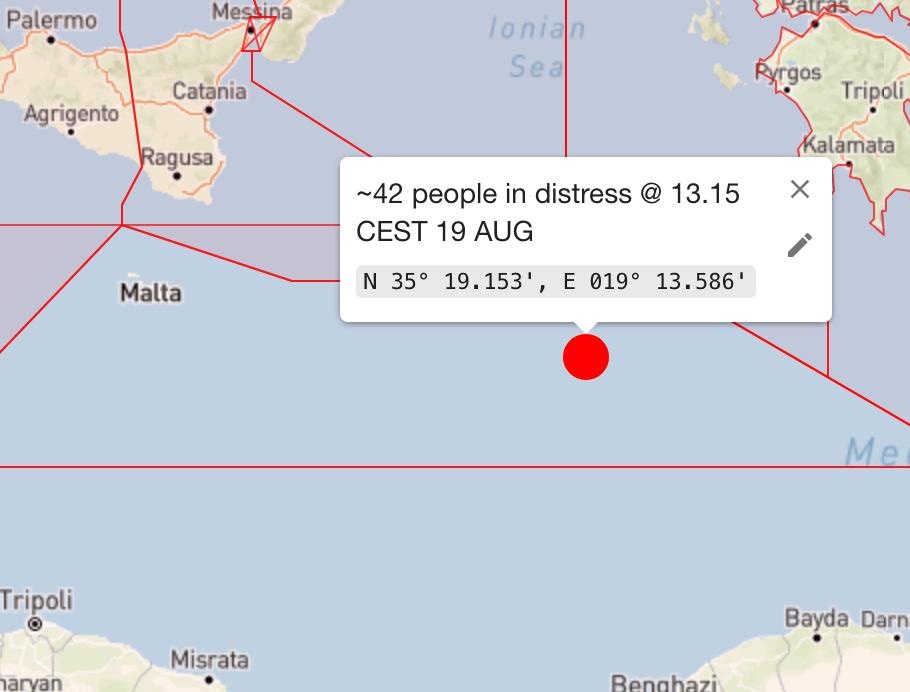
Map showing the position of the boat in Maltese SAR zone. Source: Alarm Phone
On 20 August, Alarm Phone was alerted to 32 people in distress in the Egyptian SAR zone. Later we learned that their boat had shipwrecked. Authorities told us they had been searching, but all people were still missing at sea.
On 21 August, about 62 people were in distress at sea south of Crete. Alarm Phone was alerted by relatives who were very worried about their safety. The Greek Coastguard refused to give us any information. Only some time later we learned that the group was rescued to Crete but we fear what they will face in Greece with the suspension of asylum for people arriving from North Africa.
On 23 August, the organisation RESQSHIP reported that in the night before their sailing vessel Nadir had rescued 65 people from an overcrowded and flooded rubber boat. During the evacuation survivors discovered the bodies of three sisters aged 9, 11 and 17 who had drowned in the water inside the boat. Another person was reported missing. Alarm Phone had alerted authorities and the Civil Fleet to this case and thanked the Nadir for responding to the distress as European coastguards did not act. The three sisters have died due to Europe’s deadly borders.
On 24 August, the Ocean Viking of the NGO SOS Mediterranée, who had just rescued 47 people after an alert by Alarm Phone, was deliberately and violently attacked by the so-called Libyan Coastguard, who fired hundreds of shots at their ship. Although no one was physically wounded, everyone on board feared for their lives, and crucial rescue equipment and the ship herself suffered significant damage. At the time of the attack, the Ocean Viking was in international waters, approximately 40 nautical miles north of the Libyan coast, when she was approached by a Corrubia-class patrol vessel, given to the so-called Libyan Coastguard by Italy. With 87 survivors already on board, their vessel had been authorised by the Italian Coordination Center to search for an additional boat in distress. While their crew was actively engaged in searching for this boat, the Ocean Viking was approached by the Libyan patrol vessel, which unlawfully demanded that they leave the area and head north. Even though the crew answered that they were leaving the area, two men aboard the patrol vessel opened fire without any warning or ultimatum, unleashing at least 20 relentless minutes of assault gunfire directly at the ship.
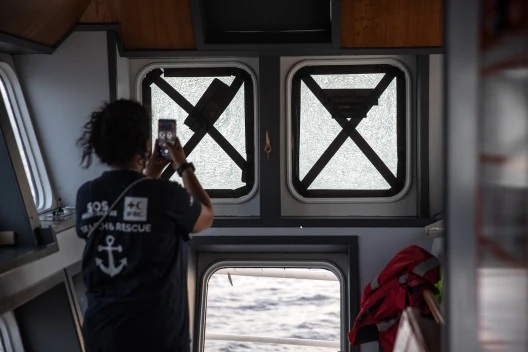
A window of the Ocean Viking after the attack. Source: Max Cavallari/SOS Mediterranée
On 25 August, the Mediterranea ship was blocked by Italian authorities because they had ignored the instructions to go to the distant port of disembarkation Genoa, but arrived in Trapani, Sicily.
On 27 August, it was reported that 1,541 people arrived in Italy during the last two days, 942 in Lampedusa, and 117 in Portopalo, Sicily.
On 28 August, a militia connected to the so-called Libyan Coastguard (TBZ) intercepted 180 nm off the coast of Benghazi 37 people, who had probably alerted Alarm Phone. All disembarked in Benghazi and were transferred to a detention center.
On 30 August, 41 people who had fled Libya were intercepted by the supply ship MARDIVE 208 in the Maltese SAR zone. Authorities were planning to hand them over to Tunisia, but the people refused to enter the Tunisian Coastguard vessel. One day later, the MARIDIVE 208 was running out of food and water for the survivors. A demand for a medical evacuation for two people in critical medical condition was not answered by the authorities. The humanitarian ship Garganey VI was on site to provide assistance. On 2 September, the Aurora ship evacuated the people from the MARIDIVE and brought them to Lampedusa. Seven people went missing.
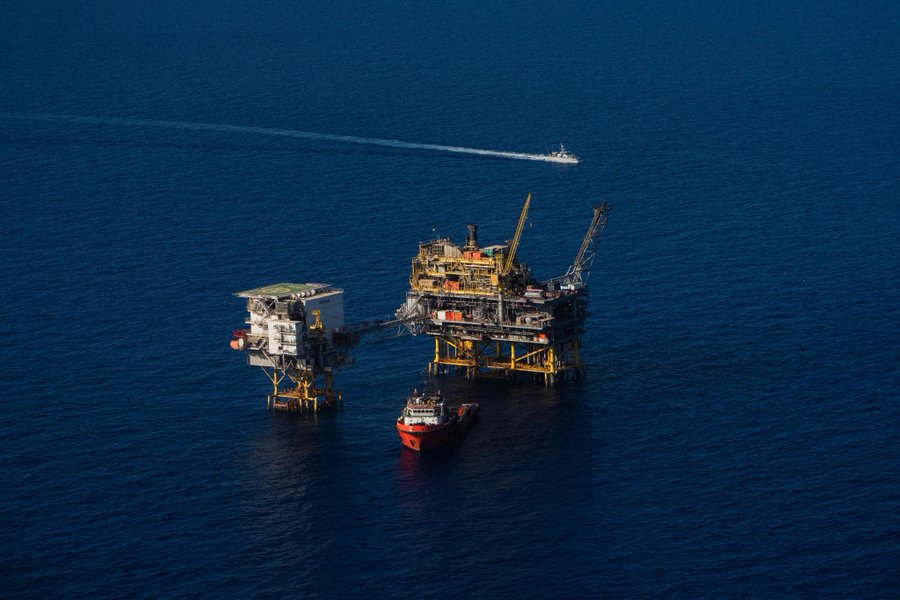
Rescue ship Aurora evacuates 41 people after six days at sea. Source: https://x.com/seawatch_intl/status/1962896275700859148
Also on 30 August, Alarm Phone was alerted to a group of 47 people who had fled from Sfax, Tunisia and who shipwrecked early in the morning. The people went overboard and were in immediate danger of drowning. Relatives and authorities have confirmed their rescue. While we‘re relieved that they survived, we feared their deportation to desert border areas of Tunisia.
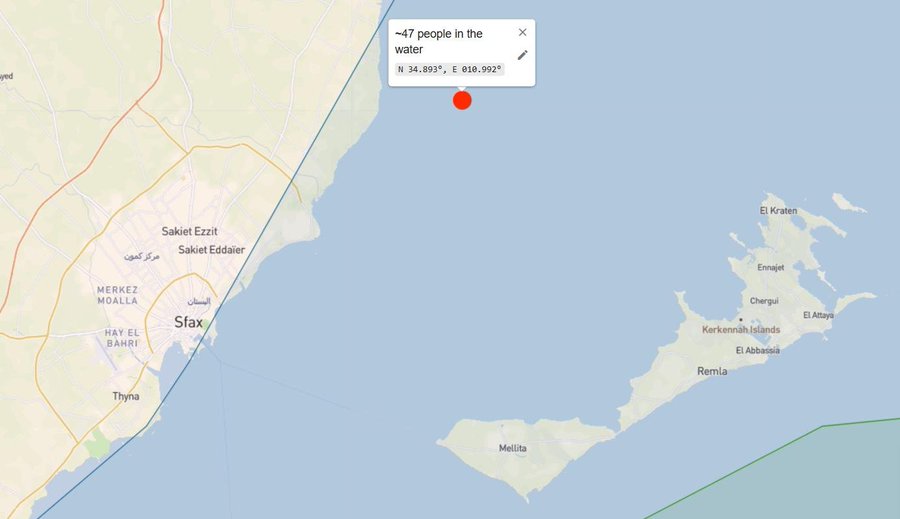
Map showing the position of the boat from Sfax. Source: Alarm Phone
On 31 August, Alarm Phone was alerted by 50 people in distress who had fled Libya. They reported several people onboard with severe gunshot wounds. We lost contact to the group and were worried about their well-being. Only on 3 September, we were informed that the people were found by the Italian Coastguard. We hope they can recover from their journey and the violence they experienced.
September
In September, Alarm Phone was alerted to 94 boats in distress in the Central Med, among them 81 departing from Libya, eleven from Tunisia, one from Turkey and one from an unknown departure place. NGO vessels rescued a total of 20 boats that month – not all of them had alerted Alarm Phone. One boat was rescued by a merchant vessel and we also know of ten autonomous arrivals. The Italian Coastguard rescued at least 31 boats – they often rescued boats when they had already almost reached Lampedusa, and they also coordinated some rescue operations of boats heading towards Sicily or Calabria. One boat was rescued to Malta. We know of three boats rescued by the Greek Coastguard, but there were probably more on the route from eastern Libya to Crete. We know of 52 interceptions by the so-called Libyan Coastguard. One boat was intercepted to Egypt. About Tunisian interceptions we rarely receive reliable figures – we only know about five, but for sure there were many more. We learned about six shipwrecks in September.
On 1 September, a group of about 37 people alerted Alarm Phone from a boat drifting south of the small island of Gavdos, close to the Greek SAR zone. Later we received news that the group was rescued by a merchant vessel, the ANATOLIA, and brought to Crete.
On 2 September, the civil rescue ship Mediterranea, which docked in Trapani on 24 August, was detained for 60 days by Italian authorities. They were accused of “serious, premeditated, and repeated” disobedience to the Ministry of Interior’s order to reach the distant port of Genoa with traumatised shipwreck survivors on board, who were not only affected by their detention in Libya but also by the attempted murder they suffered at sea.
On 4 September, an online press conference was organised by several NGOs including Alarm Phone to announce a chain of transnational actions dedicated to freedom of movement and to remember the extraordinary “summer of migration” of 10 years ago.
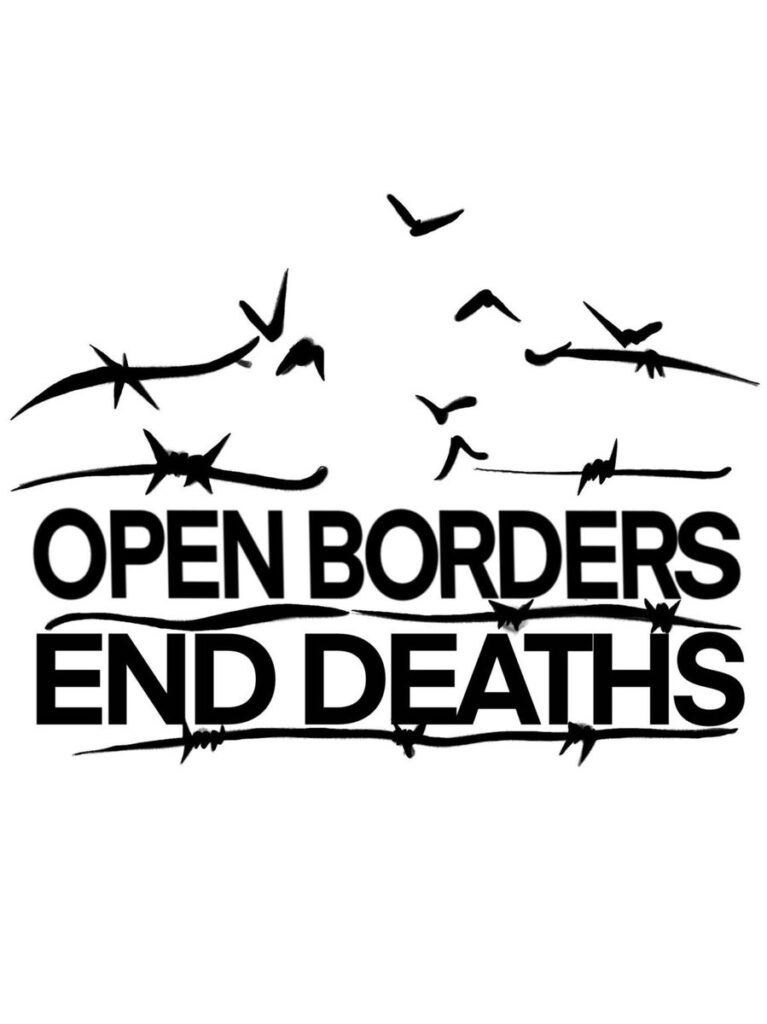
Picture of the call for the chain of actions. Source: Alarm Phone
On 5 September, the NGO SOS Mediterranée filed a legal procedure to identify the responsible actors of the attack on their vessel Ocean Viking. The patrol boat used by so-called Libyan Coastguard during the attack had been donated to them by Italy in the frame of a program financed by the EU.
On 6 September, the NGO vessel Aurora rescued 75 people from a boat in distress, which had been reported by Alarm Phone. They embarked all of them safely in Pozzallo, Sicily.
On 7 September, Alarm Phone was in touch with a group fleeing Libya on a small adrift boat. Unfortunately, we were unable to reach the people again after alerting. We fear a Libyan interception.
On the same day, Alarm Phone was alerted by about 30 people drifting 35 nautic miles southwest of Lampedusa in a rubber boat. We were relieved that they ended up being rescued by the Italian Coastguard and brought to Lampedusa.
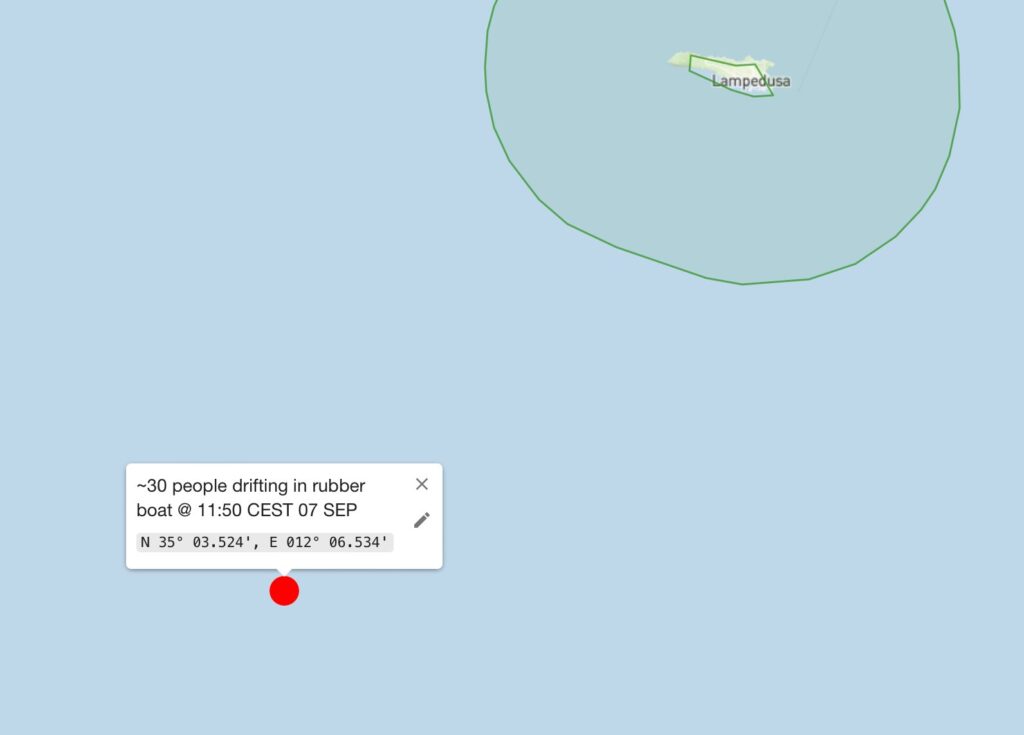
Position of the drifting rubber boat. Source: Alarm Phone
On 8 September, a UN Human Rights committee ruled on the MARIDIVE case on 30 August: They concluded that Italy and Malta had violated their duty to rescue. Seven people had died and the 41 survivors had been rescued thanks to the civilian rescue ship Aurora.
On 9 September, Alarm Phone expressed solidarity with the Global Sumud Flotilla, heading to Gaza for humanitarian aid, which was attacked by a drone on one of the boats. People on board said they heard a drone flying three or four metres above their heads before the device hit, causing a fire that damaged the boat, but luckily caused no injuries.
On the same day, it was reported that over 1,500 people were in the hotspot in Lampedusa after a wave of arrivals. A group among them said that Libyan authorities had fired on them during their crossing from Libya.
On 10 September, Alarm Phone was informed that the Maltese authorities had sent a vessel to a boat in distress that had alerted us and took the 36 people to Malta.
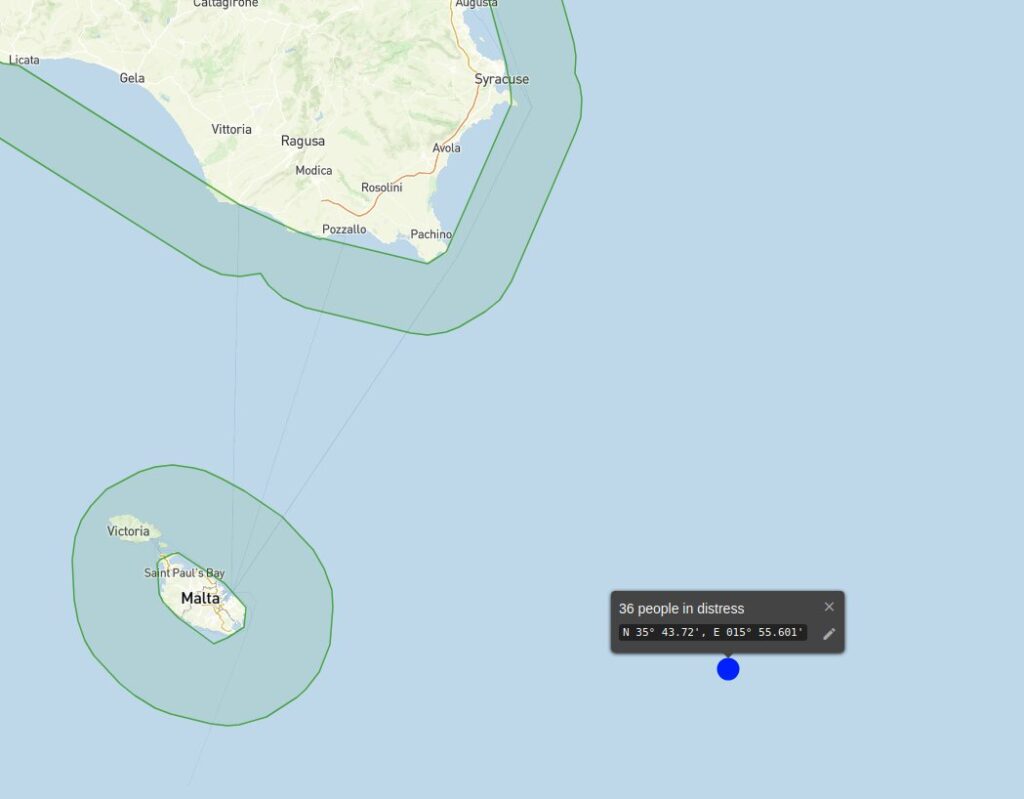
Position of the boat rescued to Malta. Source: Alarm Phone
On 11 September, the Court of Agrigento annulled as “illegitimate” the administrative seizure of the civilian sailing vessel Trotamar III. She was accused of “failing to collaborate with the Libyan authorities”.
On 12 September, Alarm Phone joined a protest by Refugees in Libya (RiL) in Geneva in front of the UNHCR headquarters. During their press conference, we also supported refugees in Niger who protested at the same time in Agadez. RiL wrote a “Book of Shame” that names and criticizes the humanitarian agencies – UNHCR, IOM and the EU – that are supposed to act in support of refugees and handed the book over to staff of UNHCR and journalists.
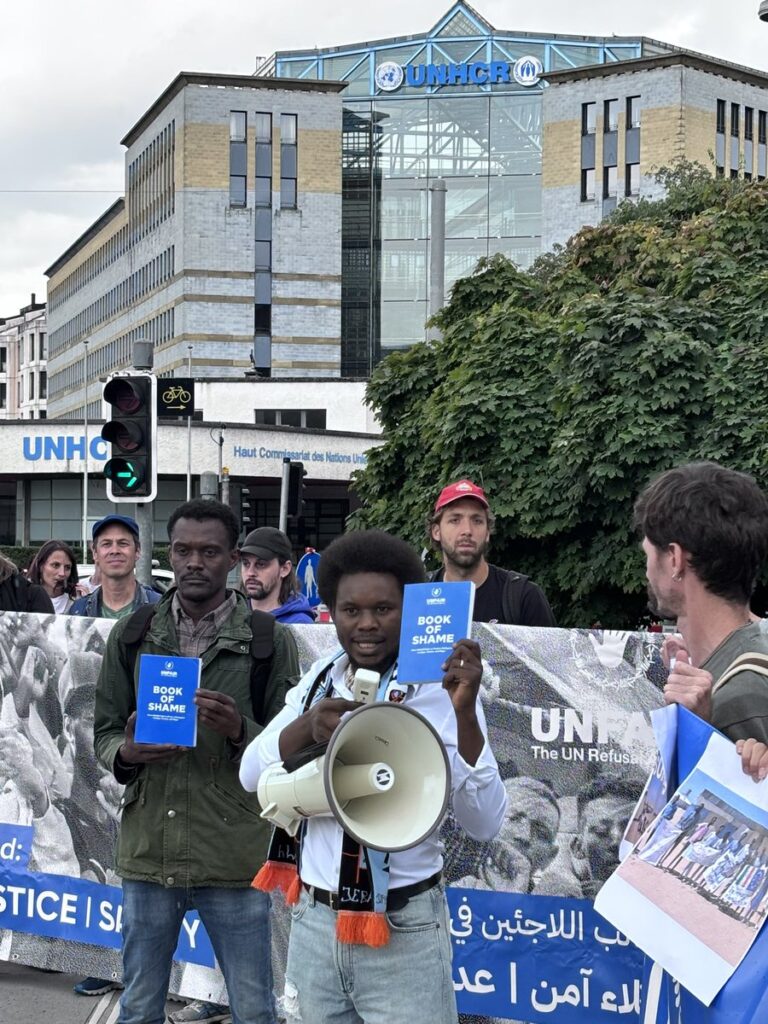
Demonstration with the “Book of Shame” at the UNHCR headquarters in Geneva. Source: Refugees in Libya
On 13 September, it was reported that during the last three days, the Tobruk branch of the so-called Libyan Coastguard and the Tarek Ibn Zied militia had intercepted three boats on their way to Crete and thrown the people into a detention center.
On the same day, a shipwreck occurred 15 nautical miles off the coast of Tobruk. 74 people were on board the boat; 14 of them were rescued and one body recovered.
On 15 September, another shipwreck was reported on the way from eastern Libya to Crete. Eleven people of 51 who had been on the boat died.
On the same day, the NGO ship Louise Michel rescued 26 people after an alert from Alarm Phone and Seabird, who had located their overcrowded rubber boat in distress.
On 16 September, an iron boat was about to sink 83 km off Lampedusa. One woman died, and another one went missing. About 50 survivors were rescued and the body of the deceased was recovered with the help of the civilian rescue ship Dakini.
On 17 September, the Nadir crew reported that after an evacuation of 44 people from an overcrowded rubber boat in distress two days prior, they were harassed at sea by a fast approaching militia ship without navigation light, issuing aggressive radio orders “Stop the vessel!” The crew de-escalated the situation until finally the militia ship turned away.
On 18 September, the sailing vessel Imara assisted a group of people who had alerted Alarm Phone from a small rubber boat in distress. Finally, they were rescued by the Italian Coastguard to Lampedusa.
On the same day, it was reported that a boat off the coast of Tunisia had capsized on its way to Italy and 39 people had died.
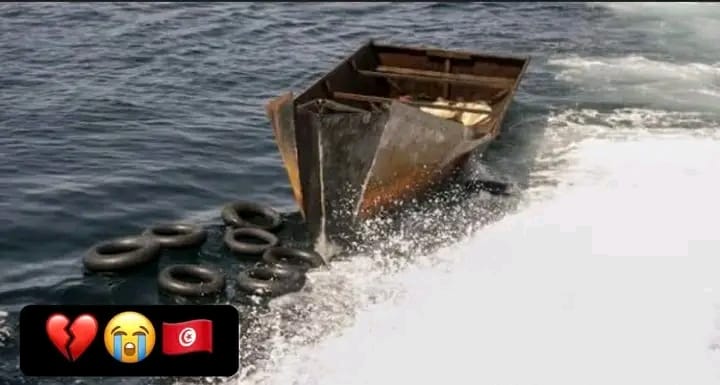
Empty iron boat from Tunisia. Source: Refugees in Tunisia
On 19 September, a journalist working for Italy’s daily newspaper La Repubblica, who accompanied a rescue mission by the NGO ship Mediterranea, documented instances of government-aligned Libyan militia throwing migrants into the sea.
On 21 September, the airplane Colibri of Pilotes Volontaires was detained and fined the astronomic sum of 100,000 € – another attempt to hinder the Civil Fleet from monitoring state crimes in the Central Mediterranean.
On 22 September, 17 Tunisian migrants were missing since leaving the coastal city of Sfax, according to the Tunisian Observatory for Human Rights. Alarm Phone got in contact with the people and learned that they had been intercepted by the Tunisian Coastguard and imprisoned, but later released.
On 23 September, 42 humanitarian and civil society groups published a joint letter to the EU Commision demanding to stop cooperation with Libya after migrant rescue ships had been attacked.
On 24 September, Alarm Phone was contacted by about 70 people adrift south of Crete. After alerting Libyan and Greek coastguards, we could not reach the group any more. But the media reported the rescue of a boat close to the last known position of this group in Greek SAR.
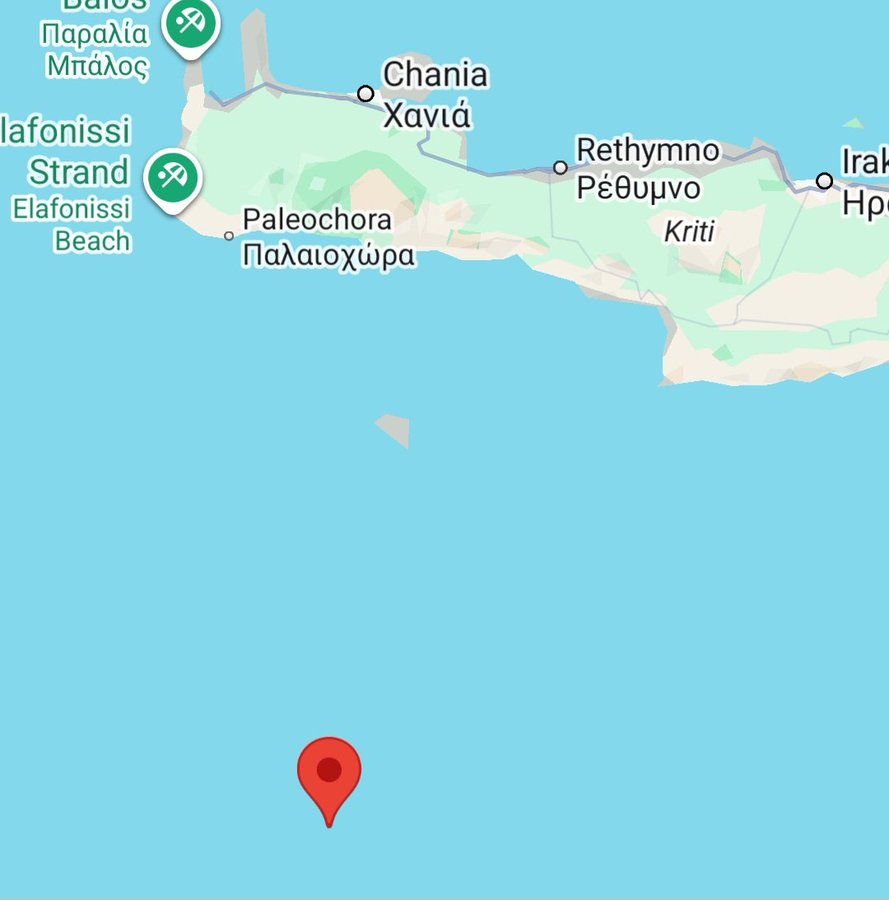
Position of the boat adrift south of Crete. Source: Alarm Phone
On 26 September, it was reported that 51 people had been rescued by the Italian Coastguard to Pozzallo, Sicily, after being three days at sea. It might have been people who had alerted Alarm Phone. Also another small boat, carrying 41 people, arrived in Roccella Jonica after being located by the Italian Coastguard 150 miles off the coast of Calabria, possibly also people that had been in contact with Alarm Phone.
On the same early morning, the Sea-Watch 5 was shot at by the so-called Libyan Coastguard while rescuing 66 people. Luckily, no one was injured and it was “only one shot”. But for a while after, the Libyan vessel remained only a few miles behind the Sea-Watch 5.
On 28 September, police in Sabratha launched a large-scale operation against people on the move. “Security” forces and militia stormed houses, their belongings were looted and many people arrested. The same happened in Tripoli.
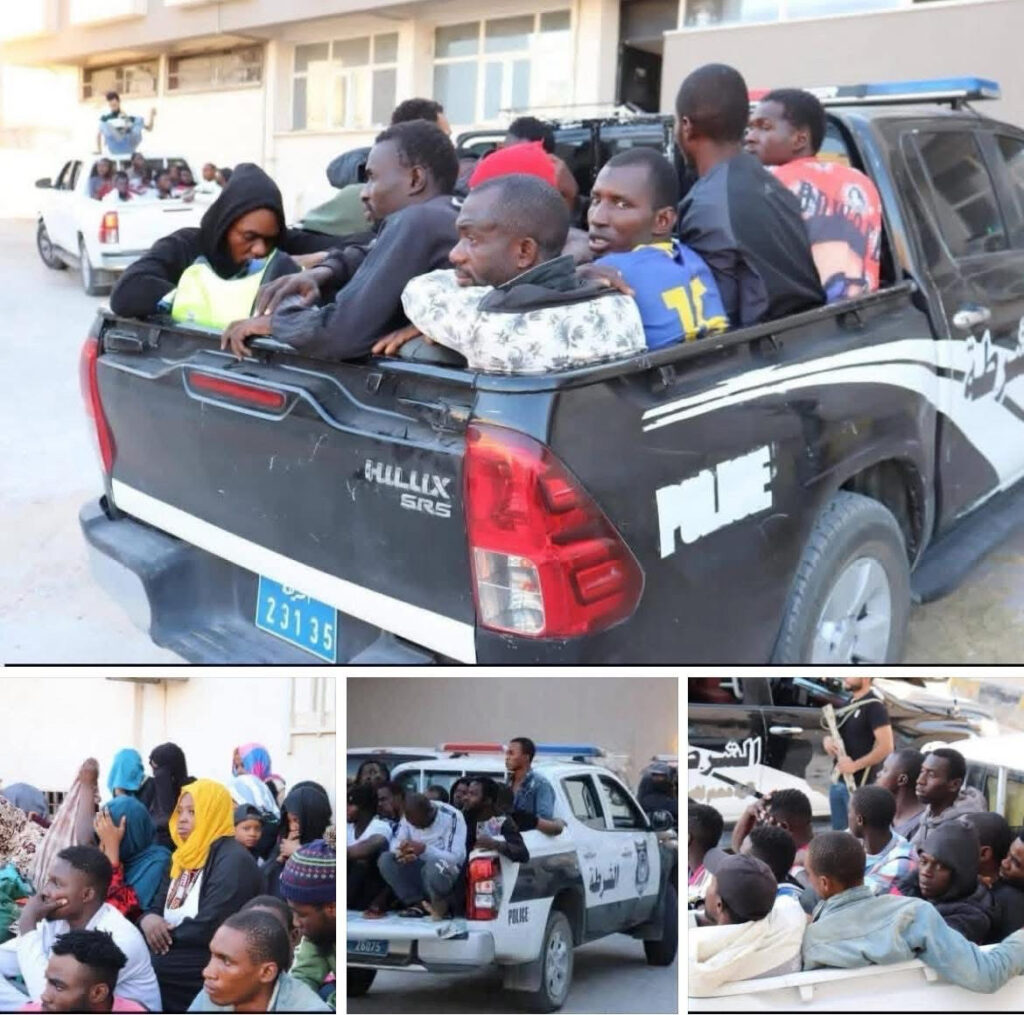
People arrested in Sabratha and Tripoli. Source: Refugees in Libya
On the same day, it was reported that the Libyan Navy and the so-called Libyan coastguard from Benghazi and Tobruk completed training in Taranto, Italy. The training was conducted with support of EUNAFVOR MED operation IRINI.
On 29 September, Sea-Watch reported that one day prior the so-called Libyan coastguard had tried to force people back to Libya and chased them across the sea. When people fell into the water, they left them to die. One person drowned. The Sea-Watch 5 rescued another boat and – with 124 survivors on board – went towards Napoli.
On 30 September, a relative of people who had alerted Alarm Phone on 28 September, departing from Sfax, informed us that the Tunisian coastguard had intercepted the group of 55 people by capsizing the boat. Everybody had fallen into the sea. While one or two people were left at sea, the others were returned to Sfax.
October
In October, Alarm Phone was alerted to 74 boats in distress in the Central Med, among them 68 departing from Libya and five from Tunisia with the departure place of one boat unknown. NGO vessels rescued a total of 19 boats that month – not all of them had alerted Alarm Phone. We also know of seven autonomous arrivals. The Italian Coastguard rescued at least 37 boats – most of them already close to Lampedusa – and they also coordinated some rescue operations of boats heading towards Sicily or Calabria. Not a single boat was rescued to Malta. We know of one boat rescued by the Greek Coastguard, which we assume to have traveled on the route from eastern Libya to Crete. In total, we know of 42 interceptions by the so-called Libyan Coastguard. Unfortunately, we rarely receive reliable figures regarding Tunisian interceptions. We learned of three shipwrecks in October.
On 1 October, Refugees in Libya received an alert about a group of 40 people who were captured at sea while fleeing to Europe and then pushed back by Tunisian authorities to the desert close to the Algerian border. Videos sent by the people confirmed their desperate situation.
On 2 October, several vessels of the Global Sumud Flotilla were intercepted by Israeli forces. Alarm Phone denounced this assault on the Flotilla and expressed solidarity with the 500 activists on board, struggling against the genocide in Gaza.
On the same day, Alarm Phone alerted authorities to 26 people adrift in international waters. Nine hours after our alert, still no help was in sight. We eventually lost contact to the boat, but relatives confirmed on 3 October that the people were rescued to Lampedusa.
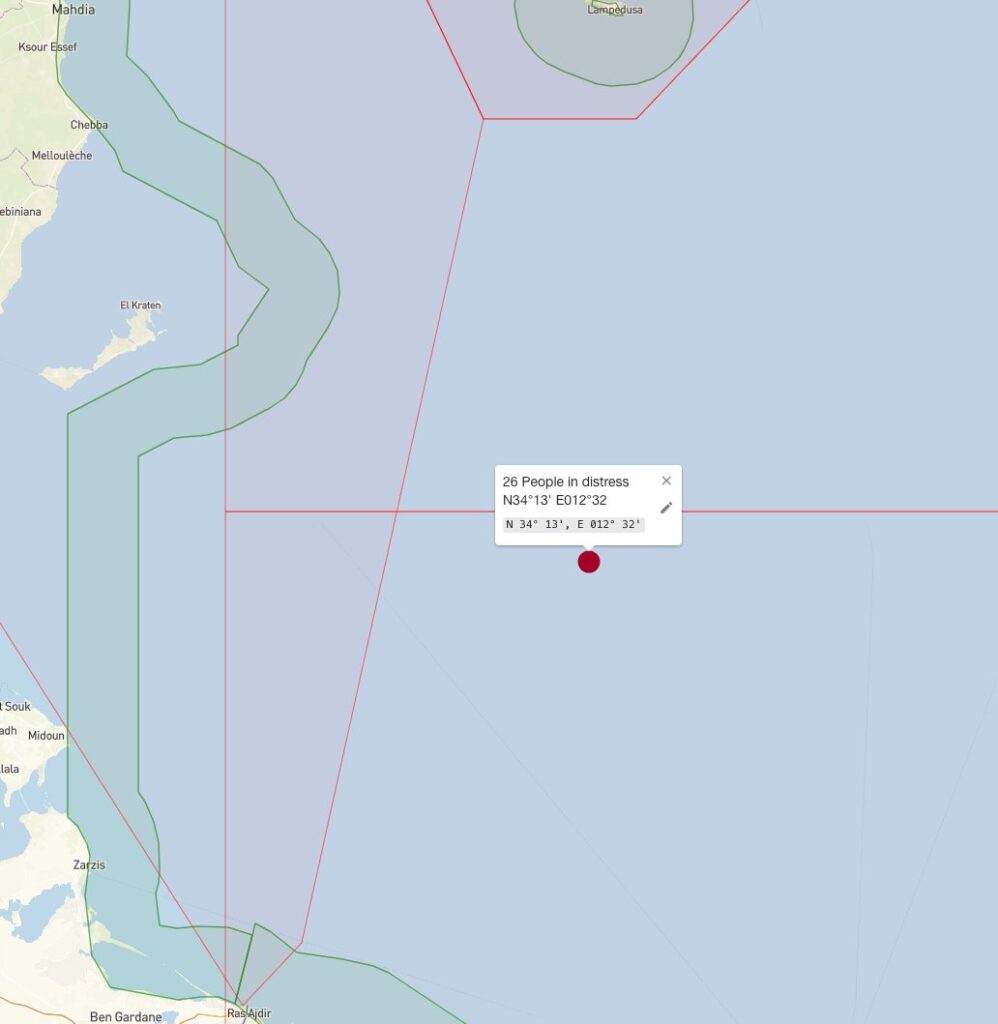
Map showing the position of the boat in distress. Source: Alarm Phone
On 5 October, the NGO ship Humanity 1 rescued 41 people who had been on a rubber boat in distress for more than four days. Due to bad weather, it took three attempts before the Italian Coastguard was able to bring five people to Lampedusa. For two people, however, help came too late. Despite tireless emergency medical efforts, they died on board. But instead of quickly bringing the rescued and the two dead ashore, the Italian authorities assigned the Humanity 1 to the port of Bari, over 1,000 kilometres away, for disembarkation.
On 6 October, Alarm Phone was alerted to a wooden boat carrying 41 people that had left from Zuwara on the evening of 5 October, trying to reach Lampedusa. Although we could not reach the people on the boat, we alerted authorities immediately as the weather was very bad and rescue was urgent. On 7 October, we learned from a relative of a person on board that they were intercepted and forced back to Zawiyah in Libya.
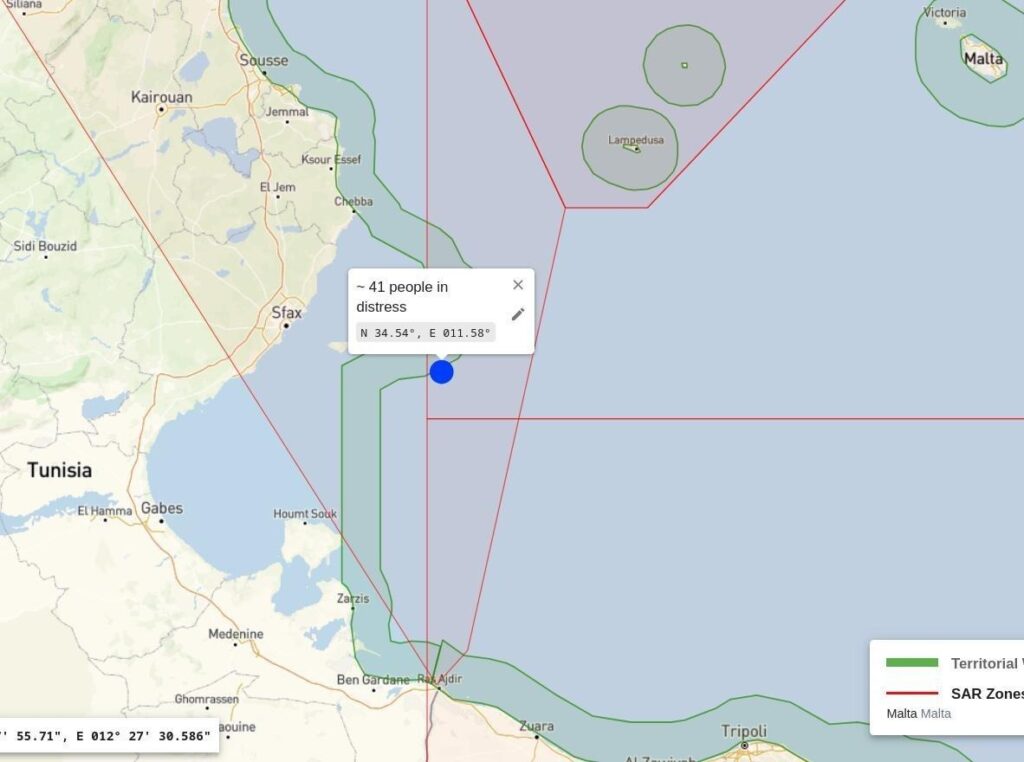
Map showing the position of the boat in distress. Source: Alarm Phone
On 7 October, the Sea-Watch 5 rescued 79 people and got assigned the port of La Spezia. On the way north, the crew was alerted twice to other distress cases, but could not find the boats in bad weather. Possibly they were intercepted.
On 8 October, the court of Trapani ruled in favour of Mediterranea: consequently, the detention of their ship was suspended. This is an important legal and political victory for the Civil Fleet.
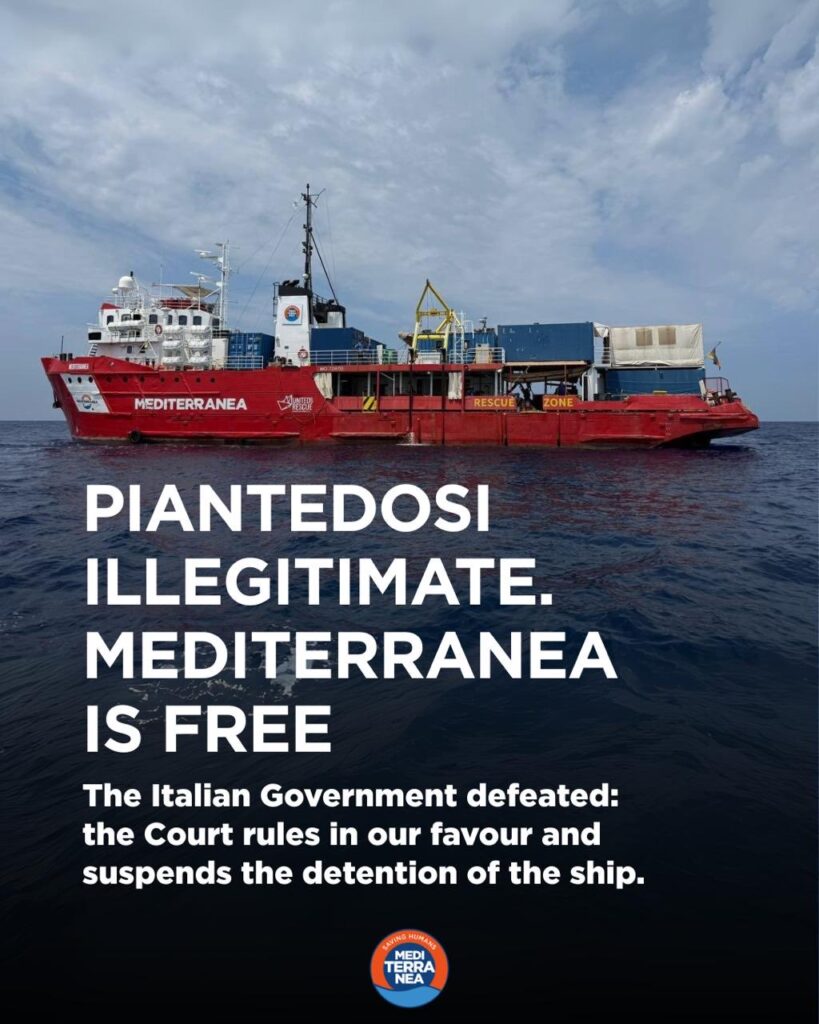
Victory for the Civil Fleet. Source: Mediterranea
On the same day, Alarm Phone alerted authorities to a boat carrying 35 people that had left Sfax on 7 October. Only on 12 October, we learned that the 35 people – after more than three days at sea – had been intercepted by the Tunisian Coastguard. As far as we know, only some were returned to Sfax, others were forced to Libya.
On 10 October, it was announced that the European Commission and Frontex would host a delegation of Libyan migration officials from both the east and west of the country. The mission was scheduled for October 14 in Warsaw (headquarters of Frontex) and for October 15 and 16 in Brussels, to meet officials from DG Home, the European Commission’s Directorate-General for Home Affairs and Migration. This was the first time that officials from the eastern part of Libya under the control of General Khalifa Haftar were invited to Frontex headquarters and similar meetings in Brussels with the Commission.
On 11 October, Alarm Phone turned 11 years old. Since we started in Oct. 2014, we assisted over 10,000 boats in distress, trying to accompany them on their journeys to Europe. Also in the years to come, we’ll keep struggling with people on the move and for the freedom of movement of all!
On 12 October, Alarm Phone was in contact with a boat in the Maltese SAR zone where the people on board reported being shot at by the so-called Libyan Coastguard. Militias were still near the boat and shooting at them when they reached out to us. We called on European authorities to condemn this attack and rescue the people without delay, but only an aerial asset of Frontex was on scene. Only the following day, on 13 October, the people were rescued by an asset of the Italian Coastguard to Pozzallo, Sicily, and members of Mediterranea reported from the dock: One person on the attacked boat, with a bullet lodged in their skull, was in a coma and fighting for his life while two others were seriously injured. Alarm Phone published a report with a timeline, but Maltese media reported that AFM (Armed Forces of Malta) said they can neither “confirm or deny” claims of a migrant boat shooting in the Maltese SAR zone. According to the Italian Coastguard, three injured migrants were rescued from a fishing boat, carrying 140 people, which had left from Libya and was intercepted 40 miles off Pozzallo. Supposedly, an investigation would be launched. On 14 October, Italian TV reported about the case and on 15 October, Alarm Phone published a video taken by people on the boat which showed that Haftar’s militia, the Tariq Ben Zeyad Brigade, was behind the shooting. On 16 October, the Libyan Navy denied that their coastguard had fired on the migrants.
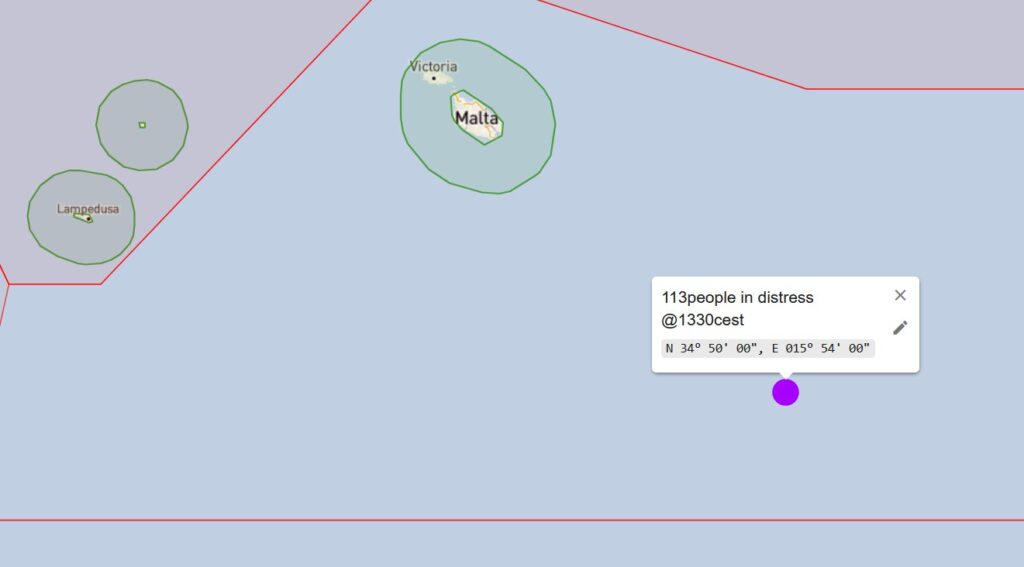
Position of the boat which was shot at. Source: Alarm Phone
On 13 October, Human Rights Watch published an article on the 2017 Memorandum of Understanding between Italy and Libya which would be automatically renewed for three years on 2 November 2025. They demanded that Italy should revoke its damaging cooperation agreement with Libya as it enabled Libyan Coastguard forces over the last eight years to intercept tens of thousands of people at sea and forcibly return them to Libya, where they face inhumane conditions of detention, a high risk of torture, and other ill treatment. Additionally, the so-called Libyan Coastguard threatens and endangers nongovernmental rescue vessels trying to bring people to safety.
On the same day, Sea-Watch published a detailed report on 60 violent incidents by Libyan militias such as the so-called Libyan Coastguard, against migrants as well as civil and EU state actors at sea since 2016.
On 14 October, the European Center for Constitutional and Human Rights (ECCHR) demanded that Italy must now answer to the European Court of Human Rights. A torture survivor, who had been unlawfully detained in Libya, had filed an application to the European Court of Human Rights against Italy for its failure to cooperate in the investigation and prosecution by the International Criminal Court (ICC) of a high-ranking Libyan official wanted for crimes against humanity and war crimes. Osama Elmasry Njeem (also known as Almasri) was in charge of one of the detention centres where the applicant had been detained.
On the same day, Alarm Phone joined the mobilisation of Refugees in Libya for action days in Rome against the 2017 Memorandum of Understanding (MoU) between Italy and Libya, which was scheduled to be renewed by the Italian Parliament on 16 October.
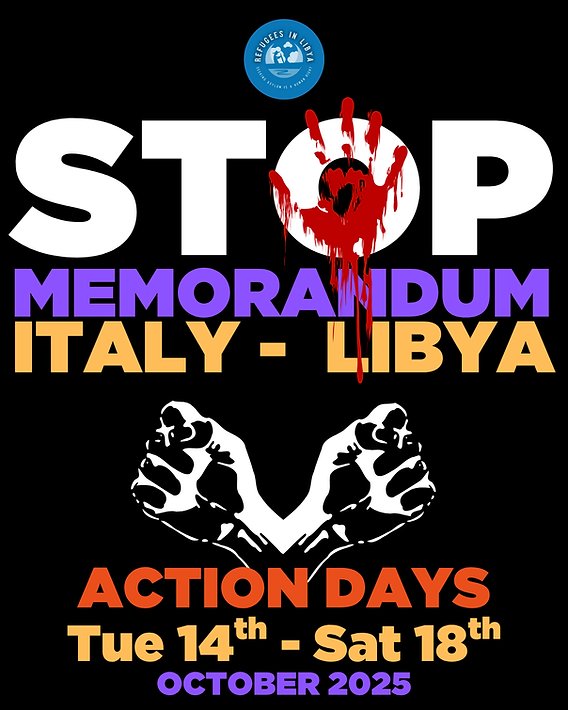
Call for the action days in Rome. Source: Refugees in Libya
On 15 October, Libyan and European officials agreed to intensify efforts to return “irregular migrants” to their home countries and to strengthen border management across Libya. The agreement was reached during a meeting in Brussels. For the first time, Libyan officials also visited the headquarters of Frontex in Warsaw and discussed cooperation methods and operational standards.
On 16 October, several interceptions of boats departing from Tobruk, eastern Libya, were reported.
On the same day, lawyers accused 122 European officials of committing crimes against people on the move in the Mediterranean Sea.
On 17 October, a shipwreck off Lampedusa occurred. Alarm Phone had alerted authorities already on 16 October to a boat carrying about 35 people in Maltese SAR zone. The boat capsized as rescue came too late. The Italian Coastguard, coordinated by the Rescue Coordination Center (RCC) in Malta, could only rescue 11 people and recover one body.
On 18 October, on a “stage of survivors” in the center of Rome, Refugees in Libya and other comrades reported their experiences with detention and torture in Libya and demanded an end to the agreements between Italy and Libya. On an event at the university, women told their stories and explained from a gender perspective what the effects of the MoU on migrant women are.
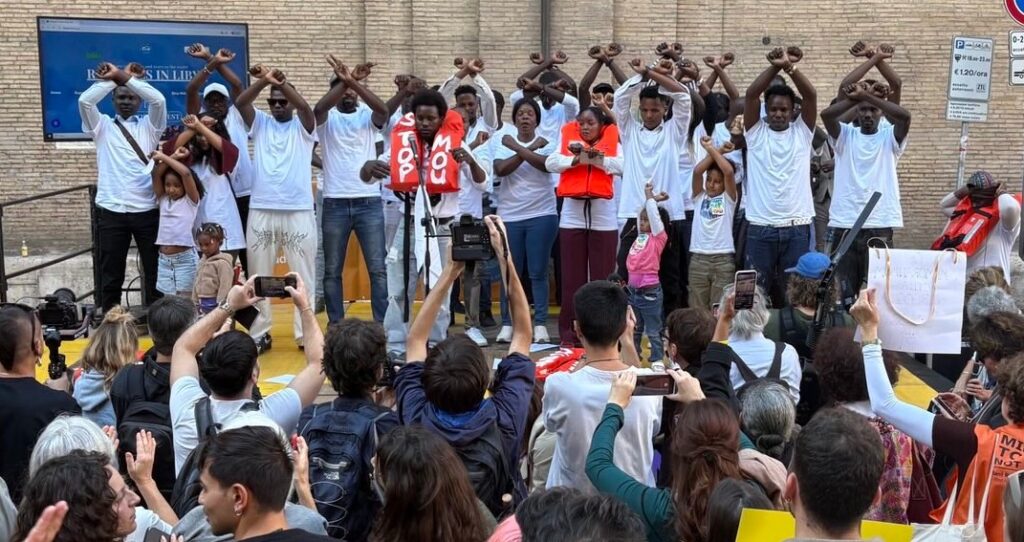
Stage of survivors in Rome. Source: Refugees in Libya
On the same day, around 70 people in distress at sea close to Crete alerted Alarm Phone. Later, local media reported about a rescue of 76 people south of the small island of Gavdos near Crete. We hope that the people rescued are the ones who reached out to us and that they were able to access asylum in Greece. But we know that other boats departing from eastern Libya were intercepted by Libyan Special Naval Forces (TBZ) and forced back to Tobruk.
On 19 October, another shipwreck near Lampedusa was reported. A rescue operation of the Italian Coastguard resulted in the rescue of 91 people. 14 of them had to be hospitalized in serious condition while two people did not survive the journey.
On 20 October, Alarm Phone was alerted by 42 people who told us that their boat was taking on water. They reported seeing a merchant vessel nearby, probably the IVAR BEAUTY. After being abandoned by this ship, the people in distress were intercepted by the so-called Libyan Coastguard.
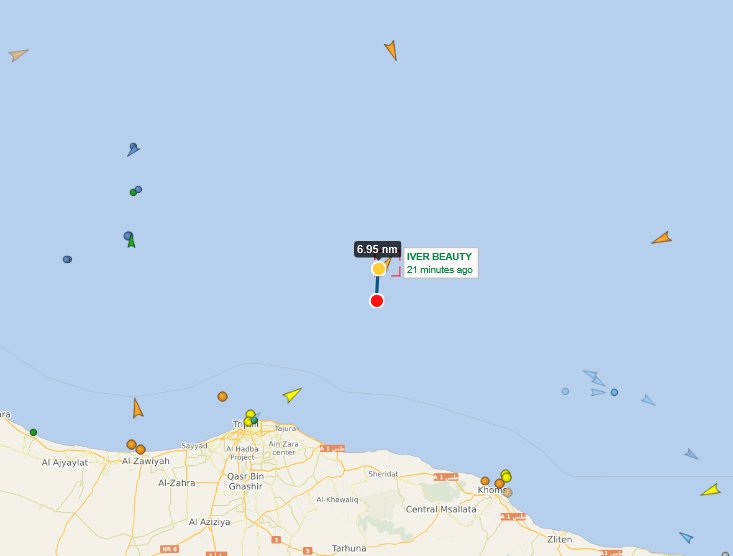
Position of the boat in distress and the merchant vessel. Source: Alarm Phone
On 21 October, a trial against six friends from Mediterranea started in Ragusa. They were accused of receiving money from a Danish cargo ship that rescued shipwrecked migrants. This trial is politically motivated and a farce. In 2020, following an Alarm Phone case, Mediterranea rescued 27 people who were left stranded on the Maersk Etienne as EU states had refused to let them disembark for 38 days.
On 22 October, the civil court in Agrigento ruled in favor of the rescue ship Aurora and decided that their detention in July 2025 was illegal, as the actions they took had been necessary to protect human lives.
On the same day, a shipwreck off Tunisia occurred. At least 40 people died. 30 people were rescued.
On 23 October, eleven people were rescued by an oil rig supply vessel and transferred to Tripoli by the Libyan Coast Security. The group had spent 2,5 days at sea clinging to debris after their boat caught fire and sunk.
On the same day, 38 members of the European Parliament sent a letter to the EU Commission. They called for an end to EU support of all Libyan security forces and demanded that the International Criminal Court (ICC) investigate their crimes against humanity.
On 24 October, the Italian newspaper Avvenire reported that the man who threatened Don Mattia Ferrari, chaplain of the Mediterranea, was identified. He is an IT executive with ties to Frontex and a former coastguard officer in Canada called Robert Brytan, on X writing as “rgowans”. A criminal trial was opened against him at the Court of Modena, Italy.
On the same day, “rgowans” informed on X about a Libyan interception off the coast of Zuwara. 49 people were forced back to detention in Tripoli.
On 26 October, a boat that had departed from Kélibia (northern Tunisia), carrying three families and six children, was in distress and asking for help. Eventually, they were rescued by the Tunisian Coastguard and returned to Tunisia.
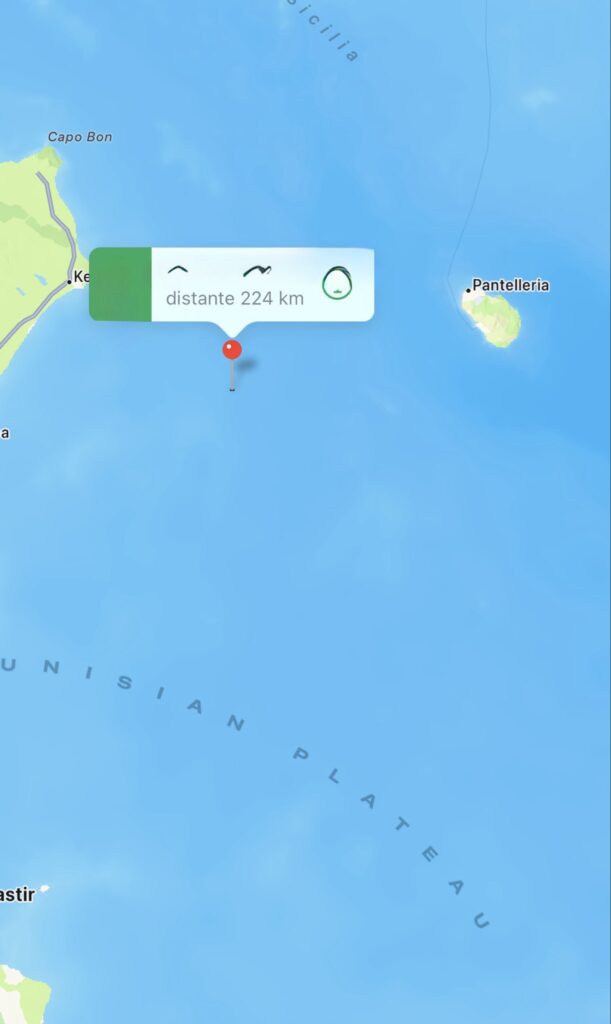
Map showing the position of the boat in distress. Source: Alarm Phone
On 27 October, Frontex, the European Union Agency for Asylum (EUAA) and Europol, together with the Italian authorities, completed a test exercise of the new EU screening process in Lampedusa. The exercise is part of preparations to implement the EU Pact on Migration and Asylum.
On the same day, Tunisia ordered the Tunisian Forum for Economic and Social Rights (FTDES), a prominent civil rights and migrant advocacy organization, to suspend activities for a month. The FTDES is one of several associations under such orders. FTDES official Ramadhan Ben Omar told Reuters that the government said the suspension was to allow for a financial audit related to foreign funding the group receives. “Its real aim is to silence every independent voice within civil society”, he said.
On 28 October, Alarm Phone declared its solidarity with the FTDES and all those resisting oppression in Tunisia and elsewhere and published a statement by the FTDES which they could not publish any more because of the suspension of their activities.
On 29 October, MSF (Doctors without Borders) published that they had been ordered in a letter from the Libyan Ministry of Foreign Affairs to leave the country by 9 November. No reason had been given to justify their expulsion. In March, MSF had been instructed to suspend its activities following the closure of its premises by the Libyan Internal Security Agency (ISA) and the interrogation of several of its employees. There are now no NGOs providing medical care to migrants in western Libya.
On 31 October, Seabird reported that two days before, they had sighted a wooden boat. The people on the boat were rescued later by the Italian Coastguard. For four of them, however, help arrived too late: They had suffocated below deck.
November
In November, Alarm Phone was alerted to 68 boats in distress in the Central Med, among them 65 departing from Libya and three from Tunisia. NGO vessels rescued a total of 12 boats that month – not all of them had alerted Alarm Phone. One boat was rescued by a merchant vessel. The Italian Coastguard rescued at least 12 boats – most of them already close to Lampedusa – and they also coordinated some rescue operations of boats heading towards Sicily or Calabria. Not a single boat was rescued to Malta. We have no figures of boats rescued by the Greek Coastguard on the route from eastern Libya to Crete. In total, we know of 26 interceptions by the so-called Libyan Coastguard and three by the Tunisian Coastguard, but probably there were many more. Unfortunately, we rarely receive reliable figures regarding Tunisian interceptions. We learned of seven shipwrecks in November.
On 1 and 2 November, protests took place in Albania to oppose the Rama-Meloni agreement and to demand the dismantlement of the detention centres built in Gjader and Shegnjin. After a march through the streets of Tirana, activists from all over the world gathered outside the gates of Gjader, in solidarity with the 24 people currently imprisoned. In one year, 220 people were detained in this facility, where Hamid Badoui died on 19 May 2025.
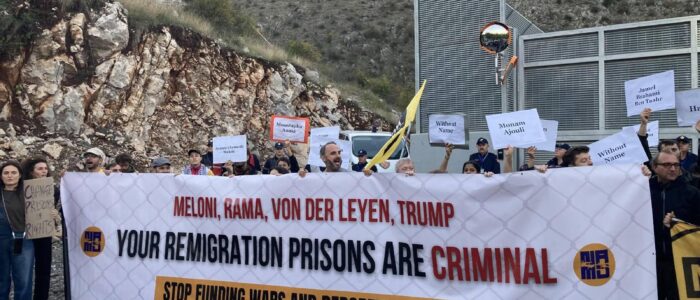
Demonstration at the detention centre in Gjader, Albania. Source: Alessandro Murtas
On 2 November, the memorandum between Italy and Libya “on cooperation in the fields of development, combating illegal immigration, human trafficking, smuggling, and strengthening border security” was automatically renewed. The pact, signed on February 2, 2017, will be deemed tacitly confirmed on February 2, 2026. It will be discussed again in three years. This comes as no surprise as the memorandum wasn‘t even debated in parliament, and only a few humanitarian associations and NGOs in the country have tried, in vain, to raise their voices.
On 3 November, SOS Humanity won its first court case against the Italian government in the context of dozens of illegal and arbitrary detentions of non-governmental search and rescue vessels. A court of appeals reaffirmed the groundbreaking decision of the Court of Crotone in June 2024, clarifying that the EU-financed so-called Libyan Coastguard cannot be considered a legitimate search and rescue actor in the Mediterranean. Moreover, the ruling confirmed that SOS Humanity acted in accordance with international law in carrying out its search and rescue operations and that the detention of its rescue vessel has been unlawful.
On the same day, two boats which had departed from Libya, were intercepted by the Tunisian Coastguard. The first group reported to have seen IOM on board before being deported to Libya and detained in Al Assah prison. About the second group, relatives reported that they had been beaten and then detained in Sfax.
On 4 November, the ship Mediterranea disembarked 92 people whom they had rescued during the days before and docked at the pier in Porto Empedocle, Sicily. In the evening, a “warning notice” was issued by the Port Authority of Porto Empedocle, ordering the ship MEDITERRANEA, “after the disembarkation of minors only, to immediately resume navigation with the remaining migrants on board toward the originally assigned POS (Place of Safety), identified as the port of Livorno.” Authorities threatened the ship although they had clearly recognized the physical and mental vulnerability conditions that would not have allowed the shipwreck survivors to endure another three days of navigation.
On 5 November, Refugees in Libya joined the press conference for the Justice Fleet. To oppose the daily injustice at sea, the Civil Fleet announced that it would refuse to share any communication with Libyan militias and to stand up against the obstruction of rescues by the Italian government. Alarm Phone is in support and solidarity with the Justice Fleet.
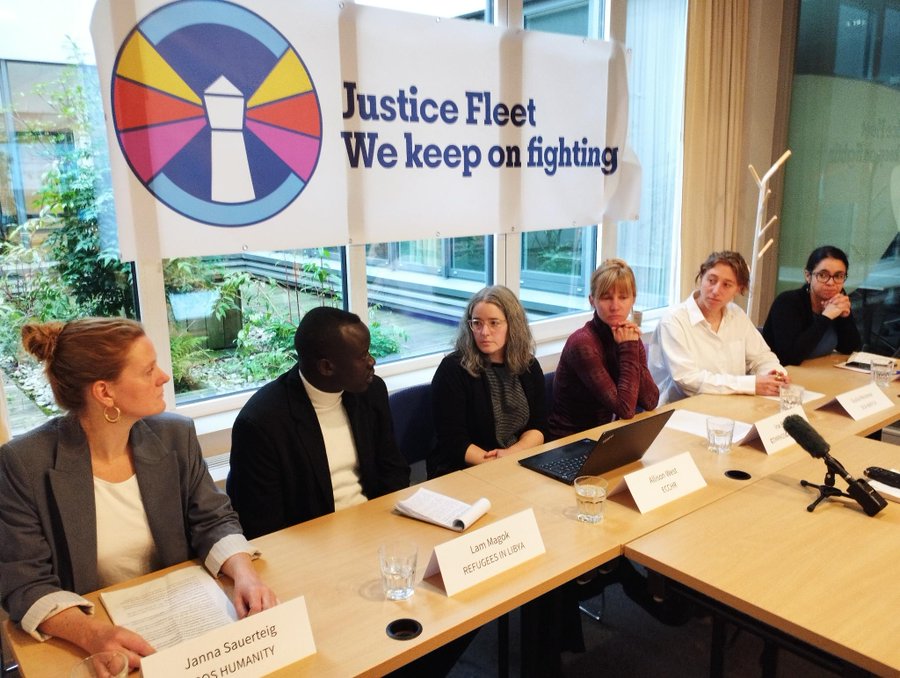
Press conference for the Justice Fleet in Berlin. Source: Alarm Phone
On the same day, the Tripoli prosecutor’s office ordered the arrest of Osama Njeem Almasri on charges of torture and abuse against several inmates at Mitiga prison near Tripoli airport. Almasri – responsible for countless murders and human rights abuses – was finally detained. This can be only a first step towards justice for the many victims and survivors of his crimes.
On 6 November, 62 people remained in urgent distress in the Maltese SAR zone after their rubber dinghy began deflating, with neither Maltese nor Italian authorities launching rescue operations despite being alerted by Alarm Phone the day before. The people called us again, but much further south, close to the Libyan coast. We learned that in the end the people were forced back to Libya where they were thrown into prison and their families asked to pay for their release.
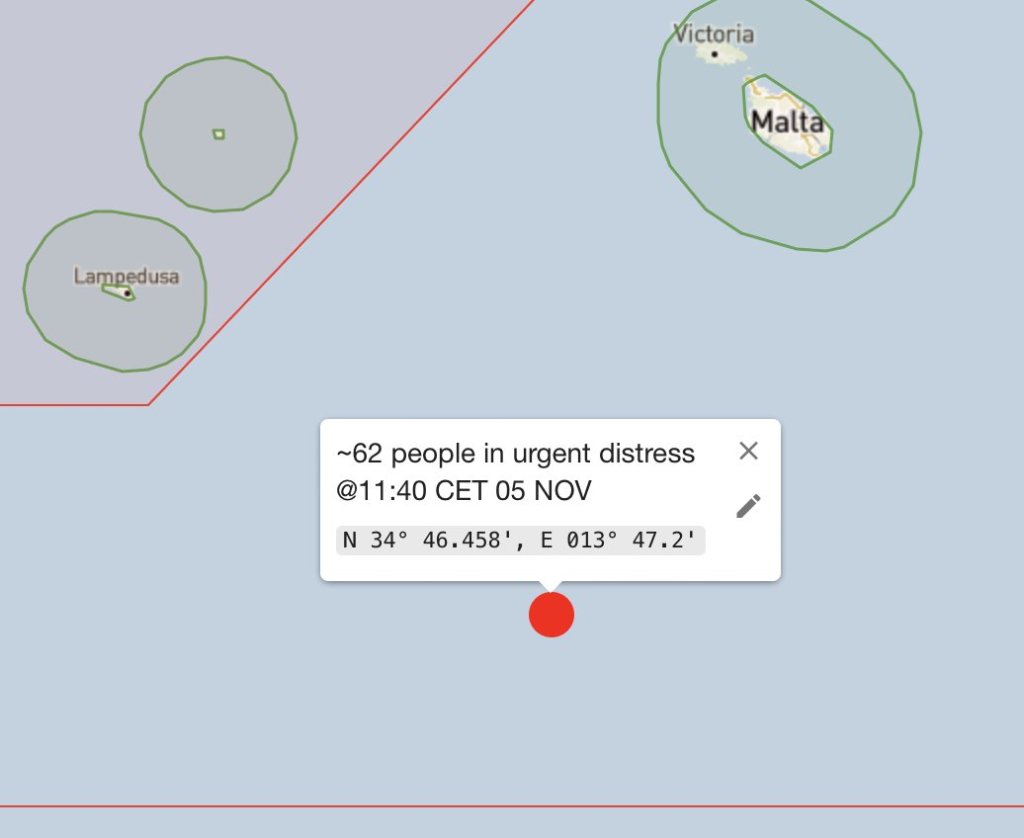
Position of the boat in distress in the Maltese SAR zone. Source: Alarm Phone
On the same day, Amnesty International published a report about the dangerous shift in Tunisia’s migration policy. „Over the past three years, Tunisian authorities have adopted migration and asylum policies that utterly disregard the lives, safety and dignity of refugees and migrants and are used as a tool of racialized exclusion. Officials carry out life-threatening collective expulsions in violation of the principle of non-refoulement, following often reckless sea interceptions or racially targeted arrests, frequently accompanied by torture and other ill-treatment, including dehumanizing sexual violence.“
On 7 November, Sea-Watch and Compass Collective reported about a boat carrying 53 people who had been trapped on the supply vessel MARIDIVE 208 near the Miskar gas platform since 6 November. The rescue ship Trotamar III was nearby and ready to take the people on board, but European and Tunisian authorities ignored their calls and refused to coordinate a rescue. The Tunisian Maritime Rescue Coordination Centre (MRCC) sent a speed boat to bring the people back to Tunisia, but they refused boarding. Eventually, the Trotamar III was able to take the people and bring them to Lampedusa.
On the same day, the Ministry of Defence of the western Libyan government carried out airstrikes on Zuwara fishing port, resulting in civilian casualties, as well as the destruction of many fishing boats and two „coastguard“ vessels of local militias.
On 8 November, we learned about a shipwreck off Sfax. The day before, we had alerted authorities to a sinking boat. According to the Tunisian Coastguard, 59 people were rescued and at least three people went missing. On the same day, Libyan authorities found seven survivors of another shipwreck, which had happened already on 3 November. According to IOM, 42 people died.
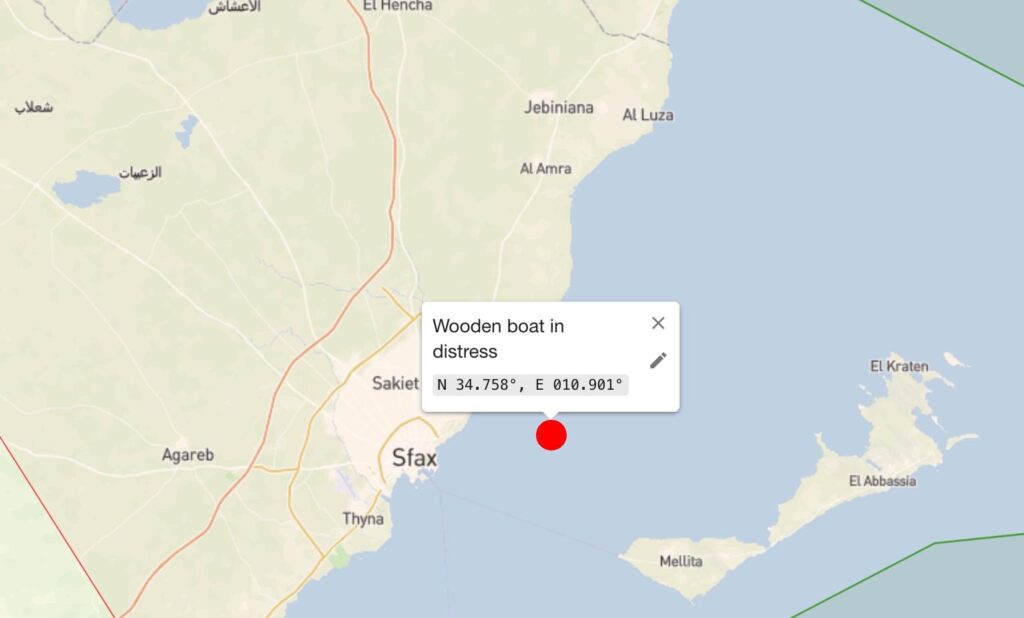
Position of the shipwreck off Sfax. Source: Alarm Phone
On the same day, the Tunisian government announced that nearly 10,000 people were „repatriated“ in 2025 under a so-called „voluntary return“ scheme with IOM with weekly return flights.
On 10 November, the so-called Libyan Coastguard intercepted 61 people on a boat north-west of Tobruk. They were handed over to Libyan authorities who reiterated their commitment to strengthening maritime surveillance and reducing departures from Libyan coasts.
On the same day, a delegation of the German Embassy and UNHCR visited the East Tripoli Immigration Detention Center in Tajoura. During the visit among other topics, the acceleration of repatriation procedures was discussed.
On 11 November, a shipwreck 15 nautical miles south of the Greek island of Gavdos occurred. Alarm Phone had alerted authorities already on 10 November about the boat in distress, but they either refused to share information with us or did not pick up the phone. Only in the afternoon of 11 November we were told that a Frontex ship was active in the area. Three bodies were recovered and 56 people rescued by the Frontex boat, but survivors report that between 10 and 13 people remain missing. The rescued survivors were transferred to the port of Agia Galini, Crete.
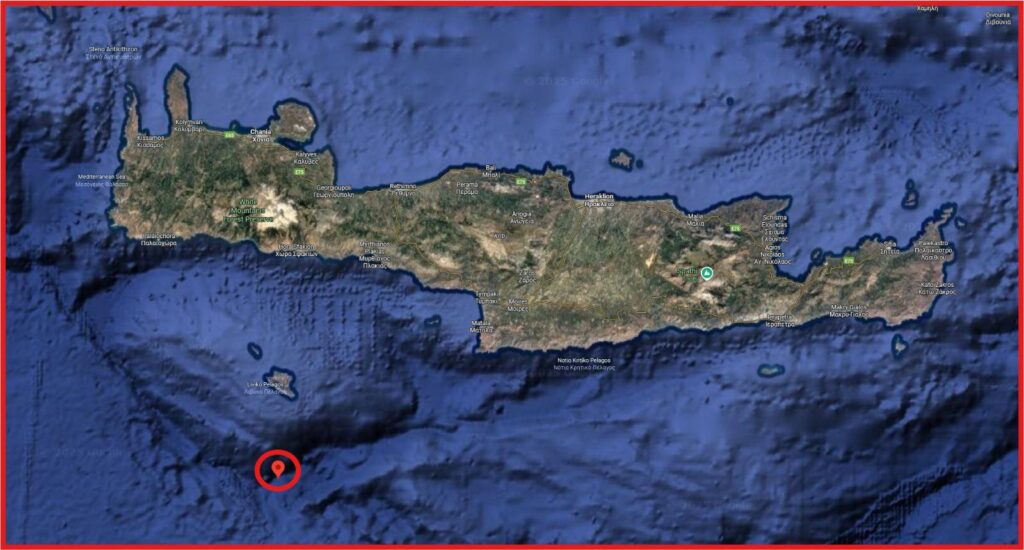
Position of the shipwreck off Gavdos. Source: Alarm Phone
On 12 November, a new training center for the Libyan Border Guard was inaugurated in Tripoli. It is part of a European program and implemented by the Italian Ministry of the Interior together with IOM with the aim „to combat irregular migration and human trafficking“ and improve the capacities of Libyan authorities.
On the same day, MSF announced that they are back in the Central Mediterranean with their new search and rescue vessel Oyvon (which means „hope for the island“ in Icelandic), after almost one year of being forced to terminate operations with their last rescue vessel, the Geo Barents.
On 13 November, SOS Mediterrannée started monitoring flights with a new plane, the Albatross. It spotted two empty boats (probably interceptions) and a boat in distress with about 40 people on board in the Maltese SAR zone. The Aircraft alerted all relevant assets and authorities and later learned that the people were rescued by the civil ship Aurora.
On 14 November, the so-called Libyan Coastguard intercepted 71 people on a boat trying to escape from Libya 250 nautic miles north-west of Benghazi. They were handed over to Libyan authorities and probably detained.
On 15 November, the ship Mediterranea was punished with 60 days of detention and a €10,000 fine.This is the second identical sanction imposed for the two missions carried out by their new ship, this time following the rescue of 92 people. The measure targets rescue operations despite them being carried out in full compliance with the Hamburg Convention on maritime rescue, which clearly requires assigning the nearest safe port after a rescue. As happened with the disembarkation in Trapani in August, where the Civil Court already suspended a similar punitive measure previously imposed, Mediterranea announced that they would immediately appeal against this detention and fine.
On 16 November, the Libyan Red Crescent reported that at least four people were killed when two boats carrying 95 people on the move capsized off the Libyan coastal city of Al Khums.
On 17 November, the crew of the civil ship Oyvon rescued 27 people in distress on a rubber boat after Alarm Phone had alerted about this boat.
On 18 November, Alarm Phone received calls from people on a deflating rubber boat north of Tripoli, Libya. They reported people already in the water. We informed authorities immediately, but it took a long time until we reached the so-called Libyan Coastguard. They later claimed they were not able to search for the 70 people, because they did not have any assets available. Later we received information that only seven people were found alive at the position where the boat was spotted from the air by Frontex. These deaths occured because rescue was delayed for hours.
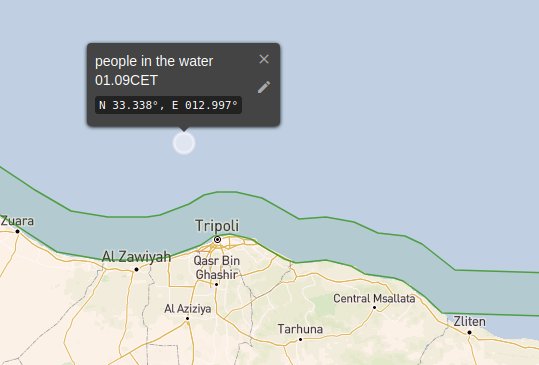
Position of the deflating rubber boat. Source: Alarm Phone
On 19 November, we were relieved that 38 people who had fled from Benghazi on 11 November and alerted Alarm Phone four days later, managed to arrive on Sicily, after authorities had left them alone for several days.
On the same day, General Commander Field Marshal Khalifa Haftar received the German Special Envoy and Ambassador in Benghazi to discuss the latest political developments and strengthen bilateral cooperation.
On 20 November, 43 people on a boat off the coast of Sabratha were intercepted by the so-called Libyan Coastguard. Two boats with a total of 61 people were intercepted off the coast of Tobruk.
On 21 November, Alarm Phone was alerted by 27 people in distress off Crete in the Greek SAR zone. The people reported that there was a hole in the boat – they were panicking. We informed the Greek Coastguard and a merchant vessel nearby. Later we heard that the people were rescued and brought to Crete.
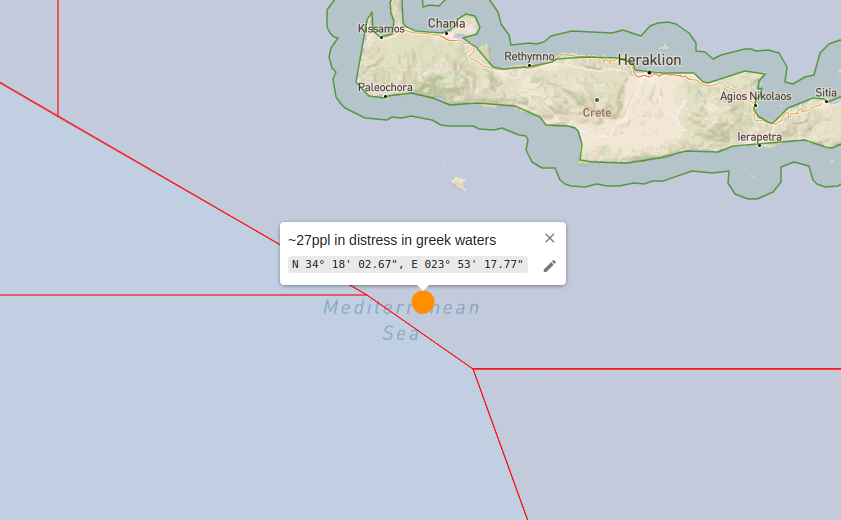
Position of the boat in distress off Crete. Source: Alarm Phone
On 22 November, thousands of Tunisians marched in the capital in a protest against „injustice and repression“, accusing President Kais Saied of cementing one-man rule by using the judiciary and police. Thousands also demanded the closure of a chemical plant on environmental grounds.
On 23 November, Alarm Phone was informed about a boat in distress about 80 nautical miles off Crete and alerted authorities. One day later, the Greek Coastguard and local media reported that a boat with 76 people was rescued and taken to Crete. We believe it was the same case.
On 24 November, after a distress call from Alarm Phone, the civil rescue ship Humanity 1 was able to rescue 70 people from an unseaworthy wooden boat. They had been at sea for over 24 hours in bad weather conditions with a broken engine and no life-saving equipment.
On 28 November, the FTDES could resume their activities. They expressed their gratituted for all received solidarity and announced to always stand „with truth, with dignity and all those who face injustice“.
On 29 November, EU Migration Commissioner Magnus Brunner told the Maltese press in an interview that there was no alternative to cooperation with Libya, and that Malta had a key relationship, which the EU finds very helpful. The number of irregular migrant sea arrivals dropped from 2,281 in 2020 to 238 in 2024. This happened after Malta signed a secret migration coordination deal with Libya in 2020. Data also show that interceptions by the so-called Libyan Coastguard surged by 230%.
On 30 November, Libyan authorities with consular and IOM support deported 175 people of Bangladesh nationality from the detention center in Tajoura, East Tripoli.
December
In December, Alarm Phone was alerted to 45 boats in distress in the Central Med, among them 37 departing from Libya and four from Tunisia with the departure place of four boats unknown. NGO vessels rescued a total of 13 boats that month – not all of them had alerted Alarm Phone. Three boats were rescued by merchant vessels, two of them were then brought to Egypt and the people of one boat transferred to the NGO ship Ocean Viking. The Italian Coastguard rescued at least 16 boats – most of them already close to Lampedusa – and they also coordinated some rescue operations of boats heading towards Sicily or Calabria. The survivors of a shipwrecked boat were rescued to Malta. We know of three boats rescued by the Greek Coastguard on the route from eastern Libya to Crete. In total, we know of 21 interceptions by the so-called Libyan Coastguard, but probably there were many more. Unfortunately, we rarely receive reliable figures regarding Tunisian interceptions. We learned of five shipwrecks in December.
On 1 December, a patrol boat of the so-called Libyan Coastguard closely approached the Louise Michel and fired shots into the water at just 200-300 metres away. Shortly after the incident, the crew found an empty rubber boat – probably the sign of an illegal pullback to Libya. We know that on the same day, several boats were intercepted by the so-called Libyan Coastguard and the people forced back to detention and abuse in Zuwara.
On the same day, Mr Khaled Mohamed Ali El Hishri was surrendered to the custody of the International Criminal Court (ICC). Mr El Hishri, a national of Libya, was arrested on 16 July 2025 by the authorities of the Federal Republic of Germany pursuant to a warrant of arrest. Mr El Hishri is alleged to have been one of the most senior Mitiga Prison officials, where thousands of persons were detained for prolonged periods. He is suspected of having committed directly himself, ordered or overseen crimes against humanity and war crimes, including murder, torture, rape, and sexual violence, allegedly committed in Libya from February 2015 to early 2020. Alarm Phone signed a joint statement to welcome El Hishri’s surrender to the ICC.
On 2 December, the Interior Minister of Tripoli declared with full „political audacity“ that Libyan authorities were ready to cooperate with the Europeans to stop migrants from reaching EU shores, in exchange for Europe supporting Libya in speeding up deportations.
On the same day, the civil rescue ship Humanity 1 was provisionally detained in the port of Ortona, Italy, after the rescue of 85 people. The provisional detention was ordered by the Italian authorities to investigate whether Humanity 1 violated the Piantedosi law for not having communicated with the Libyan Rescue Coordination Centre. As part of an alliance of search and rescue organisations, the Justice Fleet Alliance, SOS Humanity deliberately suspended operational communication with the Libyan Joint Rescue Coordination Centre because the so-called Libyan Coastguard cannot be considered a legitimate search and rescue actor.
On 3 December, the Court of Agrigento suspended the administrative detention of the sailing boat Trotamar III, belonging to CompassCollective, stating that failure to communicate with the Libyan authorities is not provided for by law as grounds for punishment and therefore cannot justify either fines or administrative detention. The Trotamar III and its captain had been accused of not immediately communicating the rescue operations to the coordination center responsible for maritime rescue in the area where the event took place (the Libyan one), but exclusively to the Maltese and Italian authorities. This action resulted in the administrative detention of the vessel and the imposition of an administrative penalty on the captain and the shipowner.
On 4 December, Libyan authorities announced a major ramp-up in deporting „irregular migrants“, mostly Black Africans, back to their home countries. At a press conference in Tripoli, Interior Minister Imad Trabelsi emphasized that Libya had received limited international support in handling migration, despite significant efforts by Libyan authorities. The European Union said it had spent over half a billion euros on migration issues in Libya between 2015 and 2027.
On 5 December, also Tunisia reported about deportations, so-called „voluntary returns“, of people on the move, trying to survive in Tunisia or departing towards Europe, to several West African countries (Cameroon, Guinee and Ivory Coast).
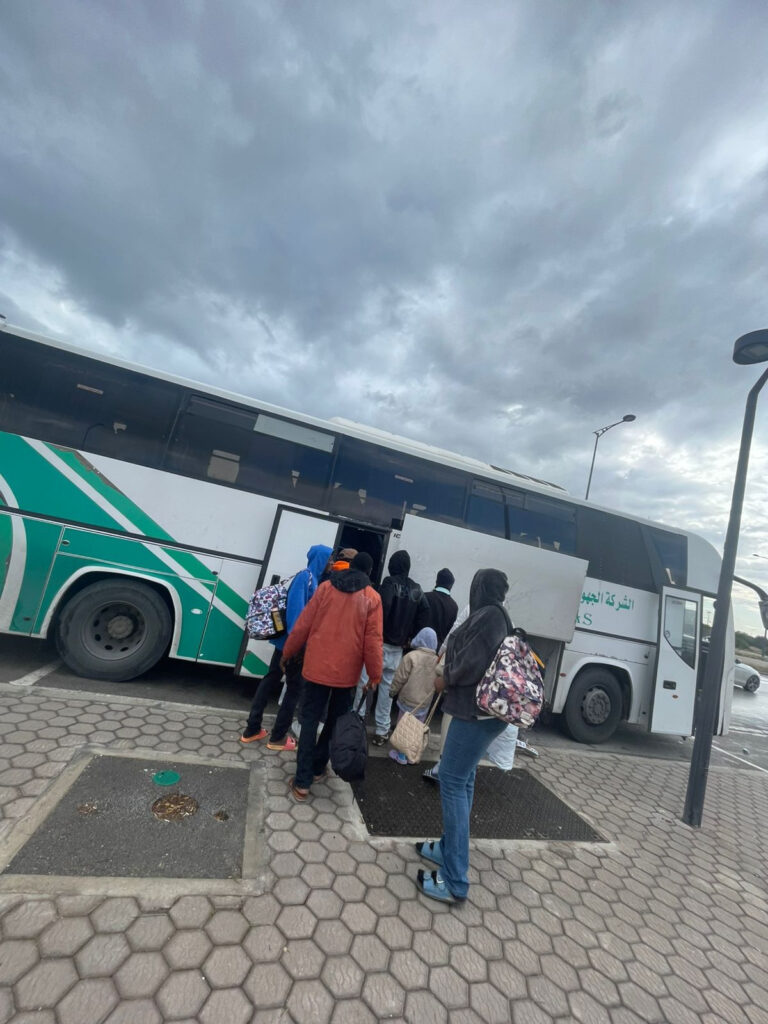
People on the way to the deportation flight. Source: https://bsky.app/profile/brirmijihed.bsky.social/post/3m7ankwu2oc24
On the same day, we mourned the deaths of people who lost their lives on their way from Tunisia to Italy. With no safe ways to reach Europe, they had taken a boat that capsized due to bad weather. At least five migrants, including a minor, are believed to have died after falling into the sea during the crossing from Sfax, Tunisia, before the Italian Coastguard rescued 45 survivors off Lampedusa.
On 6 December, at least 18 people died when their inflatable boat capsized south of Crete. Only two people survived and were brought to a hospital. Local media said that the inflatable boat was found by a passing Turkish merchant vessel 26 miles south of the island of Chryssi.
On 8 December,the EU Council agreed on its position for two pieces of EU legislation that will strengthen the practical application of key „safe country“ concepts in EU asylum rules. The new regulation revising the „safe third country“ concept will expand the circumstances under which an asylum application can be rejected as inadmissable. The Council also completed an important piece of the 2024 Migration and Asylum Pact, by agreeing on the first ever common EU list of safe countries of origin. The following countries will be designated as safe countries of origin at EU level: Bangladesh, Colombia, Egypt, India, Kosovo, Morocco and Tunisia.
On the same day, Libya deported a total of 112 migrants from Tobruk Immigration Detention Center in two separate operations. All people of Egyptian nationality were repatriated via the Emsaed land border crossing. The second group was transferred to Qanfoudah Immigration Detention Center in Benghazi for the completion of legal procedures and repatriation. They were nationals of Bangladesh, Chad, Eritrea and Sudan.
On 11 December, the Agrigento Court issued a decree suspending the administrative detention of the ship Mediterranea, which had been imposed by the prefecture of the Sicilian city on November 12th. It had been an exceptionally severe measure: 60 days of administrative detention of the vessel and a financial penalty of €10,000 for both the captain and the shipowner.
On the same day, 122 people arrived on a plane from Libya to Italy thanks to a humanitarian corridor. They come primarily from Sudan, South Sudan, and Eritrea. Fifty-three will be welcomed by the Community of Sant’Egidio, another 39 will be managed by the Reception and Integration System, and 30 by ARCI.
On 12 December, Sea-Watch 5 rescued 67 people, hosting then a total of 101 people on board. The day before, the Italian authorities had assigned them the port of La Spezia, which is located far away in the north. Sea-Watch continued to request a closer port, in order to let everyone disembark safely as soon as possible.
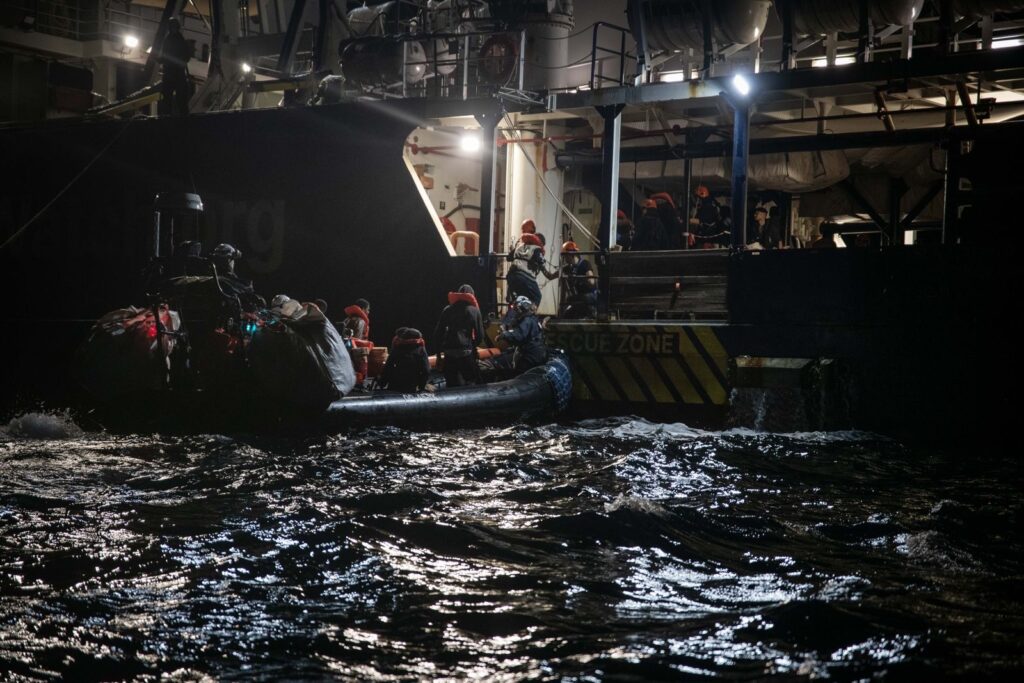
Rescue operation by Sea-Watch. Source: Sea-Watch e.V.
On 13 December, we learned about another shipwreck. A boat that Alarm Phone had been alerted to capsized off Sicily. 61 survivors were brought to Malta, some had to be admitted to a hospital. One person died. We never had contact to the boat, but were told it carried 72 people.
On the same day, three boats were rescued: 49 people, who were adrift in the Ionian Sea, had alerted Alarm Phone, waiting for three days at sea to be rescued. According to the captain of the merchant vessel Vertom Anne Marit, who assisted in the distress case, all people were rescued by the Italian Coastguard and brought safely to Italy. 42 people were rescued by the NGO ship Aurora from an unseaworthy rubber boat. The Louise Michel rescue vessel carried out another rescue of 61 people.
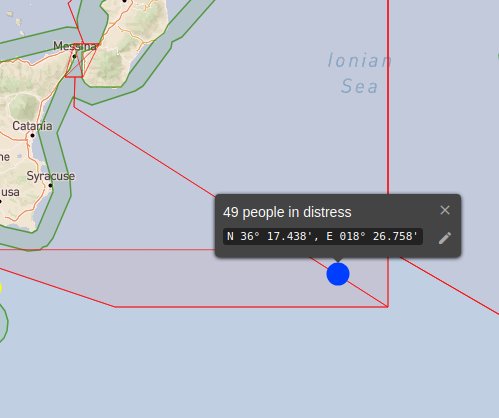
Position of the boat adrift in the Ionian Sea. Source: Alarm Phone
On 14 December, relatives informed us about ca. 500 people on their way from Libya to Crete. We were unable to reach the people and did not get their location, but we alerted the Greek Coastguard. On 15 December, relatives told us they believed that the group had returned to Libya independently as they could not go on due to a mechanical issue with their boat.
On the same day, the NGO ship Life Support rescued 44 people from a boat in distress who had alerted Alarm Phone. They had been at sea for four days.
On 15 December, the Tunis Court rejected all requests for release in the case of the Terre d’Asile Association and postponed the hearing until January 5. They are accused of facilitating the entry, accommodation and settlement of asylum seekers in an irregular situation.
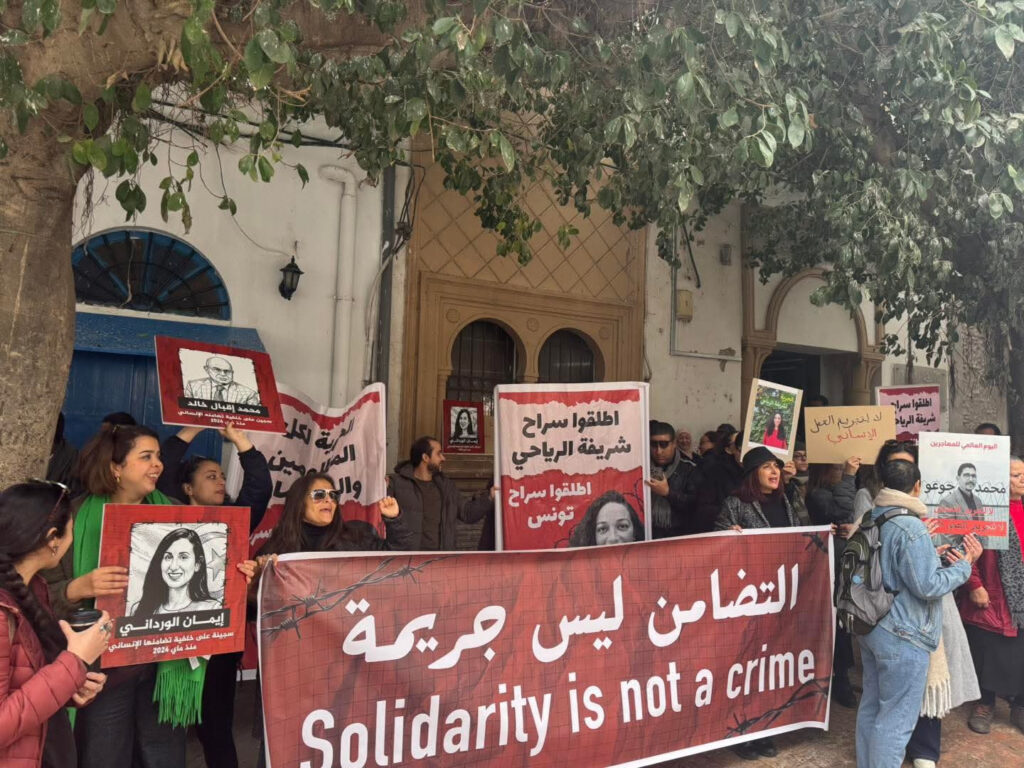
Manifestation in solidarity with Terre d’Asile. Source: https://bsky.app/profile/brirmijihed.bsky.social/post/3ma2i3je5g22j
On 16 December, authorities confirmed that 36 people who had alerted Alarm Phone and were rescued by a merchant vessel, were brought to Egypt, which is not a safe place. We could not reach the people directly and don’t know about their further whereabouts. (map in the tweet)
On 17 December, the EU Parliament greenlighted the „Rwanda model“. Members of the German CDU and AfD as well as other far right parties voted together in favour of allowing asylum seekers to be transferred from the EU to so-called ‘safe third countries’ in the future.
On the same day, the airplane Seabird found a boat in distress that Alarm Phone had reported. The ca. 50 people were adrift in the Maltese SAR zone as their engine was broken. Authorities were alerted, but only after 38 hours at sea, the exhausted people were rescued by the Italian Coastguard to Lampedusa. Malta did neither coordinate nor carry out a rescue at any time.
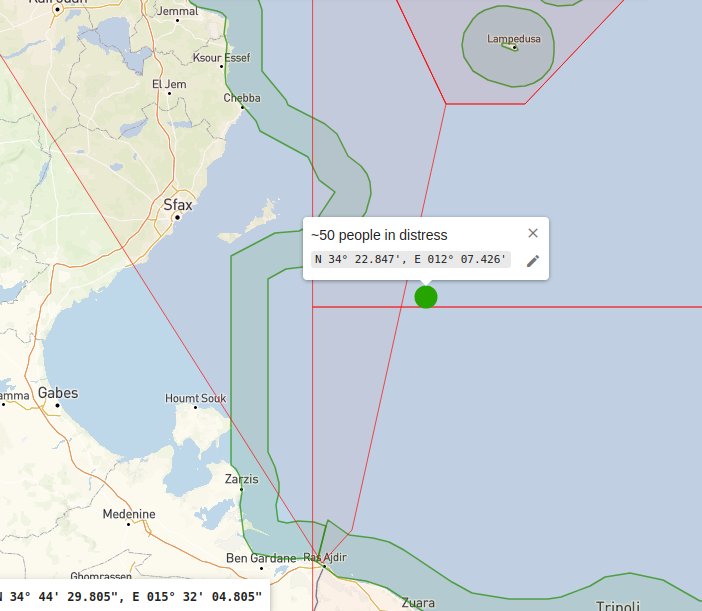
Position of the boat in distress. Source: Alarm Phone
On 18 December, the IOM director general, Amy Pope, visited Libya, holding a series of meetings in the country with the aim of reducing the numbers of migrants attempting to cross on the Central Mediterranean route, and thus „reduce the loss of life“, as stated by the organization.
On the same day, it was reported that 14 people died as their boat capsized off the coast of Crete. The Egyptian Embassy in Greece announced that it had initiated the necessary procedures to repatriate the remains of the 14 Egyptian citizens.
On 19 December, Greek authorities rescued more than 540 migrants from an overcrowded fishing boat near the southernmost Greek island of Gavdos. The Hellenic Coastguard said it received a distress call shortly after 3am on December 19 and launched a coordinated search and rescue operation, with three coastguard ships, three Frontex vessels and several commercial ships taking part.
On 20 December, we learned that around 40 people and another boat with 55 people Alarm Phone was alerted to were intercepted by the Tunisian Coastguard when they tried to escape the brutal conditions in Tunisia. From relatives we heard that they were separated and the men were deported to the desert.
On the same day, Alarm Phone alerted authorities about a boat with ~100 people on board who left Zuwara in the evening of 18 December. During the following days, several relatives contacted us, searching for their loved ones. Unfortunately, authorities did not share any information and despite our continued efforts to find out more, their fate remains unknown.
On 21 December, 38 people on a boat in distress south of Crete alerted Alarm Phone. Later we learned that they were rescued by the merchant vessel LADY ANDRIANE, originally going to Malta and then to Italy. But Malta refused the disembarkation of the rescued people. After waiting for orders from coastguards, the merchant vessel turned around and headed towards Egypt, which is no safe place. Eventually, the 38 people from Sudan were taken to the port of Alexandria and we heard that they were detained there.
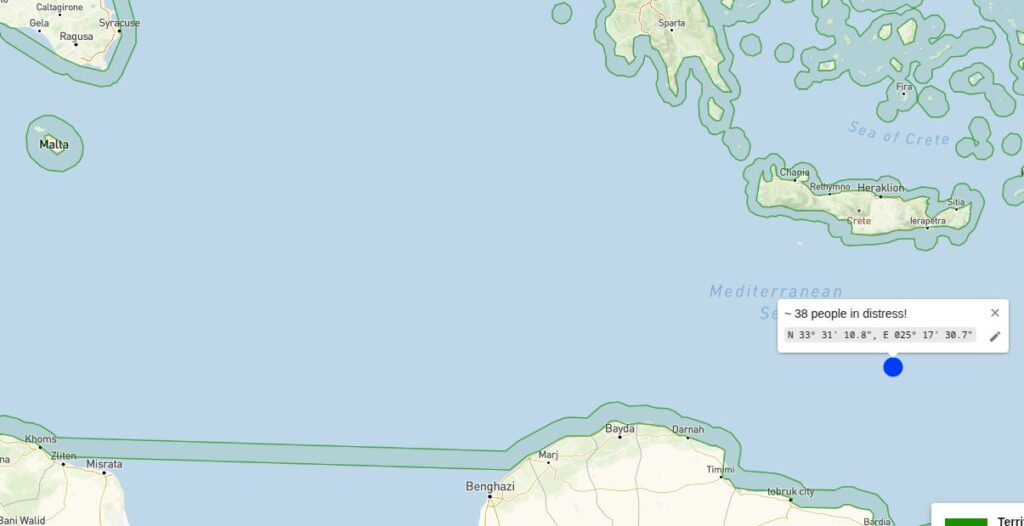
Position of the boat in distress south of Crete. Source: Alarm Phone
On 22 December, the Italian Coastguard reported that they rescued 50 people overnight on 21 December. Lampedusa is now also seen as a pilot site for the European Union’s new migration screening system. An estimated 240 people who had arrived irregularly on the island took part in the testing of the “Screening Toolbox“, a standardized set of procedures designed to harmonize how people arriving without authorization are registered and checked at the EU’s external borders. The screening includes identity verification, health and vulnerability checks, the provision of information about asylum rights, and the collection of biometric data. The new screening measures will become mandatory from June 2026.
On 23 December, Aljazeera published that the Libyan army chief Mohammed Ali Ahmed al-Haddad and four top military officials had been killed in a plane crash near Ankara. Libya declared three days of mourning.
On 24 December, Alarm Phone published first results of our research on the missing people who left Zuwara on 18 December. We fear a shipwreck of a boat carrying about 117 people with only one survivor. We demand answers from authorities, families searching for their loved ones have the right to know the truth.
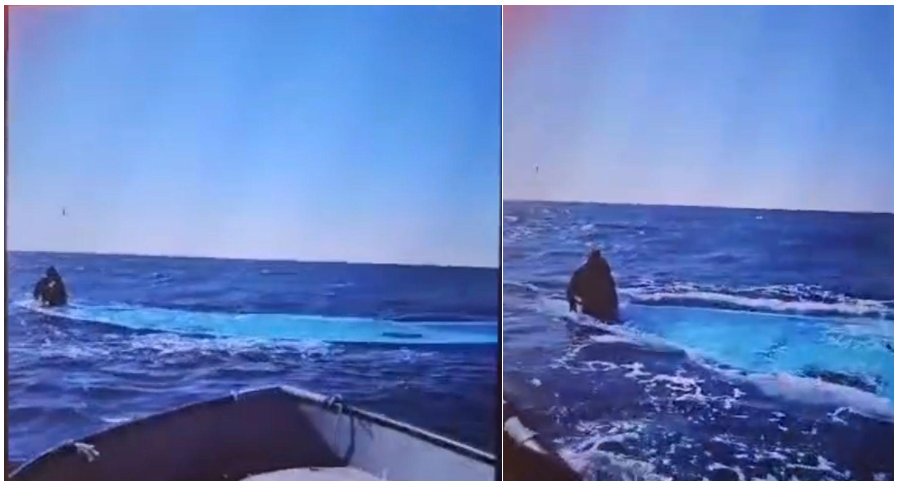
Screenshots of a video received by Alarm Phone how fishermen find the survivor. Source: Alarm Phone
On the same day, it was reported that Tunisian authorities deported again more than 210 people in so-called „voluntary returns“ to several West African countries. This is in line with Europe’s new deportation package: faster returns, fewer safeguards, outsourced violence.
On 25 December, a boat carrying about 40 people left from Zuwara. One day later they called Alarm Phone and said their boat was at risk of capsizing. We alerted authorities, but they did not react. We lost contact to the people and the merchant vessel BEAGLE could not find them. We fear a Libyan interception.
On 26 December, a group of 34 people was rescued within the Maltese SAR zone by the Offshore Tug/Supply Ship MARIDIVE 703 close to the Miskar oil platform. However, instead of being brought to safety, they were at risk of being returned against their will to Tunisia.
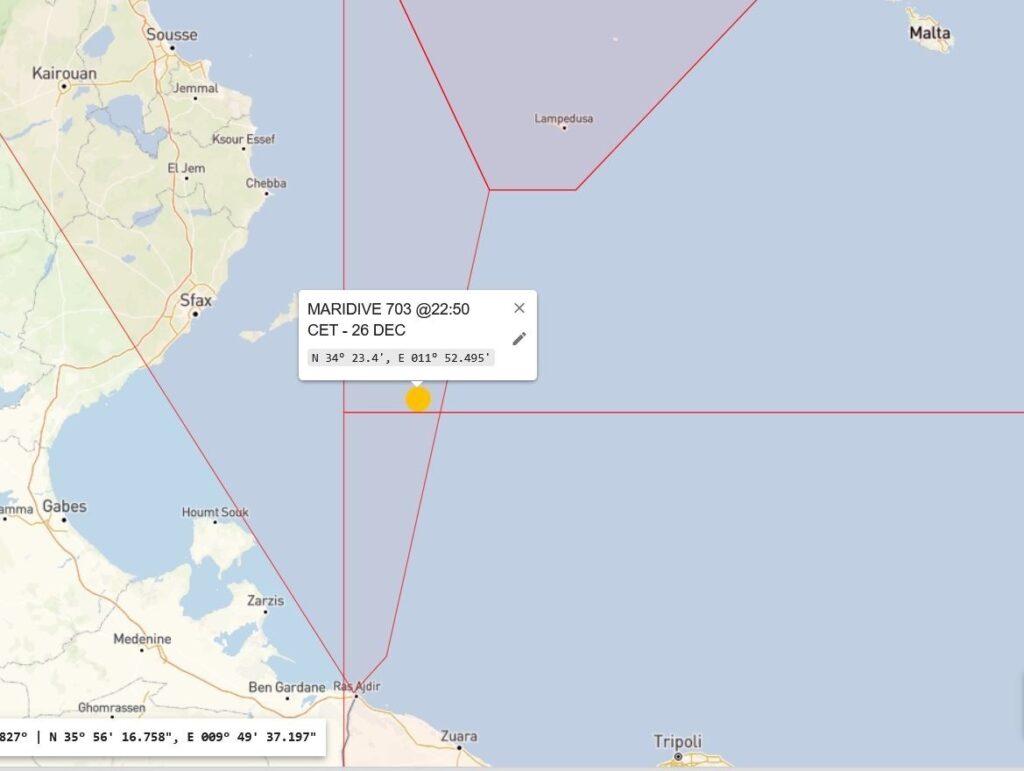
Position of the MARIDIVE 703 on 26 December. Source: Alarm Phone
On 27 December, the 34 people were still at risk of a pushback. Maltese authorities refused to share any information. We called again for disembarkation at a place of safety, which is not Tunisia.
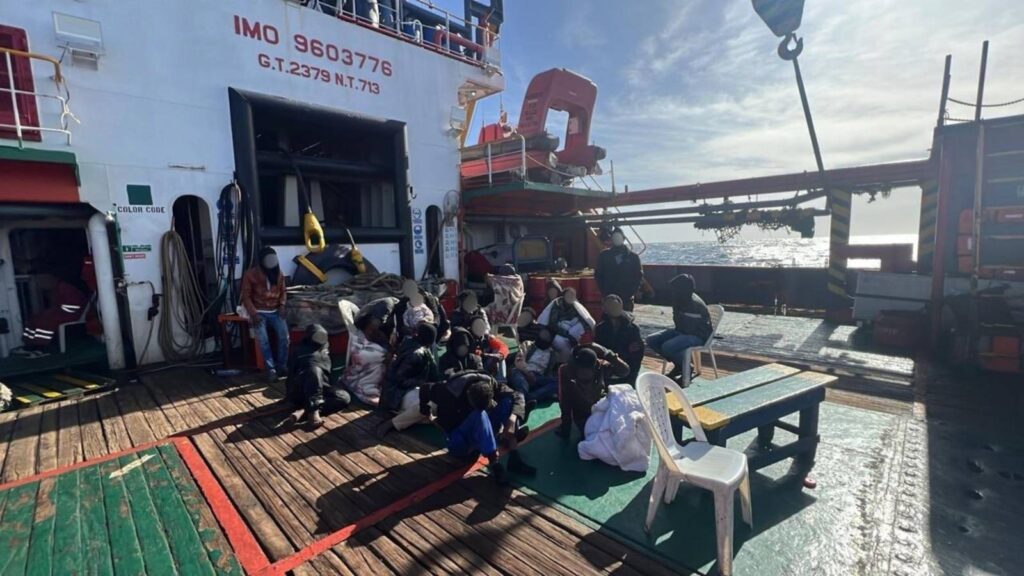
Photo of the people on the MARIDIVE 703. Source: Alarm Phone
On the same day, 400 people were rescued south of Crete in three operations. The rescue operations involved the Danish-flagged cargo ship ALBERT MAERSK and Greek Coastguard patrol vessels.
On 28 December, the Maltese press reported about the case of the people on the MARIDIVE 703.
On 29 December, we reminded authorities of similar cases when the UN human rights comitee recognized that Italy and Malta had the duty to intervene and ensure that survivors could disembark in a proper safe place.
On the same day, another four deportation flights from Tunisia were reported. In total, 275 people, including children, were registered for so-called voluntary returns to five West African countries.
On 30 December, there was a rumor that a second boat was rescued by the MARIDIVE 703, but later we learned that these people had been stranded nearby under the Miskar platform.
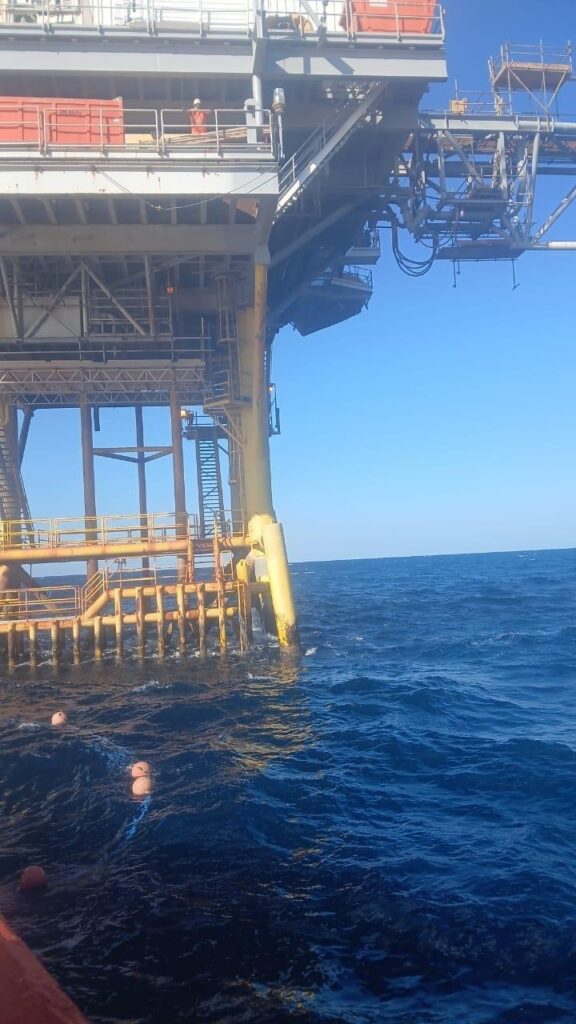
Photo of the Miskar oil platform near the MARIDIVE 703. Source: Alarm Phone
On 31 December, the NGO ship Ocean Viking evacuated 33 people rescued by the MARIDIVE 703 (they were not 34 as said before). The crew learned from survivors they took onboard from the MARIDIVE 703 vessel that they had witnessed another boat with about 75 people stuck under the nearby oil platform. These people were later taken onboard by Tunisian coastguards and brought to Tunisia where their rights aren’t respected. The Tunisian vessel then approached the survivors previously rescued by the MARIDIVE 703 crew and attempted to bring them to Tunisia against their will, but the people resisted. The Ocean Viking brought them to safety in Italy.


